


About us


-
See what students, mentors, alumni and recruiters say about Masters' Union University. Shared highlights and moments that reflect our culture, learning and community. Explore their voices.
OVERVIEW

-
See how Masters’ Union University is represented across leading news and media platforms. Explore articles, features, and press coverage that reflect our journey, initiatives, and growing impact in education, innovation, and industry engagement.
OVERVIEW
-
Explore the awards, rankings and accreditations that recognise the quality, impact and industry relevance of Masters' Union University programmes.
OVERVIEW
-
Explore the reports, brochures, policies, and publications that document Masters' Union University's outcomes, standards, and institutional commitments.
OVERVIEW


PROGRAMMEs
- Highlights
- Curriculum
- Admissions & Fees
- Immersions
- Entrepreneurship
- Careers
- Class Profile
PROGRAMME oVERVIEW
- Highlights
- Curriculum
- Admissions & Fees
- Immersions
- Entrepreneurship
- Career Prospects
- Class Profile
PROGRAMME oVERVIEW
- Highlights
- Curriculum & Faculty
- Immersions
- Admissions & Fees
- Career Prospects
- Class Profile
PROGRAMME oVERVIEW
- Highlights
- Curriculum
PROGRAMME oVERVIEW
- Home
PROGRAMME oVERVIEW
- Highlights
- Curriculum & Faculty
- Admissions & Fees
- Career Prospects
- Class Profile
PROGRAMME oVERVIEW
- Highlights
- Curriculum & Faculty
- Admissions & Fees
- Career Prospects
- Class Profile
PROGRAMME oVERVIEW
- Highlights
- Curriculum
- Admissions & Fees
- Career Prospects
- Class Profile
PROGRAMME oVERVIEW
PROGRAMMEs
- Highlights
- Curriculum & Faculty
- Admissions & Fees
- Career Prospects
- Class Profile
PROGRAMME oVERVIEW
- Highlights
- Curriculum & Faculty
- Admissions & Fees
- Career Prospects
- Class Profile
PROGRAMME oVERVIEW
- Highlights
- Curriculum
- Admissions & Fees
- Career Prospects
- Class Profile
PROGRAMME oVERVIEW
- Highlights
- Curriculum & Faculty
- Admissions & Fees
- Career Prospects
- Class Profile
PROGRAMME oVERVIEW
- Highlights
- Curriculum & Faculty
- Admissions & Fees
- Career Prospects
- Class Profile
PROGRAMME oVERVIEW
- Highlights
- Curriculum
- Admissions & Fees
- Career Prospects
- Class Profile
PROGRAMME oVERVIEW
- Highlights
- Curriculum
- Admissions & Fees
- Career Prospects
- Class Profile
PROGRAMME oVERVIEW
PROGRAMMES
-
PGP in
Technology & Business Management

-
PGP in
Technology & Business Management
(Young Leaders Cohort)
-
Post Graduate Diploma (Human Resources and Organisation Strategy)
-
Post Graduate Diploma (Sports Management and Gaming)
-
PGP in
Applied AI & Agentic Systems
-
PGP in Sustainability &
Business Management
-
Four Nations Global
Business Programme
- Highlights
- Curriculum
- Immersions
- Admissions & Fees
- Career Prospects
- Cohort Profile
PROGRAMME oVERVIEW
- Highlights
- Curriculum
- Immersions
- Admissions & Fees
- Career Prospects
- Faculty & Student Stories
PROGRAMME oVERVIEW
- Highlights
- Curriculum
- Immersions
- Admissions & Fees
- Career Prospects
PROGRAMME oVERVIEW
- Highlights
- Curriculum & Faculty
- Admissions & Fees
- Career Prospects
PROGRAMME oVERVIEW
- Highlights
- Curriculum & Faculty
- Admissions & Fees
- Career Prospects
PROGRAMME OVERVIEW
- Highlights
- Curriculum & Faculty
- Admissions & Fees
PROGRAMME OVERVIEW
- Highlights
PROGRAMME OVERVIEW
- Highlights
- Curriculum
- Immersions
- Admissions & Fees
- Career Prospects
- Cohort Profile
PROGRAMME oVERVIEW
PROGRAMMES
-
Post Graduate Diploma (Rise General Management)
-
Post Graduate Diploma (Capital Markets & Trading)
-
PGP in US Capital Markets &
Trading
-
PGP
in Entrepreneurship & Business Acceleration
-
Post Graduate Diploma (Rise General Management Global)
-
AI First Operator Programme
-
Bloomberg Equity Research Programme
- Highlights
- Curriculum
- Faculty
- Admissions & Fees
- Career Prospects
- Cohort Profile
PROGRAMME oVERVIEW
- Home
PROGRAMME oVERVIEW
- Highlights
- Curriculum
- Admissions & Fees
PROGRAMME oVERVIEW
- Highlights
- Curriculum
- Admissions & Fees
PROGRAMME oVERVIEW
- Highlights
- Curriculum
- Immersions
- Faculty & Coaches
- Admissions & Fees
- Career Prospects
PROGRAMME oVERVIEW
- Highlights
- Curriculum
PROGRAMME oVERVIEW
- Home
PROGRAMME oVERVIEW
- Highlights
- Global Immersions
- Curriculum
- Faculty & Coaches
- Leadership Learning
- Admissions & Fees
PROGRAMME oVERVIEW
- Highlights
- Curriculum
- Admissions & Fees
PROGRAMME oVERVIEW
PROGRAMMES
- Highlights
- Curriculum
- Beyond Classroom
- Admissions & Fees
PROGRAMME oVERVIEW
- Highlights
- Curriculum
- Beyond Classroom
- Admissions & Fees
PROGRAMME oVERVIEW
- Home
PROGRAMME oVERVIEW
- Home
PROGRAMME oVERVIEW
PROGRAMMES
- Home
PROGRAMME oVERVIEW
- Highlights
- Curriculum
- Beyond Classroom
- Admissions & Fees
PROGRAMME oVERVIEW
- Home
PROGRAMME oVERVIEW
- Home
PROGRAMME oVERVIEW
STUDENT LIFE
- Student Premises
- Amenities
- Hostel Council
oVERVIEW


- Case Union
- UnMute
- Clubs & Committees
oVERVIEW


oVERVIEW
- Healthcare
- BFSI
- Technology
- Manufacturing
- Retail
Industry
- Governments
- Universities
- Startups
- SMEs
- Large Enterprises
Industry
oVERVIEW
PROGRAMMEs
- Highlights
- Curriculum & Faculty
- Admissions & Fees
- Career Prospects
- Class Profile
PROGRAMME oVERVIEW
- Highlights
- Curriculum & Faculty
- Admissions & Fees
- Career Prospects
- Class Profile
PROGRAMME oVERVIEW
- Highlights
- Curriculum
- Admissions & Fees
- Career Prospects
- Class Profile
PROGRAMME oVERVIEW
- Highlights
- Curriculum & Faculty
- Admissions & Fees
- Career Prospects
- Class Profile
PROGRAMME oVERVIEW
- Highlights
- Curriculum & Faculty
- Admissions & Fees
- Career Prospects
- Class Profile
PROGRAMME oVERVIEW
- Highlights
- Curriculum
- Admissions & Fees
- Career Prospects
- Class Profile
PROGRAMME oVERVIEW
- Highlights
- Curriculum
- Admissions & Fees
- Career Prospects
- Class Profile
PROGRAMME oVERVIEW
PROGRAMMES
- Highlights
- Curriculum
- Immersions
- Admissions & Fees
- Career Prospects
- Cohort Profile
PROGRAMME oVERVIEW
- Highlights
- Curriculum
- Immersions
- Admissions & Fees
- Career Prospects
- Faculty & Student Stories
PROGRAMME oVERVIEW
- Highlights
- Curriculum
- Immersions
- Admissions & Fees
- Career Prospects
PROGRAMME oVERVIEW
- Highlights
- Curriculum & Faculty
- Admissions & Fees
- Career Prospects
PROGRAMME oVERVIEW
- Highlights
- Curriculum
- Immersions
- Admissions & Fees
- Career Prospects
- Cohort Profile
PROGRAMME oVERVIEW
PROGRAMMES
- Highlights
- Curriculum
- Faculty
- Admissions & Fees
- Career Prospects
- Cohort Profile
PROGRAMME oVERVIEW
- Highlights
- Curriculum
- Admissions & Fees
PROGRAMME oVERVIEW
- Highlights
- Curriculum
- Admissions & Fees
PROGRAMME oVERVIEW
- Highlights
- Curriculum
- Immersions
- Faculty & Coaches
- Admissions & Fees
- Career Prospects
PROGRAMME oVERVIEW
- Highlights
- Global Immersions
- Curriculum
- Faculty & Coaches
- Leadership Learning
- Admissions & Fees
PROGRAMME oVERVIEW
- Highlights
- Curriculum
- Admissions & Fees
PROGRAMME oVERVIEW


About Us

Undergraduate
Postgraduate
PGP in Technology & Business Management
PGP in Technology & Business Management
(Young Leaders Cohort)
Post Graduate Diploma (Human Resources and Organisation Strategy)
Post Graduate Diploma (Sports Management and Gaming)
PGP in Applied AI & Agentic Systems
PGP in Sustainability & Business Management
Four Nations Global Business Programme
Executive
Post Graduate Diploma (Rise General Management)
Post Graduate Diploma (Capital Markets & Trading)
PGP in US Capital Markets & Trading
PGP in Entrepreneurship & Business Acceleration
Post Graduate Diploma (Rise General Management Global)
AI First Operator Programme
Bloomberg Equity Research Programme
Family Business
Immersions
1:1 Executive Coaching
Careers
Innovations
Faculty
MU Ventures
Enterprise L&D
Student Life
Jobs
Become a Master
Merch Store
events
For Companies
Blog
Coach LMS
UI/UX Design Career
UI/UX Is Evolving | Here's the PG Programme Built for What's Next
April 17, 2026
Every designer has had that moment. You are mid-wireframe, and a thought creeps in — what if the next version of this AI tool just does this better than me?
It is not an irrational fear. Figma already has AI that generates layouts. Midjourney is producing visuals that would have taken a senior designer two days. Companies are openly discussing how many design roles they actually need anymore. So the question is worth asking directly: is a career in product design still worth betting on, or are you training for a job that is quietly being automated away?
Here is the honest answer: AI is not replacing designers. It is replacing designers who only know how to design.
The ones who understand product thinking, who can walk into an engineering conversation and hold their ground, who know how AI tools work well enough to direct them rather than compete with them - those designers are not on the radar of automation. They are the ones being promoted while others are being let go.
That distinction is what separates a design course from a design career. And it is exactly the gap that Masters' Union's PG in UI/UX and AI Product Design is built to close.
What Challenges Do Designers Face After Graduation?
If you’ve just finished your degree and are chasing your first UI/UX role, you know the drill; courses done, portfolio ready, applications sent. But somewhere mid-interview, you’re asked things no course covered: designing for AI-first products, challenging unclear briefs, and you freeze.
Not because you lack skill, but because no one trained you for that part.
And if you’re already working but feeling stuck, going back to education feels right, isn’t it? But the problem here is that most PG design programmes have repackaged undergrad - longer and more expensive. You might get better case studies, but not the skills that actually unlock growth, i.e., AI-led product thinking, strategic conversations with PMs or working closely with engineering to craft a design that’s actionable for them.
So you spend a year (and a lot of money)… and hit the same ceiling again.
What Skills Does A UI/UX Designer Require in 2026?
93% of designers in India are already working with AI tools. The question is no longer whether to learn this. It is whether your programme treats it as a core skill or an optional extra.
At companies building products at scale in India, designers are expected to manage three things at once.
The first is research ability. The capacity to go out into the field, speak with users, make sense of messy qualitative data, and turn that into design decisions that can be defended in a cross-functional review with a product manager who wants a business case and an engineer who wants a clear spec.
The second is design craft. Typography, visual hierarchy, interaction states, responsive behaviour, and design systems built with real governance. The kind of precision that produces interfaces that feel thought through rather than put together quickly.
The third is AI fluency. Not using AI to generate options faster, but understanding how AI changes the interaction model itself. How to design for systems that behave differently across sessions. How to prototype with AI assistance and still arrive at outcomes grounded in genuine user insight.
How Masters' Union’s PG in UI/UX & AI Product Design Programme Is Built Differently?
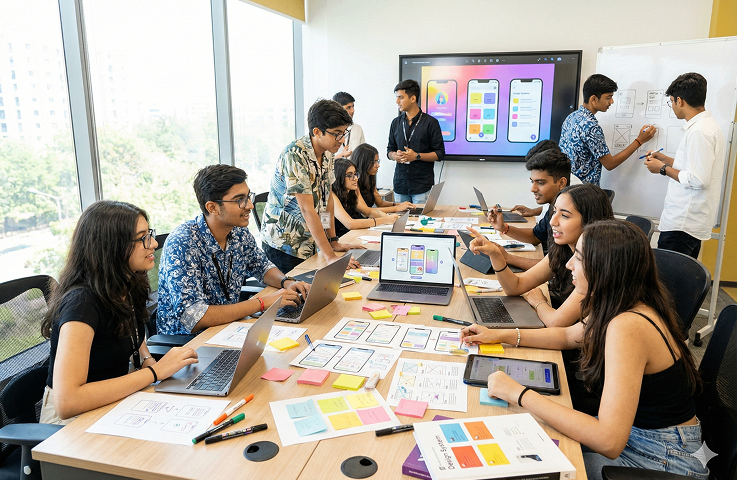
To fill the gap between academia and industry for UI/UX designers, we have launched a PG Programme in UI/UX & Product Design where students learn in 16 months to build around one idea. We believe the best way to train a designer is to put them inside real product problems from day one!
|
Duration |
Format |
|
16 Months |
Hybrid: Online/Offline |
|
Eligibility |
Starts |
|
Bachelor's Degree (any discipline) |
August 2026 |
How is the Curriculum Designed?
The curriculum spans five terms, each covering a distinct level of design capability. It moves from digital foundations and AI-native design, through user research and prototyping, into interaction systems, advanced psychology, and a final capstone project.
But the more important decision in how this programme is designed is that every term runs alongside a live industry challenge. Not a practice brief. A real problem from a real company, with a defined business outcome and an actual client to present to.
Here’s the Outclass Challenges We Have:
This is what separates this postgraduate product design course from others available in India. The portfolio graduates build is not a set of self-directed redesigns. It is documented proof of real business problems worked through and solved. That kind of work is very hard to dismiss in an interview.
Term 1
Dark Pattern Audit Challenge
Students audit a live consumer application for deceptive UI. Forced continuity flows, hidden costs, patterns built to trap users rather than serve them. The brief asks for a redesign using trust-centred principles, followed by a simulated A/B test showing the effect on Long-Term User Value. Target: 25% LTV improvement. This is not a classroom exercise. It is the kind of brief that lands on a design team when a key growth metric starts to fall.
Term 2
Ghost Cart Revenue Recovery Challenge
An audit and redesign of a real e-commerce checkout flow, focused on recovering revenue lost to abandoned carts. Students prototype a streamlined, multi-step checkout experience built around trust and conversion. They then pitch the solution to real client stakeholders with a developer handoff package and ROI forecast. Target: 15% or more increase in annual gross revenue. The deliverable is not a Figma file. It is a business case a product leader could take to their CEO.
Term 3
AI-Copilot SaaS Dashboard
Students map an organisation's data-to-decision workflow, find where the process slows down, and prototype a natural language search interface with AI-driven insight components. The system is designed to cut time-to-insight to under 60 seconds. The efficiency gain is measured during testing, not estimated. Target: 20% or more improvement in employee productivity.
Term 4
Founder's Right Hand Challenge
Students work directly with unicorn startup founders and Chief Design Officers on live problems. Early-stage product discovery, MVP UX, investor-facing design work. The deliverables are used in actual pitches and product launches. Mentors have included founders from Paytm, Ola, and MakeMyTrip. Every decision carries real business consequences.
Learn from the Mentors Who Could Be Your Next Recruiter
More than 100 industry practitioners are part of the programme. What matters is not the number. It is who they are and what they bring into the room.
The AVP of Design at Swiggy teaches on AI-accelerated design workflows and what it looks like to operate inside a high-scale consumer technology company. A former UX Leader at Amazon covers research methods at the enterprise level - the kind that global product organisations actually use, rather than what gets adapted for a classroom setting. A former Product Design Lead at Google teaches systems-level design thinking. The Head of Design at BharatPe brings the perspective of designing for India's fintech space: trust, simplicity, and the specific demands of financial product design in this market.
Masterclasses are delivered by Chief Design Officers and global professors. In Term 4, students work directly alongside the founders themselves.
The point is straightforward. The people teaching this programme are the same people making hiring decisions at the companies graduates want to work at.
What’s the Eligibility Criteria for This Programme?
This PG UI UX design programme is open to graduates from any discipline. A prior design qualification is not needed, and neither is an existing portfolio of UI work.
What the programme does ask for is the ability to think clearly about problems, communicate that thinking and take feedback seriously. Engineers make strong design candidates because they understand the technical constraints within which their decisions will eventually be built. Commerce graduates bring business thinking that most pure design programmes never develop. Those from psychology and social sciences bring the behavioural depth that separates good UX research from surface-level user testing.
The admissions process is set up to bring out this kind of thinking. The portfolio submission does not require polished screens. It requires evidence of how a candidate approaches problems. The interview is a design conversation, not a test of existing visual skills.
Designed for Flexible Modes to Pursue
The Offline Weekday Programme is full-time and on-campus in Gurugram. Live design studios, collaborative sprints, peer critique, direct mentor access and placement support. This is the right path for recent graduates who want a fully immersive experience.
The Online Weekend Programme is for working professionals who want to transition into product design without stepping away from their current role. Live weekend classes, self-paced weekday work, and career transition support built around moving into a UI UX design role from within an existing job.
FAQs
What is the best UI UX design course in India after graduation?
Masters' Union's PG Programme in UI/UX and AI Product Design stands out among postgraduate UI UX design courses in India because of its AI-first curriculum, live industry challenges with real business outcomes, faculty drawn from Swiggy, Google, Amazon, and BharatPe, and placement data that is independently audited. It is open to graduates from any academic background.
What global opportunities are available for UI UX designers?
Product design is one of the few fields where a strong portfolio travels well. Designers with AI fluency and international exposure are increasingly competitive for roles in the US, UK, UAE, and Singapore, and the programme's immersion trips to Europe, Singapore, Japan, and Dubai are built to close that gap early.
Is a design portfolio required to apply?
A portfolio submission is part of the process, but it does not need to be a traditional UI/UX portfolio. Case studies, research work, visual projects, or exploratory pieces all count. What the panel looks for is clarity of thinking and how a candidate frames and approaches problems, not the polish of the finished work.
How do you become a UI UX designer after graduation?
The most direct path is a structured postgraduate programme that covers research methods, design craft, and AI tools, alongside real project work built around genuine business problems. A PG UI UX design course in India, like this one, gives you the portfolio and the skills at the same time, rather than asking you to build one after the other.
What is a UX designer's salary in India?
Entry-level UX designer salaries at product companies in India typically fall approx. ranging from 5 to 8 LPA. With two to three years of experience and a portfolio showing real business impact, a 12 to 20 LPA is achievable at funded startups. Senior and lead roles at large product organisations pay considerably more.
What UI designer jobs are available in India?
UI designer jobs in India span roles including Product Designer, UI Designer, Interaction Designer, Visual Designer, UX Strategist, Growth Designer, Motion Designer, and Service Designer. Demand is highest at product-first companies in fintech, consumer tech, edtech, and SaaS. The programme recruiter network includes Google, Razorpay, Zepto, CRED, Myntra, Flipkart, and Swiggy.
What skills are required for a UI UX designer?
Research, design craft, and AI fluency are the three non-negotiables. Beyond tools and visuals, the ability to defend design decisions in a room with engineers and product managers is what separates good designers from great ones.
Can someone from a non-design background do a product design course after graduation?
Yes. This product design course, after graduation, is open to anyone with a Bachelor's degree, regardless of discipline. The admissions process looks at how candidates think and communicate, not at prior visual design experience. Engineering, commerce, and humanities graduates all bring perspectives that make them effective designers.
How is this different from other product design courses in India?
Three things set this apart from other product design courses India has to offer. AI is woven into every term of the curriculum rather than added as a separate module. Every term includes a live industry challenge with a real business target, not a practice brief. And the placement data is independently audited, which is not standard practice across most postgraduate UI UX programs in India.