


About us


-
See what students, mentors, alumni and recruiters say about Masters' Union University. Shared highlights and moments that reflect our culture, learning and community. Explore their voices.
OVERVIEW


-
See how Masters’ Union University is represented across leading news and media platforms. Explore articles, features, and press coverage that reflect our journey, initiatives, and growing impact in education, innovation, and industry engagement.
OVERVIEW
-
Explore the awards, rankings and accreditations that recognise the quality, impact and industry relevance of Masters' Union University programmes.
OVERVIEW

-
Explore the reports, brochures, policies, and publications that document Masters' Union University's outcomes, standards, and institutional commitments.
OVERVIEW


PROGRAMMEs
- Highlights
- Curriculum
- Admissions & Fees
- Immersions
- Entrepreneurship
- Careers
- Class Profile
PROGRAMME oVERVIEW
- Highlights
- Curriculum
- Admissions & Fees
- Immersions
- Entrepreneurship
- Career Prospects
- Class Profile
PROGRAMME oVERVIEW
- Highlights
- Curriculum & Faculty
- Immersions
- Admissions & Fees
- Career Prospects
- Class Profile
PROGRAMME oVERVIEW
- Highlights
- Curriculum
PROGRAMME oVERVIEW
- Home
PROGRAMME oVERVIEW
- Highlights
- Curriculum & Faculty
- Admissions & Fees
- Career Prospects
- Class Profile
PROGRAMME oVERVIEW
- Highlights
- Curriculum & Faculty
- Admissions & Fees
- Career Prospects
- Class Profile
PROGRAMME oVERVIEW
- Highlights
- Curriculum
- Admissions & Fees
- Career Prospects
- Class Profile
PROGRAMME oVERVIEW
PROGRAMMEs
- Highlights
- Curriculum & Faculty
- Admissions & Fees
- Career Prospects
- Class Profile
PROGRAMME oVERVIEW
- Highlights
- Curriculum & Faculty
- Admissions & Fees
- Career Prospects
- Class Profile
PROGRAMME oVERVIEW
- Highlights
- Curriculum
- Admissions & Fees
- Career Prospects
- Class Profile
PROGRAMME oVERVIEW
- Highlights
- Curriculum & Faculty
- Admissions & Fees
- Career Prospects
- Class Profile
PROGRAMME oVERVIEW
- Highlights
- Curriculum & Faculty
- Admissions & Fees
- Career Prospects
- Class Profile
PROGRAMME oVERVIEW
- Highlights
- Curriculum
- Admissions & Fees
- Career Prospects
- Class Profile
PROGRAMME oVERVIEW
- Highlights
- Curriculum
- Admissions & Fees
- Career Prospects
- Class Profile
PROGRAMME oVERVIEW
PROGRAMMES
-
PGP in
Technology & Business Management

-
PGP in
Technology & Business Management
(Young Leaders Cohort)
-
Post Graduate Diploma (Human Resources and Organisation Strategy)
-
Post Graduate Diploma (Sports Management and Gaming)
-
PGP in
Applied AI & Agentic Systems
-
PGP in Sustainability &
Business Management
-
Four Nations Global
Business Programme
- Highlights
- Curriculum
- Immersions
- Admissions & Fees
- Career Prospects
- Cohort Profile
PROGRAMME oVERVIEW
- Highlights
- Curriculum
- Immersions
- Admissions & Fees
- Career Prospects
- Faculty & Student Stories
PROGRAMME oVERVIEW
- Highlights
- Curriculum
- Immersions
- Admissions & Fees
- Career Prospects
PROGRAMME oVERVIEW
- Highlights
- Curriculum & Faculty
- Admissions & Fees
- Career Prospects
PROGRAMME oVERVIEW
- Highlights
- Curriculum & Faculty
- Admissions & Fees
- Career Prospects
PROGRAMME OVERVIEW
- Highlights
- Curriculum & Faculty
- Admissions & Fees
PROGRAMME OVERVIEW
- Highlights
PROGRAMME OVERVIEW
- Highlights
- Curriculum
- Immersions
- Admissions & Fees
- Career Prospects
- Cohort Profile
PROGRAMME oVERVIEW
PROGRAMMES
-
Post Graduate Diploma (Rise General Management)
-
Post Graduate Diploma (Capital Markets & Trading)
-
PGP in US Capital Markets &
Trading
-
PGP
in Entrepreneurship & Business Acceleration
-
Post Graduate Diploma (Rise General Management Global)
-
AI First Operator Programme
-
Bloomberg Equity Research Programme
- Highlights
- Curriculum
- Faculty
- Admissions & Fees
- Career Prospects
- Cohort Profile
PROGRAMME oVERVIEW
- Home
PROGRAMME oVERVIEW
- Highlights
- Curriculum
- Admissions & Fees
PROGRAMME oVERVIEW
- Highlights
- Curriculum
- Admissions & Fees
PROGRAMME oVERVIEW
- Highlights
- Curriculum
- Immersions
- Faculty & Coaches
- Admissions & Fees
- Career Prospects
PROGRAMME oVERVIEW
- Highlights
- Curriculum
PROGRAMME oVERVIEW
- Home
PROGRAMME oVERVIEW
- Highlights
- Global Immersions
- Curriculum
- Faculty & Coaches
- Leadership Learning
- Admissions & Fees
PROGRAMME oVERVIEW
- Highlights
- Curriculum
- Admissions & Fees
PROGRAMME oVERVIEW
PROGRAMMES
- Highlights
- Curriculum
- Beyond Classroom
- Admissions & Fees
PROGRAMME oVERVIEW
- Highlights
- Curriculum
- Beyond Classroom
- Admissions & Fees
PROGRAMME oVERVIEW
- Home
PROGRAMME oVERVIEW
- Home
PROGRAMME oVERVIEW
PROGRAMMES
- Home
PROGRAMME oVERVIEW
- Highlights
- Curriculum
- Beyond Classroom
- Admissions & Fees
PROGRAMME oVERVIEW
- Home
PROGRAMME oVERVIEW
- Home
PROGRAMME oVERVIEW
STUDENT LIFE
- Student Premises
- Amenities
- Hostel Council
oVERVIEW

- Case Union
- UnMute
- Clubs & Committees
oVERVIEW

oVERVIEW
- Healthcare
- BFSI
- Technology
- Manufacturing
- Retail
Industry
- Governments
- Universities
- Startups
- SMEs
- Large Enterprises
Industry
oVERVIEW
PROGRAMMEs
- Highlights
- Curriculum & Faculty
- Admissions & Fees
- Career Prospects
- Class Profile
PROGRAMME oVERVIEW
- Highlights
- Curriculum & Faculty
- Admissions & Fees
- Career Prospects
- Class Profile
PROGRAMME oVERVIEW
- Highlights
- Curriculum
- Admissions & Fees
- Career Prospects
- Class Profile
PROGRAMME oVERVIEW
- Highlights
- Curriculum & Faculty
- Admissions & Fees
- Career Prospects
- Class Profile
PROGRAMME oVERVIEW
- Highlights
- Curriculum & Faculty
- Admissions & Fees
- Career Prospects
- Class Profile
PROGRAMME oVERVIEW
- Highlights
- Curriculum
- Admissions & Fees
- Career Prospects
- Class Profile
PROGRAMME oVERVIEW
- Highlights
- Curriculum
- Admissions & Fees
- Career Prospects
- Class Profile
PROGRAMME oVERVIEW
PROGRAMMES
- Highlights
- Curriculum
- Immersions
- Admissions & Fees
- Career Prospects
- Cohort Profile
PROGRAMME oVERVIEW
- Highlights
- Curriculum
- Immersions
- Admissions & Fees
- Career Prospects
- Faculty & Student Stories
PROGRAMME oVERVIEW
- Highlights
- Curriculum
- Immersions
- Admissions & Fees
- Career Prospects
PROGRAMME oVERVIEW
- Highlights
- Curriculum & Faculty
- Admissions & Fees
- Career Prospects
PROGRAMME oVERVIEW
- Highlights
- Curriculum
- Immersions
- Admissions & Fees
- Career Prospects
- Cohort Profile
PROGRAMME oVERVIEW
PROGRAMMES
- Highlights
- Curriculum
- Faculty
- Admissions & Fees
- Career Prospects
- Cohort Profile
PROGRAMME oVERVIEW
- Highlights
- Curriculum
- Admissions & Fees
PROGRAMME oVERVIEW
- Highlights
- Curriculum
- Admissions & Fees
PROGRAMME oVERVIEW
- Highlights
- Curriculum
- Immersions
- Faculty & Coaches
- Admissions & Fees
- Career Prospects
PROGRAMME oVERVIEW
- Highlights
- Global Immersions
- Curriculum
- Faculty & Coaches
- Leadership Learning
- Admissions & Fees
PROGRAMME oVERVIEW
- Highlights
- Curriculum
- Admissions & Fees
PROGRAMME oVERVIEW


About Us

Undergraduate
Postgraduate
PGP in Technology & Business Management
PGP in Technology & Business Management
(Young Leaders Cohort)
Post Graduate Diploma (Human Resources and Organisation Strategy)
Post Graduate Diploma (Sports Management and Gaming)
PGP in Applied AI & Agentic Systems
PGP in Sustainability & Business Management
Four Nations Global Business Programme
Executive
Post Graduate Diploma (Rise General Management)
Post Graduate Diploma (Capital Markets & Trading)
PGP in US Capital Markets & Trading
PGP in Entrepreneurship & Business Acceleration
Post Graduate Diploma (Rise General Management Global)
AI First Operator Programme
Bloomberg Equity Research Programme
Family Business
Immersions
1:1 Executive Coaching
Careers
Innovations
Faculty
MU Ventures
Enterprise L&D
Student Life
Jobs
Become a Master
Merch Store
events
For Companies
Blog
Coach LMS
Sustainability
The Climate Economy Is Worth $115B and Here's How to Build a Career in It
April 3, 2026
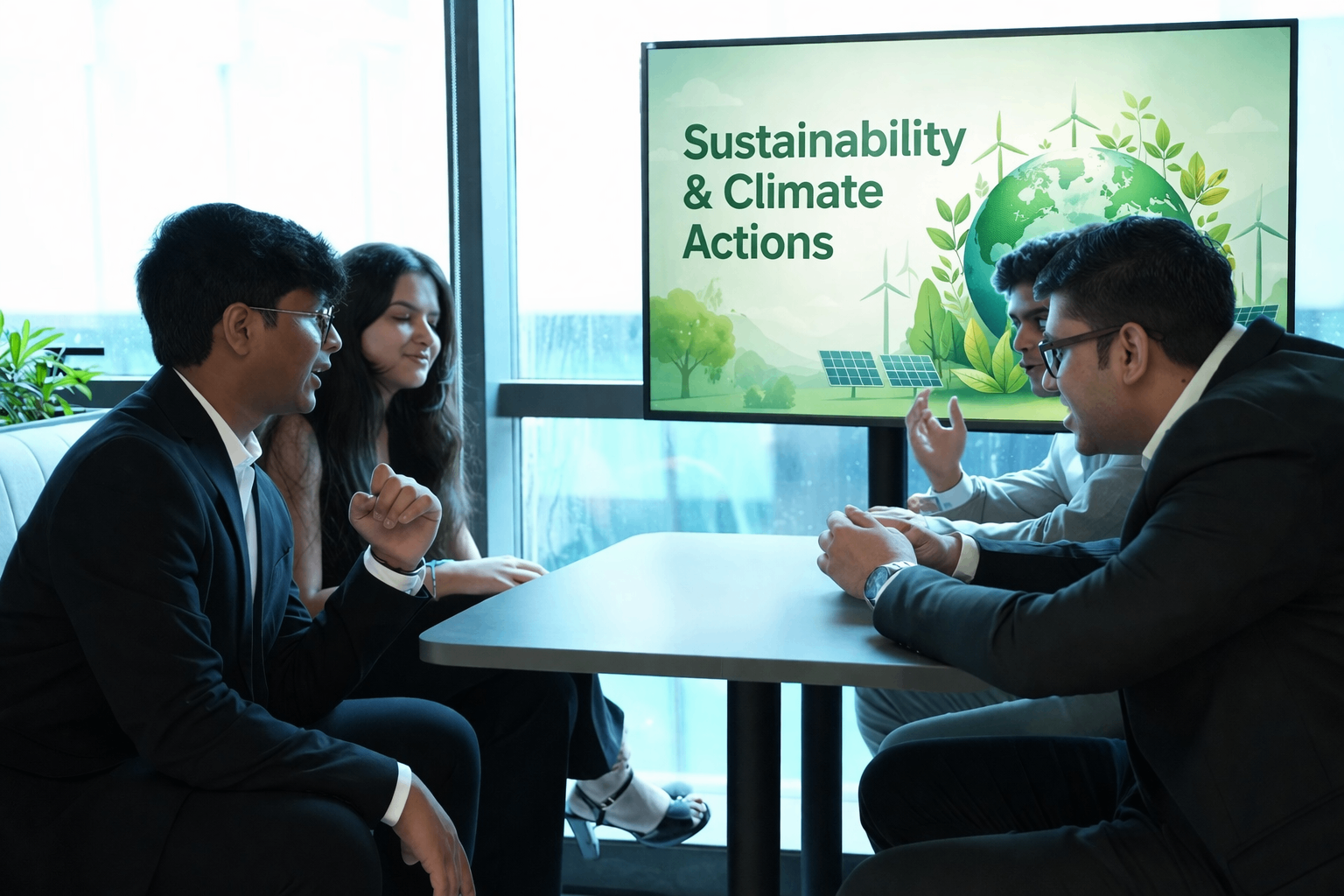
Every company you've heard of - Tata, Infosys, Mahindra, Unilever, is now hiring people to answer one question: how do we grow without destroying the planet?
That question used to belong to scientists and environmentalists. In 2026, it belongs to business people. Supply chain managers, financial analysts, marketing leads, operations heads, every function now has a sustainability dimension baked in.
It is a structural shift. SEBI mandates ESG disclosures. Global investors screen for climate risk. Consumers and regulators are moving faster than most companies are ready for.
The good part about this is that India is building the talent pipeline for this from scratch - which means the people entering this field today aren't late. They're early.
Why Business and Sustainability Skills Are in Demand?
The climate tech market was worth $38.5 billion in 2024. By 2030, it's projected to hit $115.4 billion, growing at nearly 21% a year. For context, that's faster than AI infrastructure, faster than fintech, and faster than most sectors students are currently being advised to enter.
Three forces are driving this and none of them are slowing down.
Government policy and regulation
SEBI now mandates Business Responsibility and Sustainability Reports (BRSR) for India's top 1,000 listed companies. Every one of those companies needs people who can translate policy into practice, but business professionals who understand operations, finance, and reporting. Compliance isn't optional anymore. Neither is the talent required to deliver it.
Corporate net-zero commitments
Over 5,000 companies globally have committed to net-zero targets. Tata, Mahindra, Infosys, Wipro, all of them have internal sustainability teams, and most are still hiring. These commitments create demand for supply chain analysts, sustainability strategists, and ESG reporting specialists inside mainstream companies, not only in startups or NGOs.
Investor focus on ESG
Global ESG assets under management crossed $30 trillion in 2024. Investors now screen for climate risk before writing a cheque. This has created an entirely new layer of demand in finance: green bonds, climate risk analysts, impact investment associates, roles that simply didn't exist a decade ago.
The result is a job market that spans consulting, corporate strategy, climate finance, renewable energy, and climate-tech ventures. Roles like ESG analyst, carbon markets specialist, circular economy lead, and sustainability strategist are no longer niche. They're showing up in hiring pipelines at banks, FMCG companies, logistics firms, and PE funds.
The fact is that sustainability now has a budget, a compliance deadline, and a hiring manager attached to it.
The Climate Economy Is Expanding Rapidly
-
Climate tech is growing at ~20.9% CAGR to USD 115.4 billion by 2030
-
Organisations are increasingly investing in sustainable solutions
-
Skills at the intersection of business and sustainability are in high demand
Why Traditional Sustainability Programmes Aren’t Enough
Most sustainability courses teach you what the problem is. Few teach you what to do about it on a Monday morning inside a real company.
That's the gap. Environmental science, climate theory, policy frameworks; these matter, and a good programme will cover them. But companies aren't hiring people to explain the problem but to solve it, within budgets, timelines, and competing business priorities.
The skills that actually get you hired look different from what most programmes deliver.
What traditional programmes teach
The science behind climate change. International policy frameworks like the Paris Agreement. Environmental regulations and compliance. Conservation and ecosystem thinking.
These are valuable foundations but they're designed to produce researchers, policy advocates, and scientists. Not business professionals.
What companies actually need
A sustainability manager at Mahindra isn't writing research papers. They're building a decarbonisation roadmap across 14 business units, presenting it to the CFO, and defending the capex required to deliver it. A sustainability analyst at a PE fund isn't studying ecosystems. They're stress-testing whether a portfolio company's climate risk exposure will affect its valuation at exit.
The work requires a different set of muscles: financial modelling, stakeholder communication, supply chain analysis, strategic planning, and the ability to translate environmental data into business decisions.
The business-first gap
Graduates from traditional programmes often arrive knowing the science fluently but struggling to connect it to operations, investment logic, or corporate strategy. That disconnect is precisely why companies continue to struggle, not for want of awareness, but for want of people who can act.
The programmes worth your time in 2026 are the ones that treat sustainability as a business discipline first, and an environmental science second.
From theory to practice: making sustainability work for business:
-
Sustainability theory alone does not prepare students for business problems.
-
Practical skills in strategy, finance, and operations are essential.
-
Organisations need leaders who can connect sustainability with growth.
Introducing the PGP in Sustainability & Business Management
The PG Programme in Sustainability & Business Management at Masters’ Union is a 12-month immersive programme that equips students to tackle real-world sustainability challenges using business frameworks. The curriculum is designed with input from climate-tech founders, ESG consultants, policymakers, and sustainability leaders, ensuring students learn the tools and frameworks that companies actually use today.
From designing sustainable business models to building circular ventures and evaluating climate finance opportunities, students develop skills that position them for high-impact careers in the climate economy.
Industry-led curriculum for climate economy careers:
-
One-year immersive programme combining sustainability and business skills.
-
Curriculum developed with industry leaders and real-world applications.
-
Prepares students for careers that influence corporate sustainability strategies.
Hands-On Learning Through Real Projects
The programme emphasises learning by doing. Students engage in live industry challenges such as:
-
Sustainable Investment Challenge: Building a credible 2030 sustainability roadmap for a company.
-
Policy Playbook Challenge: Designing sustainability regulations and incentives for an industry.
-
Waste-to-Wealth Innovation Lab: Creating circular businesses from real waste streams.
-
Green Supply Chain Re-Architecture Challenge: Redesigning logistics to reduce emissions by 30%.
These projects give students practical experience, not just academic knowledge, and mirror the sustainability problems companies face in 2026.
Learning by solving real-world challenges:
-
Students solve real-world sustainability challenges.
-
Projects cover circular economy, ESG strategy, policy, and supply chain decarbonisation.
-
Hands-on experience prepares students for immediate industry impact.
Learning from Industry Leaders
Over 70% of sessions are delivered by practitioners, including climate-tech founders, ESG leaders, corporate sustainability teams, and policymakers. Students also participate in 100+ masterclasses, workshops, and mentorship sessions, learning how sustainability strategies are applied in practice rather than just theory.
Industry mentorship and expert-led sessions:
-
Direct learning from climate-tech founders, ESG experts, and policymakers.
-
Access to industry networks and mentorship opportunities.
-
Students gain insights into how organisations implement sustainability today.
Global Exposure to Sustainability Practices
The programme includes a Global Immersion Programme, giving students an opportunity for international exposure in leading climate and business hubs:
-
Geneva: Sustainability policy and climate diplomacy at the United Nations.
-
Amsterdam: Climate finance insights at Rabobank headquarters.
-
Singapore: Smart-city decarbonisation and sustainable infrastructure.
-
Japan & Europe: Renewable energy, circular economy, and sustainable manufacturing practices.
-
Dubai: Clean energy, smart logistics, and sustainable infrastructure.
This exposure helps students understand how policy, finance, and innovation interact globally, equipping them with a truly international perspective.
Comprehensive Curriculum for Practical Skills
Across eight terms, the programme covers:
-
Foundations of ESG and sustainability principles
-
Governance, policy, and ESG strategy
-
Carbon markets, climate finance, and offset strategies
-
Renewable energy business models and project finance
-
Circular economy and waste-to-wealth ventures
-
Sustainable logistics and low-carbon supply chains
-
Sector labs for industry-specific sustainability solutions
-
Career preparation, consulting frameworks, and venture creation
This step-by-step journey ensures students graduate with both the knowledge and practical experience to make immediate contributions to organisations.
Career Opportunities in the Climate Economy
Graduates are prepared for a variety of high-impact roles:
-
Entry-Level (0–2 years): ESG Analyst, Sustainability Analyst, Climate Finance Associate
-
Mid-Level (2–5 years): ESG Consultant, Sustainability Strategy Manager, Circular Economy Consultant
-
Senior/Leadership (5+ years): Head of Sustainability, Director – ESG & Climate Strategy, Chief Sustainability Officer (CSO)
-
Entrepreneurial Roles: Climate-tech Startup Founder, Circular Economy Venture Builder, Climate Investment Advisor
With sustainability becoming central to strategy, graduates have future-proof careers in consulting, corporate teams, renewable energy, climate finance, and startups.
Career Pathways in Climate, ESG, and Sustainability:
-
Roles cover consulting, corporate sustainability, finance, and startups.
-
Graduates are prepared for strategic and leadership positions.
-
The programme opens pathways in the fast-growing climate economy.
Lead the Climate Economy with Business and Sustainability Skills
Graduates who combine business acumen with sustainability expertise are uniquely positioned to lead in 2026. Organisations need professionals who can:
-
Build sustainable revenue models
-
Design decarbonisation strategies
-
Integrate ESG into decision-making
-
Evaluate climate investments
By bridging the gap between business strategy and sustainability, the course prepares students for impactful careers that shape the future of industries.
Admissions Criteria and Selection Process
Admissions to the PGP in Sustainability & Business Management are based on a holistic evaluation of each candidate’s profile. Masters’ Union looks for academic performance, leadership potential, and professional curiosity in sustainability.
Admissions Considerations:
-
Academic & Co-Curricular Profile: Assessment of academic achievements, extracurricular involvement, and demonstrated interest in sustainability or business.
-
Communication & Leadership Potential: Ability to articulate ideas clearly, demonstrate leadership, and contribute to collaborative problem-solving.
-
Professional Curiosity for Sustainability: Genuine interest in sustainability, climate economy, policy, or business innovation.
The PGP in Sustainability & Business Management at Masters’ Union is more than a programme; it is a pathway to careers that matter. With industry-led learning, hands-on projects, global exposure, and career-focused curriculum, students graduate ready to solve real sustainability challenges, drive innovation, and lead organisations in 2026 and beyond.
FAQs
1. What makes this programme different?
It blends business strategy with sustainability, teaching students to build sustainable models, decarbonisation strategies, and ESG-aligned decisions.
2. Who should apply?
Candidates aiming for ESG consulting, climate finance, renewable energy, or sustainability strategy roles.
3. What hands-on projects are included?
Projects include sustainability roadmaps, circular business models, policy playbooks, and green supply chain redesigns.
4. What global exposure is offered?
Opportunity for immersions in Geneva, Amsterdam, Singapore, Japan, Europe, and Dubai, covering climate policy, finance, and corporate sustainability.
5. What are the admissions criteria and process?
Holistic evaluation of academics, leadership, and sustainability curiosity. Process: application → video essay → interview → final decision.