


About us


-
See what students, mentors, alumni and recruiters say about Masters' Union University. Shared highlights and moments that reflect our culture, learning and community. Explore their voices.
OVERVIEW


-
See how Masters’ Union University is represented across leading news and media platforms. Explore articles, features, and press coverage that reflect our journey, initiatives, and growing impact in education, innovation, and industry engagement.
OVERVIEW

-
Explore the awards, rankings and accreditations that recognise the quality, impact and industry relevance of Masters' Union University programmes.
OVERVIEW

-
Explore the reports, brochures, policies, and publications that document Masters' Union University's outcomes, standards, and institutional commitments.
OVERVIEW


PROGRAMMEs
- Highlights
- Curriculum
- Admissions & Fees
- Immersions
- Entrepreneurship
- Careers
- Class Profile
PROGRAMME oVERVIEW
- Highlights
- Curriculum
- Admissions & Fees
- Immersions
- Entrepreneurship
- Career Prospects
- Class Profile
PROGRAMME oVERVIEW
- Highlights
- Curriculum & Faculty
- Immersions
- Admissions & Fees
- Career Prospects
- Class Profile
PROGRAMME oVERVIEW
- Highlights
- Curriculum
PROGRAMME oVERVIEW
- Home
PROGRAMME oVERVIEW
- Highlights
- Curriculum & Faculty
- Admissions & Fees
- Career Prospects
- Class Profile
PROGRAMME oVERVIEW
- Highlights
- Curriculum & Faculty
- Admissions & Fees
- Career Prospects
- Class Profile
PROGRAMME oVERVIEW
- Highlights
- Curriculum
- Admissions & Fees
- Career Prospects
- Class Profile
PROGRAMME oVERVIEW
PROGRAMMEs
- Highlights
- Curriculum & Faculty
- Admissions & Fees
- Career Prospects
- Class Profile
PROGRAMME oVERVIEW
- Highlights
- Curriculum & Faculty
- Admissions & Fees
- Career Prospects
- Class Profile
PROGRAMME oVERVIEW
- Highlights
- Curriculum
- Admissions & Fees
- Career Prospects
- Class Profile
PROGRAMME oVERVIEW
- Highlights
- Curriculum & Faculty
- Admissions & Fees
- Career Prospects
- Class Profile
PROGRAMME oVERVIEW
- Highlights
- Curriculum & Faculty
- Admissions & Fees
- Career Prospects
- Class Profile
PROGRAMME oVERVIEW
- Highlights
- Curriculum
- Admissions & Fees
- Career Prospects
- Class Profile
PROGRAMME oVERVIEW
- Highlights
- Curriculum
- Admissions & Fees
- Career Prospects
- Class Profile
PROGRAMME oVERVIEW
PROGRAMMES
-
PGP in
Technology & Business Management

-
PGP in
Technology & Business Management
(Young Leaders Cohort)
-
Post Graduate Diploma (Human Resources and Organisation Strategy)
-
Post Graduate Diploma (Sports Management and Gaming)
-
PGP in
Applied AI & Agentic Systems
-
PGP in Sustainability &
Business Management
-
Four Nations Global
Business Programme
- Highlights
- Curriculum
- Immersions
- Admissions & Fees
- Career Prospects
- Cohort Profile
PROGRAMME oVERVIEW
- Highlights
- Curriculum
- Immersions
- Admissions & Fees
- Career Prospects
- Faculty & Student Stories
PROGRAMME oVERVIEW
- Highlights
- Curriculum
- Immersions
- Admissions & Fees
- Career Prospects
PROGRAMME oVERVIEW
- Highlights
- Curriculum & Faculty
- Admissions & Fees
- Career Prospects
PROGRAMME oVERVIEW
- Highlights
- Curriculum & Faculty
- Admissions & Fees
- Career Prospects
PROGRAMME OVERVIEW
- Highlights
- Curriculum & Faculty
- Admissions & Fees
PROGRAMME OVERVIEW
- Highlights
PROGRAMME OVERVIEW
- Highlights
- Curriculum
- Immersions
- Admissions & Fees
- Career Prospects
- Cohort Profile
PROGRAMME oVERVIEW
PROGRAMMES
-
Post Graduate Diploma (Rise General Management)
-
Post Graduate Diploma (Capital Markets & Trading)
-
PGP in US Capital Markets &
Trading
-
PGP
in Entrepreneurship & Business Acceleration
-
Post Graduate Diploma (Rise General Management Global)
-
AI First Operator Programme
-
Bloomberg Equity Research Programme
- Highlights
- Curriculum
- Faculty
- Admissions & Fees
- Career Prospects
- Cohort Profile
PROGRAMME oVERVIEW
- Home
PROGRAMME oVERVIEW
- Highlights
- Curriculum
- Admissions & Fees
PROGRAMME oVERVIEW
- Highlights
- Curriculum
- Admissions & Fees
PROGRAMME oVERVIEW
- Highlights
- Curriculum
- Immersions
- Faculty & Coaches
- Admissions & Fees
- Career Prospects
PROGRAMME oVERVIEW
- Highlights
- Curriculum
PROGRAMME oVERVIEW
- Home
PROGRAMME oVERVIEW
- Highlights
- Global Immersions
- Curriculum
- Faculty & Coaches
- Leadership Learning
- Admissions & Fees
PROGRAMME oVERVIEW
- Highlights
- Curriculum
- Admissions & Fees
PROGRAMME oVERVIEW
PROGRAMMES
- Highlights
- Curriculum
- Beyond Classroom
- Admissions & Fees
PROGRAMME oVERVIEW
- Highlights
- Curriculum
- Beyond Classroom
- Admissions & Fees
PROGRAMME oVERVIEW
- Home
PROGRAMME oVERVIEW
- Home
PROGRAMME oVERVIEW
PROGRAMMES
- Home
PROGRAMME oVERVIEW
- Highlights
- Curriculum
- Beyond Classroom
- Admissions & Fees
PROGRAMME oVERVIEW
- Home
PROGRAMME oVERVIEW
- Home
PROGRAMME oVERVIEW
STUDENT LIFE
- Student Premises
- Amenities
- Hostel Council
oVERVIEW


- Case Union
- UnMute
- Clubs & Committees
oVERVIEW


oVERVIEW

- Healthcare
- BFSI
- Technology
- Manufacturing
- Retail
Industry
- Governments
- Universities
- Startups
- SMEs
- Large Enterprises
Industry
oVERVIEW
PROGRAMMEs
- Highlights
- Curriculum & Faculty
- Admissions & Fees
- Career Prospects
- Class Profile
PROGRAMME oVERVIEW
- Highlights
- Curriculum & Faculty
- Admissions & Fees
- Career Prospects
- Class Profile
PROGRAMME oVERVIEW
- Highlights
- Curriculum
- Admissions & Fees
- Career Prospects
- Class Profile
PROGRAMME oVERVIEW
- Highlights
- Curriculum & Faculty
- Admissions & Fees
- Career Prospects
- Class Profile
PROGRAMME oVERVIEW
- Highlights
- Curriculum & Faculty
- Admissions & Fees
- Career Prospects
- Class Profile
PROGRAMME oVERVIEW
- Highlights
- Curriculum
- Admissions & Fees
- Career Prospects
- Class Profile
PROGRAMME oVERVIEW
- Highlights
- Curriculum
- Admissions & Fees
- Career Prospects
- Class Profile
PROGRAMME oVERVIEW
PROGRAMMES
- Highlights
- Curriculum
- Immersions
- Admissions & Fees
- Career Prospects
- Cohort Profile
PROGRAMME oVERVIEW
- Highlights
- Curriculum
- Immersions
- Admissions & Fees
- Career Prospects
- Faculty & Student Stories
PROGRAMME oVERVIEW
- Highlights
- Curriculum
- Immersions
- Admissions & Fees
- Career Prospects
PROGRAMME oVERVIEW
- Highlights
- Curriculum & Faculty
- Admissions & Fees
- Career Prospects
PROGRAMME oVERVIEW
- Highlights
- Curriculum
- Immersions
- Admissions & Fees
- Career Prospects
- Cohort Profile
PROGRAMME oVERVIEW
PROGRAMMES
- Highlights
- Curriculum
- Faculty
- Admissions & Fees
- Career Prospects
- Cohort Profile
PROGRAMME oVERVIEW
- Highlights
- Curriculum
- Admissions & Fees
PROGRAMME oVERVIEW
- Highlights
- Curriculum
- Admissions & Fees
PROGRAMME oVERVIEW
- Highlights
- Curriculum
- Immersions
- Faculty & Coaches
- Admissions & Fees
- Career Prospects
PROGRAMME oVERVIEW
- Highlights
- Global Immersions
- Curriculum
- Faculty & Coaches
- Leadership Learning
- Admissions & Fees
PROGRAMME oVERVIEW
- Highlights
- Curriculum
- Admissions & Fees
PROGRAMME oVERVIEW


About Us

Undergraduate
Postgraduate
PGP in Technology & Business Management
PGP in Technology & Business Management
(Young Leaders Cohort)
Post Graduate Diploma (Human Resources and Organisation Strategy)
Post Graduate Diploma (Sports Management and Gaming)
PGP in Applied AI & Agentic Systems
PGP in Sustainability & Business Management
Four Nations Global Business Programme
Executive
Post Graduate Diploma (Rise General Management)
Post Graduate Diploma (Capital Markets & Trading)
PGP in US Capital Markets & Trading
PGP in Entrepreneurship & Business Acceleration
Post Graduate Diploma (Rise General Management Global)
AI First Operator Programme
Bloomberg Equity Research Programme
Family Business
Immersions
1:1 Executive Coaching
Careers
Innovations
Faculty
MU Ventures
Enterprise L&D
Student Life
Jobs
Become a Master
Merch Store
events
For Companies
Blog
Coach LMS
AI Entrepreneurship
How AI Entrepreneurship is Reshaping The Future of Work? Ft. Nas Daily Founder
May 29, 2026
What happens when building a company starts becoming easier than applying for a job?
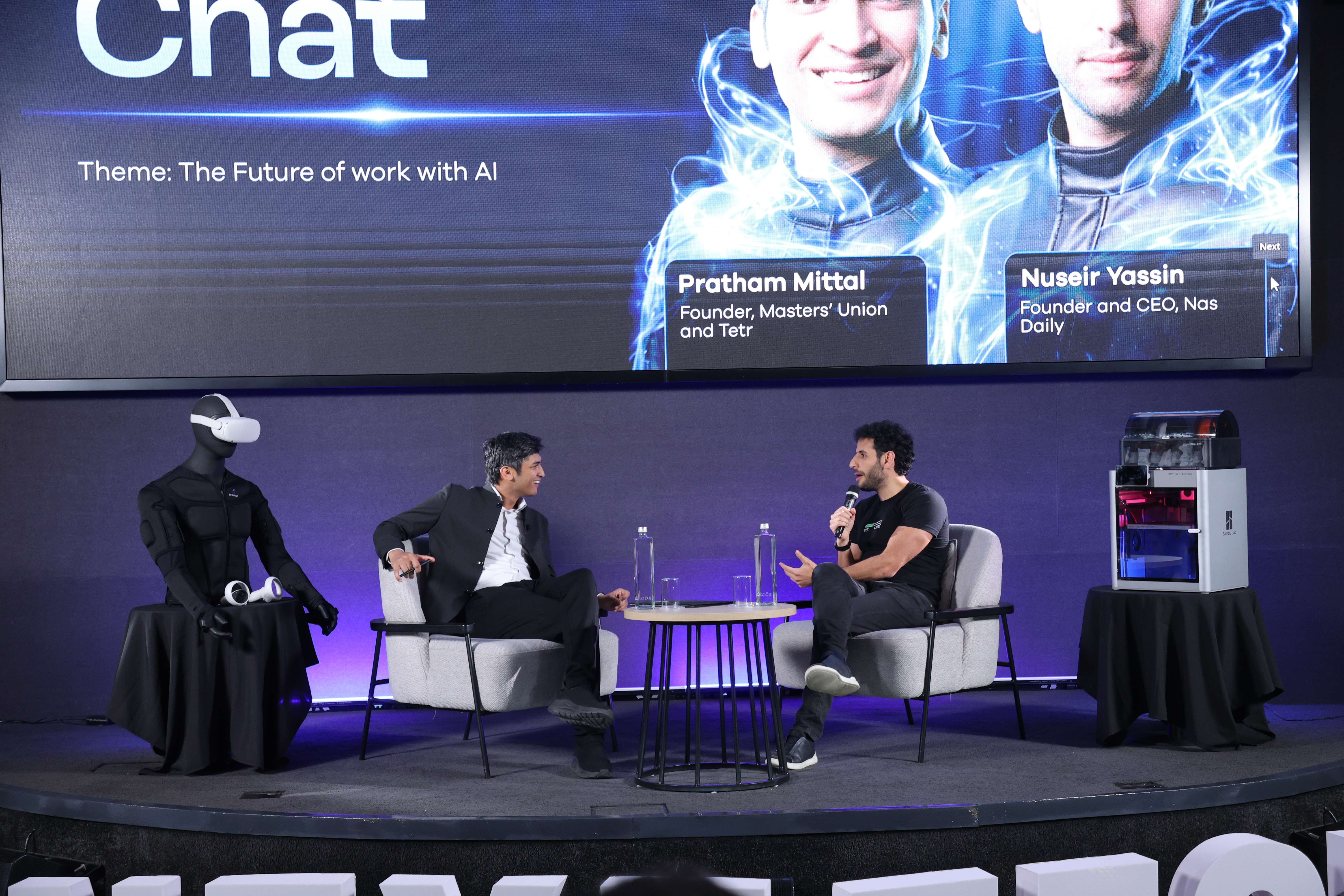
That question quietly shaped the fireside chat between Nuseir Yassin, founder of Nas Daily, and Pratham Mittal, founder & CEO of Masters’ Union, during THE NEXT TECH 1.0. What began as a conversation around AI tools and creator businesses quickly evolved into something larger: how AI entrepreneurship may fundamentally reshape careers, business building, and the future of work itself.
At one point, Nuseir said, “To become an entrepreneur, you don't need to know how to code.” The statement captured one of the central ideas behind the session. AI is not simply making work faster. It is making business creation more accessible.
For years, starting a company required technical skills, large teams, funding or specialised industry access. AI is beginning to reduce many of those barriers. That shift may influence not only startups and creators, but also how students think about careers, how companies hire talent, and how institutions prepare people for work.
Why AI Entrepreneurship is Lowering The Cost of Building Companies?
One of the strongest themes from the discussion was how AI tools are reducing the technical complexity involved in launching businesses. Nuseir explained that workflows across coding, editing, design, scripting, marketing, and customer communication are becoming dramatically easier through AI systems.
Tasks that once required entire teams can increasingly be handled by individuals using prompts, automation tools, and AI-assisted workflows.
Nuseir described a future where someone could upload a product image and AI would:
-
Build the storefront
-
Create marketing campaigns
-
Generate promotional videos
-
Write copy
-
Help identify potential customers
The larger point was accessibility.
Historically, entrepreneurship often depended on capital, technical expertise, or operational scale. AI changes that equation by lowering execution costs and shortening the distance between an idea and a functioning business.
That shift could create more opportunities for independent creators, niche operators, consultants, freelancers, and small businesses to compete at scale.
What This Means for Future Founders:
-
AI is reducing technical barriers to entrepreneurship
-
Individuals can execute work once handled by larger teams
-
Lower execution costs may increase startup creation globally
Why Paid Distribution is Becoming Essential In The Creator Economy?
The conversation also challenged one of the internet’s most popular assumptions: that organic reach alone can sustainably build a business. For years, creators treated platform virality as the primary engine for growth. Nuseir pushed back against that directly. “Organic is not dead, it’s just not predictable,” Nuseir said.
He explained that despite Nas Daily’s massive social following, a significant share of business growth still comes through paid distribution across platforms like Instagram and Facebook. The conversation became less about virality and more about distribution economics.
Nuseir argued that creators and founders should spend less time hoping algorithms work in their favour and more time learning how to build effective short-form advertisements that consistently drive results.
For students, startup founders, and creators in the audience, it became one of the most practical parts of the session because it reframed the content not as entertainment alone but as a scalable business tool.
What Builders Should Understand About Distribution:
-
Paid distribution plays a major role in online business growth
-
Organic reach alone is difficult to predict consistently
-
Short-form advertising is becoming a valuable entrepreneurial skill
Why Agentic AI Could Change How People Use Software?
Another major theme during the session was the rise of agentic AI and how it may reshape digital behaviour. Nuseir argued that people may eventually stop navigating apps and websites manually in the way they do today. Instead of opening multiple tabs, comparing products, searching through menus, or switching between platforms, AI systems could increasingly manage those actions conversationally.
His larger vision was a future where conversations become the operating system. At the same time, the discussion explored how visual interfaces may continue to remain important for comparison, discovery, and decision-making. Rather than replacing interfaces entirely, AI may work alongside them to simplify workflows and reduce friction.
That exchange added balance to the conversation because both speakers acknowledged that the future of software will likely combine intuitive interfaces with intelligent assistance.
The broader shift is towards systems that understand intent more naturally and simplify digital experiences in the background.
What This Could Change for Businesses:
-
Agentic AI could reduce dependence on traditional app navigation
-
Conversational systems may simplify digital workflows
-
Predictive assistance could automate repetitive decision-making tasks
Why Universities Are Adapting to The AI-Native Workforce?
The discussion around education became one of the most thought-provoking sections of the session. As AI tools become integrated into everyday workflows, both speakers explored how universities now have an opportunity to evolve alongside rapidly changing technology and industry expectations.
Nuseir spoke about how ambitious technical talent is increasingly moving towards AI startups, emerging technology ecosystems, and entrepreneurship. That shift places growing pressure on institutions to adapt more dynamically.
The discussion explored how universities may increasingly integrate:
-
Industry-led learning
-
AI-native thinking
-
Emerging technologies
-
Faster experimentation cycles
-
Practical problem-solving
Importantly, the conversation remained optimistic about higher education.
If AI can simplify information access, accelerate research, and support foundational learning, universities may have an even greater opportunity to focus on:
-
Judgement
-
Collaboration
-
Critical thinking
-
Real-world application
-
Industry exposure
The larger takeaway was not that education becomes less relevant. Instead, institutions may become more valuable as students look for environments that help them apply knowledge meaningfully and work alongside industry leaders.
Why Lean AI Teams Could Compete More Aggressively?
Throughout the discussion, the conversation repeatedly returned to the idea that AI is expanding what smaller teams can achieve. As automation improves productivity across functions, businesses may increasingly operate with leaner structures while still scaling effectively.
At the same time, the discussion acknowledged that many sectors will continue to rely on operational depth, research capabilities, and large-scale collaboration. AI may not necessarily replace larger organisations, but it could reshape how different businesses operate and compete. The larger idea was that AI gives smaller teams capabilities that once required entire departments.
A single person can now manage workflows across:
-
Marketing
-
Customer support
-
Content production
-
Operations
-
Software systems
The freelancer may increasingly evolve into a scalable business unit.
Why Smaller Teams Could Gain An Advantage:
-
AI increases the operating power of lean teams
-
Smaller businesses may scale faster with automation
-
Some industries will still depend on large organisations
Why The Biggest AI Opportunity May Sit In The Application Layer?
One of the sharpest insights from the discussion came when Nuseir compared AI infrastructure to electricity. He argued that foundational models and GPUs may eventually become commoditised over time. The larger opportunity, according to him, lies in how intelligence gets applied to real-world problems.
He explained: “What really matters is what you do with intelligence.” That shifts attention away from simply building models and towards building useful businesses powered by AI. The next generation of successful companies may increasingly focus on applying intelligence across sectors such as:
-
Education
-
Healthcare
-
Logistics
-
Entrepreneurship
-
Manufacturing
-
Operations
The long-term value may sit less in infrastructure ownership and more in usability, execution, and problem-solving.
Where AI Business Opportunities Could Emerge:
-
AI infrastructure may become commoditised over time
-
The application layer could create major business opportunities
-
Founders who apply AI effectively may shape future industries
How AI Entrepreneurship is Changing The Future of Work?
By the end of the session, the discussion no longer felt limited to technology. It became a broader conversation about how work itself may evolve when execution becomes dramatically cheaper.
If AI lowers the cost of building products, generating content, launching companies and distributing ideas, traditional assumptions around careers and employment may begin to shift as well.
That does not mean corporations disappear or everyone becomes a founder. But it does mean the distance between an idea and execution is shrinking rapidly. In that environment, the people who stand out may not simply be the most technical. They may be the individuals who identify opportunities early, communicate clearly, understand distribution, adapt quickly, and apply technology meaningfully.
The tools are changing quickly. The larger question is whether institutions, companies, and individuals can evolve alongside them.
What the Future of Work May Prioritise:
-
AI is reshaping assumptions around careers and employment
-
Execution barriers are shrinking rapidly
-
Adaptability may become a defining professional advantage
Ending Thoughts
AI entrepreneurship is no longer a niche conversation limited to startups or Silicon Valley. It is increasingly influencing how businesses get built, how careers evolve, and how individuals create economic value. As AI lowers the cost of execution, the advantage may increasingly belong to people who can adapt quickly, apply technology meaningfully, and build intelligently in fast-changing markets.