


About us


-
See what students, mentors, alumni and recruiters say about Masters' Union University. Shared highlights and moments that reflect our culture, learning and community. Explore their voices.
OVERVIEW


-
See how Masters’ Union University is represented across leading news and media platforms. Explore articles, features, and press coverage that reflect our journey, initiatives, and growing impact in education, innovation, and industry engagement.
OVERVIEW

-
Explore the awards, rankings and accreditations that recognise the quality, impact and industry relevance of Masters' Union University programmes.
OVERVIEW

-
Explore the reports, brochures, policies, and publications that document Masters' Union University's outcomes, standards, and institutional commitments.
OVERVIEW


PROGRAMMEs
- Highlights
- Curriculum
- Admissions & Fees
- Immersions
- Entrepreneurship
- Careers
- Class Profile
PROGRAMME oVERVIEW
- Highlights
- Curriculum
- Admissions & Fees
- Immersions
- Entrepreneurship
- Career Prospects
- Class Profile
PROGRAMME oVERVIEW
- Highlights
- Curriculum & Faculty
- Immersions
- Admissions & Fees
- Career Prospects
- Class Profile
PROGRAMME oVERVIEW
- Highlights
- Curriculum
PROGRAMME oVERVIEW
- Home
PROGRAMME oVERVIEW
- Highlights
- Curriculum & Faculty
- Admissions & Fees
- Career Prospects
- Class Profile
PROGRAMME oVERVIEW
- Highlights
- Curriculum & Faculty
- Admissions & Fees
- Career Prospects
- Class Profile
PROGRAMME oVERVIEW
- Highlights
- Curriculum
- Admissions & Fees
- Career Prospects
- Class Profile
PROGRAMME oVERVIEW
PROGRAMMEs
- Highlights
- Curriculum & Faculty
- Admissions & Fees
- Career Prospects
- Class Profile
PROGRAMME oVERVIEW
- Highlights
- Curriculum & Faculty
- Admissions & Fees
- Career Prospects
- Class Profile
PROGRAMME oVERVIEW
- Highlights
- Curriculum
- Admissions & Fees
- Career Prospects
- Class Profile
PROGRAMME oVERVIEW
- Highlights
- Curriculum & Faculty
- Admissions & Fees
- Career Prospects
- Class Profile
PROGRAMME oVERVIEW
- Highlights
- Curriculum & Faculty
- Admissions & Fees
- Career Prospects
- Class Profile
PROGRAMME oVERVIEW
- Highlights
- Curriculum
- Admissions & Fees
- Career Prospects
- Class Profile
PROGRAMME oVERVIEW
- Highlights
- Curriculum
- Admissions & Fees
- Career Prospects
- Class Profile
PROGRAMME oVERVIEW
PROGRAMMES
-
PGP in
Technology & Business Management

-
PGP in
Technology & Business Management
(Young Leaders Cohort)
-
PGP in
Human Resources & Organisation Strategy
-
PGP in Sports
Management & Gaming
-
PGP in
Applied AI & Agentic Systems
-
PGP in Sustainability &
Business Management
-
Four Nations Global
Business Programme
- Highlights
- Curriculum
- Immersions
- Admissions & Fees
- Career Prospects
- Cohort Profile
PROGRAMME oVERVIEW
- Highlights
- Curriculum
- Immersions
- Admissions & Fees
- Career Prospects
- Faculty & Student Stories
PROGRAMME oVERVIEW
- Highlights
- Curriculum
- Immersions
- Admissions & Fees
- Career Prospects
PROGRAMME oVERVIEW
- Highlights
- Curriculum & Faculty
- Admissions & Fees
- Career Prospects
PROGRAMME oVERVIEW
- Highlights
- Curriculum & Faculty
- Admissions & Fees
- Career Prospects
PROGRAMME OVERVIEW
- Highlights
- Curriculum & Faculty
- Admissions & Fees
PROGRAMME OVERVIEW
- Highlights
PROGRAMME OVERVIEW
- Highlights
- Curriculum
- Immersions
- Admissions & Fees
- Career Prospects
- Cohort Profile
PROGRAMME oVERVIEW
PROGRAMMES
- Highlights
- Curriculum
- Faculty
- Admissions & Fees
- Career Prospects
- Cohort Profile
PROGRAMME oVERVIEW
- Home
PROGRAMME oVERVIEW
- Highlights
- Curriculum
- Admissions & Fees
PROGRAMME oVERVIEW
- Highlights
- Curriculum
- Admissions & Fees
PROGRAMME oVERVIEW
- Highlights
- Curriculum
- Immersions
- Faculty & Coaches
- Admissions & Fees
- Career Prospects
PROGRAMME oVERVIEW
- Highlights
- Curriculum
PROGRAMME oVERVIEW
- Home
PROGRAMME oVERVIEW
- Highlights
- Global Immersions
- Curriculum
- Faculty & Coaches
- Leadership Learning
- Admissions & Fees
PROGRAMME oVERVIEW
- Highlights
- Curriculum
- Admissions & Fees
PROGRAMME oVERVIEW
PROGRAMMES
- Highlights
- Curriculum
- Beyond Classroom
- Admissions & Fees
PROGRAMME oVERVIEW
- Highlights
- Curriculum
- Beyond Classroom
- Admissions & Fees
PROGRAMME oVERVIEW
- Home
PROGRAMME oVERVIEW
- Home
PROGRAMME oVERVIEW
PROGRAMMES
- Home
PROGRAMME oVERVIEW
- Highlights
- Curriculum
- Beyond Classroom
- Admissions & Fees
PROGRAMME oVERVIEW
- Home
PROGRAMME oVERVIEW
- Home
PROGRAMME oVERVIEW
STUDENT LIFE
- Student Premises
- Amenities
- Hostel Council
oVERVIEW


- Case Union
- UnMute
- Clubs & Committees
oVERVIEW



oVERVIEW

- Healthcare
- BFSI
- Technology
- Manufacturing
- Retail
Industry
- Governments
- Universities
- Startups
- SMEs
- Large Enterprises
Industry
oVERVIEW
PROGRAMMEs
- Highlights
- Curriculum & Faculty
- Admissions & Fees
- Career Prospects
- Class Profile
PROGRAMME oVERVIEW
- Highlights
- Curriculum & Faculty
- Admissions & Fees
- Career Prospects
- Class Profile
PROGRAMME oVERVIEW
- Highlights
- Curriculum
- Admissions & Fees
- Career Prospects
- Class Profile
PROGRAMME oVERVIEW
- Highlights
- Curriculum & Faculty
- Admissions & Fees
- Career Prospects
- Class Profile
PROGRAMME oVERVIEW
- Highlights
- Curriculum & Faculty
- Admissions & Fees
- Career Prospects
- Class Profile
PROGRAMME oVERVIEW
- Highlights
- Curriculum
- Admissions & Fees
- Career Prospects
- Class Profile
PROGRAMME oVERVIEW
- Highlights
- Curriculum
- Admissions & Fees
- Career Prospects
- Class Profile
PROGRAMME oVERVIEW
PROGRAMMES
- Highlights
- Curriculum
- Immersions
- Admissions & Fees
- Career Prospects
- Cohort Profile
PROGRAMME oVERVIEW
- Highlights
- Curriculum
- Immersions
- Admissions & Fees
- Career Prospects
- Faculty & Student Stories
PROGRAMME oVERVIEW
- Highlights
- Curriculum
- Immersions
- Admissions & Fees
- Career Prospects
PROGRAMME oVERVIEW
- Highlights
- Curriculum & Faculty
- Admissions & Fees
- Career Prospects
PROGRAMME oVERVIEW
- Highlights
- Curriculum
- Immersions
- Admissions & Fees
- Career Prospects
- Cohort Profile
PROGRAMME oVERVIEW
PROGRAMMES
- Highlights
- Curriculum
- Faculty
- Admissions & Fees
- Career Prospects
- Cohort Profile
PROGRAMME oVERVIEW
- Highlights
- Curriculum
- Admissions & Fees
PROGRAMME oVERVIEW
- Highlights
- Curriculum
- Admissions & Fees
PROGRAMME oVERVIEW
- Highlights
- Curriculum
- Immersions
- Faculty & Coaches
- Admissions & Fees
- Career Prospects
PROGRAMME oVERVIEW
- Highlights
- Global Immersions
- Curriculum
- Faculty & Coaches
- Leadership Learning
- Admissions & Fees
PROGRAMME oVERVIEW
- Highlights
- Curriculum
- Admissions & Fees
PROGRAMME oVERVIEW


About Us

Undergraduate
Postgraduate
PGP in Technology & Business Management
PGP in Technology & Business Management
(Young Leaders Cohort)
PGP in Human Resources & Organisation Strategy
PGP in Sports Management & Gaming
PGP in Applied AI & Agentic Systems
PGP in Sustainability & Business Management
Four Nations Global Business Programme
Executive
Family Business
Immersions
1:1 Executive Coaching
Careers
Innovations
Faculty
MU Ventures
Enterprise L&D
Student Life
Jobs
Become a Master
Merch Store
events
For Companies
Blog
Coach LMS
Business
How SuperYou Scaled from ₹0 to ₹100 Crore D2C Brand in 6 Months
March 20, 2026
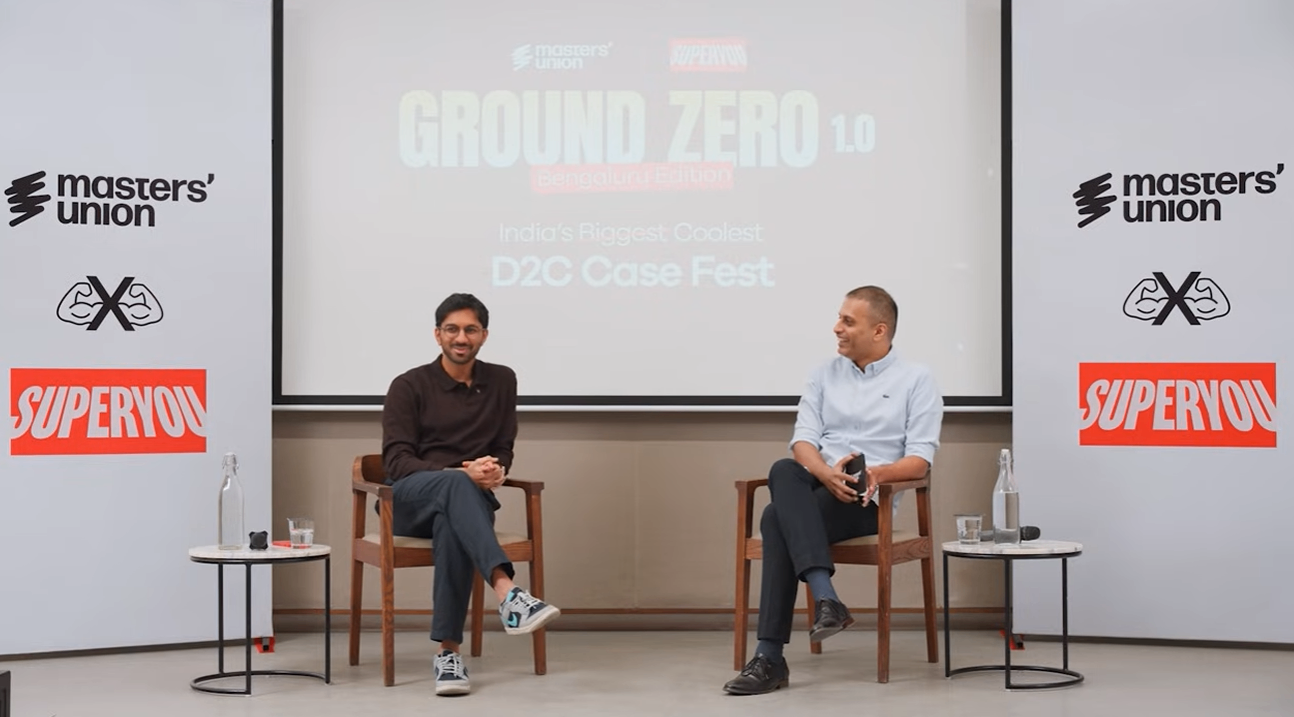
Launching a snack brand today means stepping into a crowded, highly competitive market. Many products attract initial curiosity but struggle to convert that into consistent buying. SuperYou, the high-protein snack co-founded by Ranveer Singh and Nikunj Biyani, scaled from ₹0 to ₹100 Cr within months.
These insights emerged during Ground Zero 1.0, India’s top D2C case competition held by Masters’ Union in partnership with SuperYou. Over 1,000 students from leading colleges tackled a real business problem posed by the brand. The selected finalists flew to Bangalore, where they presented their solution to Nikunj Biyani in person, and walked away with ₹3 lakhs in cash prizes.
In this conversation with Anand Sinha, the PGP Director at Masters’ Union, Nikunj explained the real reasons behind SuperYou's growth. And this made one thing clear: success in D2C rarely comes from a single advantage. It depends on how well product, distribution, and consumer behaviour work together, and whether customers choose to come back.
Scaling a D2C Brand Requires More Than a Great Product
A well-made product is often where founders begin, but it is rarely where growth is decided. Nikunj pointed out that brands don’t scale because of one standout factor. Product, pricing, distribution, timing, and execution need to move in sync. When one falls short, the impact is felt across the business.
What makes this difficult is that most teams instinctively prioritise one area, often product or marketing, while underestimating the others. In reality, growth comes from coordination. It is less about finding a single breakthrough and more about ensuring that each part of the system reinforces the rest.
Where founders often go wrong:
-
Strong products fail when distribution limits access
-
Marketing without substance brings attention, but not retention
-
Timing, both category momentum and consumer readiness, shapes outcomes more than expected
Repeat Purchases Are the Only Metric That Matters Early On
In the early days, SuperYou focused less on reach and more on behaviour. The central question was simple: Do customers come back? Rather than tracking impressions or clicks, the team looked at repeat consumption as the clearest signal of product-market fit.
This approach forced discipline. Every decision, from flavour and texture to packaging and placement, had to justify itself through customer response. If people returned without being pushed, the product was working. If they didn’t, something needed fixing.
What repeat behaviour reveals:
-
It reflects genuine product acceptance, not just curiosity
-
It highlights whether the experience matches the promise
-
It provides early clarity on what to refine before scaling
Differentiation Comes from Experience, Not Just Ingredients
SuperYou entered a category that was already crowded with protein bars. Instead of competing on claims alone, the focus was on making the product feel different; lighter, more enjoyable, and easier to incorporate into everyday routines. That shift in experience helped create space in a saturated market.
As Nikunj explained, innovation only works when it addresses something real. Early feedback played a critical role here. The team tested, listened, and adjusted, often quickly. Over time, those small improvements added up to a product that people didn’t just try once, but returned to.
The insight extended beyond the product itself. Differentiation also came from how the brand was positioned and communicated. What customers understood about the product, and how it fit into their lives, mattered just as much as what went into it.
What meaningful differentiation looks like:
-
It solves a clear, everyday consumer need
-
It evolves through honest feedback and iteration
-
It is reflected in positioning and communication, not just formulation
Celebrity Partnerships Create Attention, Not Loyalty
Bringing Ranveer Singh on board as a co-founder ensured immediate visibility. The brand stood out quickly, and awareness followed. But as Nikunj made clear, attention is only the starting point. Without a product that delivers, that visibility fades just as quickly as it arrives.
The role of a celebrity, in this case, was to open the door, not to keep it open. What sustained interest was the product itself and the experience around it. Marketing, therefore, had to reinforce what was already working, rather than compensate for what wasn’t.
Making celebrity partnerships work:
-
Visibility helps, but retention depends on product quality
-
Marketing should amplify strength, not mask weaknesses
-
Trust builds through consistent delivery, not association
Quick Commerce Turned Availability into Advantage
For a product positioned as an everyday snack, accessibility was critical. SuperYou leaned into quick commerce platforms such as Blinkit, Zepto, and Instamart to meet customers where decisions were being made in real time.
The impact of this was immediate. Short delivery windows reduced friction, while frequent visibility increased the likelihood of repeat purchases. Instead of relying solely on traditional D2C channels, the brand embedded itself into daily consumption patterns.
Why quick commerce accelerated growth:
-
Instant availability encourages impulse decisions
-
Reduced waiting time improves conversion rates
-
Frequent exposure builds habitual consumption
How to Tackle the Problem of Distribution at an Early Stage
If there was one area that proved more challenging than expected, it was distribution. Early demand did not always translate into fulfilled orders. Stockouts, partial deliveries, and operational inefficiencies created gaps that directly affected revenue.
Addressing this required a level of involvement that many founders underestimate. Orders were tracked manually, issues were resolved in real time, and systems were gradually built to handle scale. Over time, distribution became more predictable, but only through consistent effort.
What strong distribution enables:
-
Reliable fulfilment prevents lost sales
-
Operational consistency builds customer trust
-
Backend strength supports sustainable growth
Efficient Spending Matters More Than Large Budgets
Fast growth is often associated with aggressive marketing spend, but SuperYou took a more measured approach. Investment followed validation. Rather than spending heavily to generate demand, the team focused on amplifying what was already working.
This meant being deliberate about where money went. Channels were chosen based on their ability to convert, not just their reach. The result was a model where marketing supported growth, rather than driving it prematurely.
How disciplined spending supports scale:
-
Each investment should have a clear purpose
-
Targeted channels outperform broad, unfocused campaigns
-
Demand should be strengthened after it is proven, not assumed
Building for Indian Consumers Means Working with Existing Habits
A key insight from the conversation was that Indian consumers rarely need entirely new behaviours. Instead, they respond better to familiar formats that are incrementally improved. SuperYou followed this approach by offering products that fit into existing routines, rather than attempting to reshape them.
This reduced friction. Customers did not need to learn something new; they simply chose a better version of what they already consumed. Over time, this made adoption easier and repeat behaviour more natural.
What drives adoption in the Indian market:
-
Familiar formats reduce resistance
-
Incremental improvement encourages trial
-
Gradual change leads to sustained behaviour
Competition Expands the Category, Not Just the Market Share
While competition is often seen as a threat, Nikunj viewed it as a sign of validation. More brands entering the space meant more conversations around protein and better-for-you products. This, in turn, increased awareness and accelerated category growth.
No single brand builds a category alone. Growth happens when multiple players push the same narrative, making it easier for consumers to understand and adopt. In that sense, competition becomes a shared advantage.
Why competition can be beneficial:
-
It validates demand within the category
-
It accelerates consumer awareness
-
It expands the overall market, not just individual share
SuperYou’s journey highlights a simple but often overlooked reality: consumer brands don’t scale on isolated strengths. Product quality, distribution, and consumer behaviour need to move together. Consistent availability, relevance to local habits, and disciplined execution are what convert early interest into sustained growth. When these elements align, scale is not forced; it follows.