


About us


-
See what students, mentors, alumni and recruiters say about Masters' Union University. Shared highlights and moments that reflect our culture, learning and community. Explore their voices.
OVERVIEW

-
See how Masters’ Union University is represented across leading news and media platforms. Explore articles, features, and press coverage that reflect our journey, initiatives, and growing impact in education, innovation, and industry engagement.
OVERVIEW

-
Explore the awards, rankings and accreditations that recognise the quality, impact and industry relevance of Masters' Union University programmes.
OVERVIEW

-
Explore the reports, brochures, policies, and publications that document Masters' Union University's outcomes, standards, and institutional commitments.
OVERVIEW


PROGRAMMEs
- Highlights
- Curriculum
- Admissions & Fees
- Immersions
- Entrepreneurship
- Careers
- Class Profile
PROGRAMME oVERVIEW
- Highlights
- Curriculum
- Admissions & Fees
- Immersions
- Entrepreneurship
- Career Prospects
- Class Profile
PROGRAMME oVERVIEW
- Highlights
- Curriculum & Faculty
- Immersions
- Admissions & Fees
- Career Prospects
- Class Profile
PROGRAMME oVERVIEW
- Highlights
- Curriculum
PROGRAMME oVERVIEW
- Home
PROGRAMME oVERVIEW
- Highlights
- Curriculum & Faculty
- Admissions & Fees
- Career Prospects
- Class Profile
PROGRAMME oVERVIEW
- Highlights
- Curriculum & Faculty
- Admissions & Fees
- Career Prospects
- Class Profile
PROGRAMME oVERVIEW
- Highlights
- Curriculum
- Admissions & Fees
- Career Prospects
- Class Profile
PROGRAMME oVERVIEW
PROGRAMMEs
- Highlights
- Curriculum & Faculty
- Admissions & Fees
- Career Prospects
- Class Profile
PROGRAMME oVERVIEW
- Highlights
- Curriculum & Faculty
- Admissions & Fees
- Career Prospects
- Class Profile
PROGRAMME oVERVIEW
- Highlights
- Curriculum
- Admissions & Fees
- Career Prospects
- Class Profile
PROGRAMME oVERVIEW
- Highlights
- Curriculum & Faculty
- Admissions & Fees
- Career Prospects
- Class Profile
PROGRAMME oVERVIEW
- Highlights
- Curriculum & Faculty
- Admissions & Fees
- Career Prospects
- Class Profile
PROGRAMME oVERVIEW
- Highlights
- Curriculum
- Admissions & Fees
- Career Prospects
- Class Profile
PROGRAMME oVERVIEW
- Highlights
- Curriculum
- Admissions & Fees
- Career Prospects
- Class Profile
PROGRAMME oVERVIEW
PROGRAMMES
-
PGP in
Technology & Business Management

-
PGP in
Technology & Business Management
(Young Leaders Cohort)
-
Post Graduate Diploma (Human Resources and Organisation Strategy)
-
Post Graduate Diploma (Sports Management and Gaming)
-
PGP in
Applied AI & Agentic Systems
-
PGP in Sustainability &
Business Management
-
Four Nations Global
Business Programme
- Highlights
- Curriculum
- Immersions
- Admissions & Fees
- Career Prospects
- Cohort Profile
PROGRAMME oVERVIEW
- Highlights
- Curriculum
- Immersions
- Admissions & Fees
- Career Prospects
- Faculty & Student Stories
PROGRAMME oVERVIEW
- Highlights
- Curriculum
- Immersions
- Admissions & Fees
- Career Prospects
PROGRAMME oVERVIEW
- Highlights
- Curriculum & Faculty
- Admissions & Fees
- Career Prospects
PROGRAMME oVERVIEW
- Highlights
- Curriculum & Faculty
- Admissions & Fees
- Career Prospects
PROGRAMME OVERVIEW
- Highlights
- Curriculum & Faculty
- Admissions & Fees
PROGRAMME OVERVIEW
- Highlights
PROGRAMME OVERVIEW
- Highlights
- Curriculum
- Immersions
- Admissions & Fees
- Career Prospects
- Cohort Profile
PROGRAMME oVERVIEW
PROGRAMMES
-
Post Graduate Diploma (Rise General Management)
-
Post Graduate Diploma (Capital Markets & Trading)
-
PGP in US Capital Markets &
Trading
-
PGP
in Entrepreneurship & Business Acceleration
-
Post Graduate Diploma (Rise General Management Global)
-
AI First Operator Programme
-
Bloomberg Equity Research Programme
- Highlights
- Curriculum
- Faculty
- Admissions & Fees
- Career Prospects
- Cohort Profile
PROGRAMME oVERVIEW
- Home
PROGRAMME oVERVIEW
- Highlights
- Curriculum
- Admissions & Fees
PROGRAMME oVERVIEW
- Highlights
- Curriculum
- Admissions & Fees
PROGRAMME oVERVIEW
- Highlights
- Curriculum
- Immersions
- Faculty & Coaches
- Admissions & Fees
- Career Prospects
PROGRAMME oVERVIEW
- Highlights
- Curriculum
PROGRAMME oVERVIEW
- Home
PROGRAMME oVERVIEW
- Highlights
- Global Immersions
- Curriculum
- Faculty & Coaches
- Leadership Learning
- Admissions & Fees
PROGRAMME oVERVIEW
- Highlights
- Curriculum
- Admissions & Fees
PROGRAMME oVERVIEW
PROGRAMMES
- Highlights
- Curriculum
- Beyond Classroom
- Admissions & Fees
PROGRAMME oVERVIEW
- Highlights
- Curriculum
- Beyond Classroom
- Admissions & Fees
PROGRAMME oVERVIEW
- Home
PROGRAMME oVERVIEW
- Home
PROGRAMME oVERVIEW
PROGRAMMES
- Home
PROGRAMME oVERVIEW
- Highlights
- Curriculum
- Beyond Classroom
- Admissions & Fees
PROGRAMME oVERVIEW
- Home
PROGRAMME oVERVIEW
- Home
PROGRAMME oVERVIEW
STUDENT LIFE
- Student Premises
- Amenities
- Hostel Council
oVERVIEW

- Case Union
- UnMute
- Clubs & Committees
oVERVIEW


oVERVIEW
- Healthcare
- BFSI
- Technology
- Manufacturing
- Retail
Industry
- Governments
- Universities
- Startups
- SMEs
- Large Enterprises
Industry
oVERVIEW
PROGRAMMEs
- Highlights
- Curriculum & Faculty
- Admissions & Fees
- Career Prospects
- Class Profile
PROGRAMME oVERVIEW
- Highlights
- Curriculum & Faculty
- Admissions & Fees
- Career Prospects
- Class Profile
PROGRAMME oVERVIEW
- Highlights
- Curriculum
- Admissions & Fees
- Career Prospects
- Class Profile
PROGRAMME oVERVIEW
- Highlights
- Curriculum & Faculty
- Admissions & Fees
- Career Prospects
- Class Profile
PROGRAMME oVERVIEW
- Highlights
- Curriculum & Faculty
- Admissions & Fees
- Career Prospects
- Class Profile
PROGRAMME oVERVIEW
- Highlights
- Curriculum
- Admissions & Fees
- Career Prospects
- Class Profile
PROGRAMME oVERVIEW
- Highlights
- Curriculum
- Admissions & Fees
- Career Prospects
- Class Profile
PROGRAMME oVERVIEW
PROGRAMMES
- Highlights
- Curriculum
- Immersions
- Admissions & Fees
- Career Prospects
- Cohort Profile
PROGRAMME oVERVIEW
- Highlights
- Curriculum
- Immersions
- Admissions & Fees
- Career Prospects
- Faculty & Student Stories
PROGRAMME oVERVIEW
- Highlights
- Curriculum
- Immersions
- Admissions & Fees
- Career Prospects
PROGRAMME oVERVIEW
- Highlights
- Curriculum & Faculty
- Admissions & Fees
- Career Prospects
PROGRAMME oVERVIEW
- Highlights
- Curriculum
- Immersions
- Admissions & Fees
- Career Prospects
- Cohort Profile
PROGRAMME oVERVIEW
PROGRAMMES
- Highlights
- Curriculum
- Faculty
- Admissions & Fees
- Career Prospects
- Cohort Profile
PROGRAMME oVERVIEW
- Highlights
- Curriculum
- Admissions & Fees
PROGRAMME oVERVIEW
- Highlights
- Curriculum
- Admissions & Fees
PROGRAMME oVERVIEW
- Highlights
- Curriculum
- Immersions
- Faculty & Coaches
- Admissions & Fees
- Career Prospects
PROGRAMME oVERVIEW
- Highlights
- Global Immersions
- Curriculum
- Faculty & Coaches
- Leadership Learning
- Admissions & Fees
PROGRAMME oVERVIEW
- Highlights
- Curriculum
- Admissions & Fees
PROGRAMME oVERVIEW


About Us

Undergraduate
Postgraduate
PGP in Technology & Business Management
PGP in Technology & Business Management
(Young Leaders Cohort)
Post Graduate Diploma (Human Resources and Organisation Strategy)
Post Graduate Diploma (Sports Management and Gaming)
PGP in Applied AI & Agentic Systems
PGP in Sustainability & Business Management
Four Nations Global Business Programme
Executive
Post Graduate Diploma (Rise General Management)
Post Graduate Diploma (Capital Markets & Trading)
PGP in US Capital Markets & Trading
PGP in Entrepreneurship & Business Acceleration
Post Graduate Diploma (Rise General Management Global)
AI First Operator Programme
Bloomberg Equity Research Programme
Family Business
Immersions
1:1 Executive Coaching
Careers
Innovations
Faculty
MU Ventures
Enterprise L&D
Student Life
Jobs
Become a Master
Merch Store
events
For Companies
Blog
Coach LMS
CXO Insights
How NVIDIA Thinks About AI, Infrastructure and India’s Next Big Opportunity
May 26, 2026
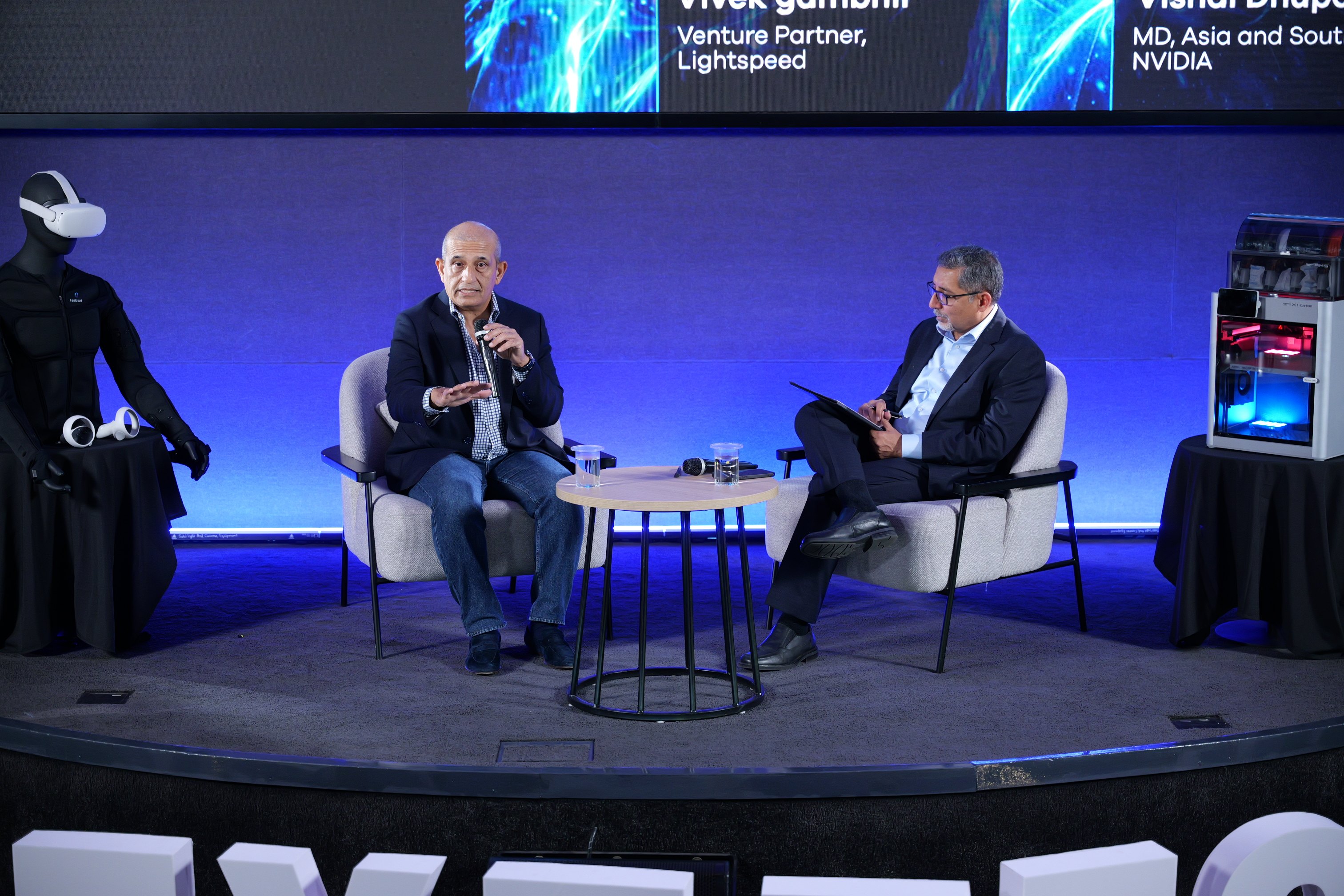
What does it actually take to build the technology powering the world’s AI revolution?
At THE NEXT TECH 1.0, India’s biggest institution-led tech startup summit, that question shaped a fascinating fireside chat between Vivek Gambhir, Venture Partner at Lightspeed, and Vishal Dhupar, Managing Director, Asia South at NVIDIA.
The conversation moved far beyond chatbots, prompts, or software demos. Instead, it unpacked the invisible systems underneath AI: energy grids, semiconductor ecosystems, compute infrastructure, developer platforms, and the long-term conviction required to build category-defining companies.
From NVIDIA’s early gaming-chip origins to India’s ambition of becoming the “global intelligence capital”, the session offered a rare inside view into how one of the world’s most influential technology companies thinks about scale, infrastructure, and the future of intelligence itself.
As Vishal Dhupar put it during the conversation, “What the world saw was a graphics chip company. What we were building was a company solving hard computing problems.”
Why NVIDIA Never Saw Itself as Just a Gaming Company?
Vivek Gambhir opened the session with the story of NVIDIA’s beginnings at a Denny’s diner in San Jose in 1993. Three engineers. One gaming chip. One ambition was to render graphics faster than anything available at the time. But Vishal Dhupar challenged the common retelling of that story almost immediately.
According to him, NVIDIA was never built to become a graphics company. Graphics simply became the first application of a much larger belief: specialised processors could solve computing problems that general-purpose systems could not.
Gaming became the entry point because gaming created scale. Millions of users stress-test the technology every day. What looked like entertainment on the surface became the training ground for an entirely different future for computing.
Lessons From NVIDIA’s Earliest Bet
-
NVIDIA viewed itself as a specialised computing company from the start
-
Gaming created the scale needed to improve GPU capabilities
-
The company focused on solving hard computing problems, not chasing categories
How CUDA Looked Like Failure Before It Changed AI?
One of the most revealing moments in the session came when Vishal spoke about CUDA (Compute Unified Device Architecture). Today, CUDA sits at the heart of modern AI computing.
For six years, NVIDIA invested heavily in a platform that had no meaningful commercial adoption. It increased costs, burdened the business, and offered no immediate return. From the outside, it looked like an expensive miscalculation. But Jensen Huang believed the world would eventually outgrow traditional computing models.
That moment arrived when Geoffrey Hinton and his team used GPUs to train deep learning systems capable of image recognition breakthroughs. Suddenly, the same gaming hardware powering graphics cards became the foundation for machine learning.
Vishal described it through one of the session’s most memorable analogies. “The GPU became the seed. CUDA became the soil. AI became the tree.”
How CUDA Quietly Became the Backbone of AI
-
CUDA spent years without meaningful customer adoption
-
Deep learning transformed GPUs into essential AI infrastructure
-
NVIDIA’s long-term conviction became one of its biggest competitive advantages
Why AI Is Not Just a Software Story?
A large part of the discussion focused on a misconception Vishal believes many founders still carry: AI is not simply a software problem. To explain this, he introduced what he called the “five-layer cake” of the AI economy.
At the base sits energy. Above that come chips, infrastructure, models, and finally applications. Most people interact only with the top layer. They see ChatGPT, copilots, and AI tools. But Vishal argued that the real transformation is happening underneath, inside power systems, semiconductor design, networking infrastructure, and compute architecture.
One striking example stood out. According to him, a single hyperscale data centre can consume as much electricity as an entire city region. Without reliable and affordable power, AI infrastructure cannot scale. He also pointed out that modern AI systems are no longer simply storing information. They are manufacturing intelligence in real time through token generation and inference systems.
What Most Founders Still Miss About AI
-
AI depends on energy, chips, infrastructure, models, and applications together
-
Compute infrastructure is becoming as important as software innovation
-
AI systems are shifting computing from information storage to intelligence generation
Why India’s AI Opportunity Is Bigger Than Most People Realise in 2026?
The conversation became especially compelling when the focus shifted to India. Vishal highlighted a fascinating imbalance. India contributes only a small fraction of global compute capacity, yet Indian talent contributes disproportionately to global AI output.
For him, this gap represents opportunity rather than limitation. He argued that India’s next leap depends on building sovereign AI infrastructure instead of relying entirely on external ecosystems. If Indian data is processed abroad and sold back as intelligence services, India risks paying repeatedly for its own digital knowledge.
He connected this directly to Aadhaar, UPI, and India Stack. Identity systems created financial access. Financial systems created transaction visibility. AI can now connect those systems to entirely new forms of credit, healthcare, education, and governance. The larger point was simple: India already has population-scale digital infrastructure. AI can become the intelligence layer sitting on top of it.
Why India Could Build the World’s Next Intelligence Economy
-
India has strong AI talent despite limited compute infrastructure
-
Sovereign AI systems are becoming strategically important
-
AI combined with Aadhaar and UPI could unlock new economic participation
Why AI Will Change Tasks Faster Than Jobs?
Questions around employment surfaced repeatedly during the conversation. Vishal approached the issue with a distinction that reframed the conversation: AI replaces tasks before it replaces jobs.
He used radiologists as an example. When computer vision systems became capable of analysing medical images, many predicted the profession would disappear. Instead, demand for radiologists increased because diagnosis is only one part of their work. Human judgement, patient interaction, and collaboration with surgeons still matter deeply.
The same logic, he argued, applies to engineering and product roles. At NVIDIA, AI tools are already improving productivity across teams. Yet the company continues hiring aggressively because higher productivity creates larger opportunities, new markets, and expanded product ambitions. For founders and operators in the room, this shifted the conversation from fear to leverage.
How AI Changes the Nature of Work
-
AI is more likely to automate tasks than eliminate entire professions
-
Productivity gains can create new market opportunities
-
Human judgement continues to matter in high-context work
Why AI Infrastructure Will Shape India’s Startup Ecosystem?
Several founders in the audience raised concerns around semiconductor manufacturing, GPU accessibility, and infrastructure costs in India. Vishal acknowledged the challenge directly.
Advanced compute remains expensive. Semiconductor ecosystems take years to mature. But he pointed toward India’s growing momentum in data centres, semiconductor partnerships, packaging capabilities, and public-private infrastructure programmes. He referenced companies like Yotta and initiatives under India’s AI mission that are helping startups access compute resources earlier than before.
The conversation carried an important subtext for founders: infrastructure may appear slow-moving, but infrastructure compounds. Roads, power systems, semiconductor ecosystems, and compute clusters all expand the ceiling for future innovation.
What India Must Build to Compete in AI
-
India is gradually building stronger semiconductor and compute infrastructure
-
Public-private partnerships are accelerating AI ecosystem growth
-
Better infrastructure expands opportunities for startups and researchers
Why Vishal Dhupar Believes India Can Become the Intelligence Capital of the World?
The session closed with a larger national vision.Vishal compared AI to previous industrial revolutions that reshaped cities and countries around specific capabilities. Fashion created Paris and Milan. Software transformed Bangalore. AI, he suggested, could position India differently altogether.
Not just as a services economy, but as the “global intelligence capital.” India has scale. India has linguistic diversity. India has developers. India has one of the world’s largest digitally connected populations. And increasingly, computers can now interact in local languages and dialects without forcing users to adapt themselves first.
He urged founders in the room to focus less on immediate scoreboards and more on durable game plans.“You gotta have a game plan. Don’t worry about the score. The score will come your way.” That line stayed with the room long after the session ended.
The Vision Vishal Dhupar Sees for India’s AI Future
-
Vishal Dhupar sees AI as India’s next large-scale economic opportunity
-
Local languages and population scale give India unique advantages
-
Long-term conviction remains central to building transformational companies
How THE NEXT TECH 1.0 Turned AI Into a Real Conversation?
What made this fireside chat memorable was not the scale of the ideas alone. It was the way those ideas were translated into systems, stories, and decisions people could actually understand.
At THE NEXT TECH 1.0, AI was not discussed as abstract hype. It was discussed as infrastructure, economics, talent, policy, energy, and national capability all moving together at once.
And perhaps that was the most valuable takeaway from the session. The future of AI may look magical on the surface. But underneath it sits decades of patient engineering, infrastructure bets, and people willing to build long before the world understands why it matters.