


About us


-
See what students, mentors, alumni and recruiters say about Masters' Union University. Shared highlights and moments that reflect our culture, learning and community. Explore their voices.
OVERVIEW


-
See how Masters’ Union University is represented across leading news and media platforms. Explore articles, features, and press coverage that reflect our journey, initiatives, and growing impact in education, innovation, and industry engagement.
OVERVIEW
-
Explore the awards, rankings and accreditations that recognise the quality, impact and industry relevance of Masters' Union University programmes.
OVERVIEW

-
Explore the reports, brochures, policies, and publications that document Masters' Union University's outcomes, standards, and institutional commitments.
OVERVIEW


PROGRAMMEs
- Highlights
- Curriculum
- Admissions & Fees
- Immersions
- Entrepreneurship
- Careers
- Class Profile
PROGRAMME oVERVIEW
- Highlights
- Curriculum
- Admissions & Fees
- Immersions
- Entrepreneurship
- Career Prospects
- Class Profile
PROGRAMME oVERVIEW
- Highlights
- Curriculum & Faculty
- Immersions
- Admissions & Fees
- Career Prospects
- Class Profile
PROGRAMME oVERVIEW
- Highlights
- Curriculum
PROGRAMME oVERVIEW
- Home
PROGRAMME oVERVIEW
- Highlights
- Curriculum & Faculty
- Admissions & Fees
- Career Prospects
- Class Profile
PROGRAMME oVERVIEW
- Highlights
- Curriculum & Faculty
- Admissions & Fees
- Career Prospects
- Class Profile
PROGRAMME oVERVIEW
- Highlights
- Curriculum
- Admissions & Fees
- Career Prospects
- Class Profile
PROGRAMME oVERVIEW
PROGRAMMEs
- Highlights
- Curriculum & Faculty
- Admissions & Fees
- Career Prospects
- Class Profile
PROGRAMME oVERVIEW
- Highlights
- Curriculum & Faculty
- Admissions & Fees
- Career Prospects
- Class Profile
PROGRAMME oVERVIEW
- Highlights
- Curriculum
- Admissions & Fees
- Career Prospects
- Class Profile
PROGRAMME oVERVIEW
- Highlights
- Curriculum & Faculty
- Admissions & Fees
- Career Prospects
- Class Profile
PROGRAMME oVERVIEW
- Highlights
- Curriculum & Faculty
- Admissions & Fees
- Career Prospects
- Class Profile
PROGRAMME oVERVIEW
- Highlights
- Curriculum
- Admissions & Fees
- Career Prospects
- Class Profile
PROGRAMME oVERVIEW
- Highlights
- Curriculum
- Admissions & Fees
- Career Prospects
- Class Profile
PROGRAMME oVERVIEW
PROGRAMMES
-
PGP in
Technology & Business Management

-
PGP in
Technology & Business Management
(Young Leaders Cohort)
-
Post Graduate Diploma (Human Resources and Organisation Strategy)
-
Post Graduate Diploma (Sports Management and Gaming)
-
PGP in
Applied AI & Agentic Systems
-
PGP in Sustainability &
Business Management
-
Four Nations Global
Business Programme
- Highlights
- Curriculum
- Immersions
- Admissions & Fees
- Career Prospects
- Cohort Profile
PROGRAMME oVERVIEW
- Highlights
- Curriculum
- Immersions
- Admissions & Fees
- Career Prospects
- Faculty & Student Stories
PROGRAMME oVERVIEW
- Highlights
- Curriculum
- Immersions
- Admissions & Fees
- Career Prospects
PROGRAMME oVERVIEW
- Highlights
- Curriculum & Faculty
- Admissions & Fees
- Career Prospects
PROGRAMME oVERVIEW
- Highlights
- Curriculum & Faculty
- Admissions & Fees
- Career Prospects
PROGRAMME OVERVIEW
- Highlights
- Curriculum & Faculty
- Admissions & Fees
PROGRAMME OVERVIEW
- Highlights
PROGRAMME OVERVIEW
- Highlights
- Curriculum
- Immersions
- Admissions & Fees
- Career Prospects
- Cohort Profile
PROGRAMME oVERVIEW
PROGRAMMES
-
Post Graduate Diploma (Rise General Management)
-
Post Graduate Diploma (Capital Markets & Trading)
-
PGP in US Capital Markets &
Trading
-
PGP
in Entrepreneurship & Business Acceleration
-
Post Graduate Diploma (Rise General Management Global)
-
AI First Operator Programme
-
Bloomberg Equity Research Programme
- Highlights
- Curriculum
- Faculty
- Admissions & Fees
- Career Prospects
- Cohort Profile
PROGRAMME oVERVIEW
- Home
PROGRAMME oVERVIEW
- Highlights
- Curriculum
- Admissions & Fees
PROGRAMME oVERVIEW
- Highlights
- Curriculum
- Admissions & Fees
PROGRAMME oVERVIEW
- Highlights
- Curriculum
- Immersions
- Faculty & Coaches
- Admissions & Fees
- Career Prospects
PROGRAMME oVERVIEW
- Highlights
- Curriculum
PROGRAMME oVERVIEW
- Home
PROGRAMME oVERVIEW
- Highlights
- Global Immersions
- Curriculum
- Faculty & Coaches
- Leadership Learning
- Admissions & Fees
PROGRAMME oVERVIEW
- Highlights
- Curriculum
- Admissions & Fees
PROGRAMME oVERVIEW
PROGRAMMES
- Highlights
- Curriculum
- Beyond Classroom
- Admissions & Fees
PROGRAMME oVERVIEW
- Highlights
- Curriculum
- Beyond Classroom
- Admissions & Fees
PROGRAMME oVERVIEW
- Home
PROGRAMME oVERVIEW
- Home
PROGRAMME oVERVIEW
PROGRAMMES
- Home
PROGRAMME oVERVIEW
- Highlights
- Curriculum
- Beyond Classroom
- Admissions & Fees
PROGRAMME oVERVIEW
- Home
PROGRAMME oVERVIEW
- Home
PROGRAMME oVERVIEW
STUDENT LIFE
- Student Premises
- Amenities
- Hostel Council
oVERVIEW


- Case Union
- UnMute
- Clubs & Committees
oVERVIEW


oVERVIEW

- Healthcare
- BFSI
- Technology
- Manufacturing
- Retail
Industry
- Governments
- Universities
- Startups
- SMEs
- Large Enterprises
Industry
oVERVIEW
PROGRAMMEs
- Highlights
- Curriculum & Faculty
- Admissions & Fees
- Career Prospects
- Class Profile
PROGRAMME oVERVIEW
- Highlights
- Curriculum & Faculty
- Admissions & Fees
- Career Prospects
- Class Profile
PROGRAMME oVERVIEW
- Highlights
- Curriculum
- Admissions & Fees
- Career Prospects
- Class Profile
PROGRAMME oVERVIEW
- Highlights
- Curriculum & Faculty
- Admissions & Fees
- Career Prospects
- Class Profile
PROGRAMME oVERVIEW
- Highlights
- Curriculum & Faculty
- Admissions & Fees
- Career Prospects
- Class Profile
PROGRAMME oVERVIEW
- Highlights
- Curriculum
- Admissions & Fees
- Career Prospects
- Class Profile
PROGRAMME oVERVIEW
- Highlights
- Curriculum
- Admissions & Fees
- Career Prospects
- Class Profile
PROGRAMME oVERVIEW
PROGRAMMES
- Highlights
- Curriculum
- Immersions
- Admissions & Fees
- Career Prospects
- Cohort Profile
PROGRAMME oVERVIEW
- Highlights
- Curriculum
- Immersions
- Admissions & Fees
- Career Prospects
- Faculty & Student Stories
PROGRAMME oVERVIEW
- Highlights
- Curriculum
- Immersions
- Admissions & Fees
- Career Prospects
PROGRAMME oVERVIEW
- Highlights
- Curriculum & Faculty
- Admissions & Fees
- Career Prospects
PROGRAMME oVERVIEW
- Highlights
- Curriculum
- Immersions
- Admissions & Fees
- Career Prospects
- Cohort Profile
PROGRAMME oVERVIEW
PROGRAMMES
- Highlights
- Curriculum
- Faculty
- Admissions & Fees
- Career Prospects
- Cohort Profile
PROGRAMME oVERVIEW
- Highlights
- Curriculum
- Admissions & Fees
PROGRAMME oVERVIEW
- Highlights
- Curriculum
- Admissions & Fees
PROGRAMME oVERVIEW
- Highlights
- Curriculum
- Immersions
- Faculty & Coaches
- Admissions & Fees
- Career Prospects
PROGRAMME oVERVIEW
- Highlights
- Global Immersions
- Curriculum
- Faculty & Coaches
- Leadership Learning
- Admissions & Fees
PROGRAMME oVERVIEW
- Highlights
- Curriculum
- Admissions & Fees
PROGRAMME oVERVIEW


About Us

Undergraduate
Postgraduate
PGP in Technology & Business Management
PGP in Technology & Business Management
(Young Leaders Cohort)
Post Graduate Diploma (Human Resources and Organisation Strategy)
Post Graduate Diploma (Sports Management and Gaming)
PGP in Applied AI & Agentic Systems
PGP in Sustainability & Business Management
Four Nations Global Business Programme
Executive
Post Graduate Diploma (Rise General Management)
Post Graduate Diploma (Capital Markets & Trading)
PGP in US Capital Markets & Trading
PGP in Entrepreneurship & Business Acceleration
Post Graduate Diploma (Rise General Management Global)
AI First Operator Programme
Bloomberg Equity Research Programme
Family Business
Immersions
1:1 Executive Coaching
Careers
Innovations
Faculty
MU Ventures
Enterprise L&D
Student Life
Jobs
Become a Master
Merch Store
events
For Companies
Blog
Coach LMS
E-commerce Category Creation in India: What It Really Takes to Build Trust-Led Markets
April 24, 2026

Buying a sofa online in India still feels like a calculated risk for most households. Even after hours of scrolling through options, comparing prices, and checking reviews, many customers still end up visiting a physical store before making the final decision, or abandoning the purchase altogether. The hesitation is not about a lack of choice, but a lack of certainty about what will actually arrive at their home.
This gap between browsing and buying is where e-commerce category creation in India either succeeds or fails. It is not driven by product listings or discounts, but by how effectively a business reduces uncertainty in high-consideration decisions.
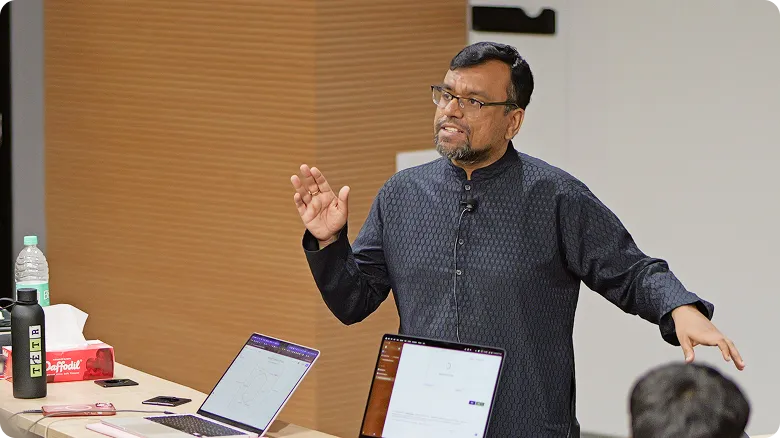
At Masters’ Union, a round table discussion with Ashish Shah, Co-Founder & CEO of Pepperfry, brought students into a direct exchange on what it takes to build and scale a category-defining e-commerce business.
Unlike a conventional lecture, the format encouraged interrogation, debate, and real-time problem solving. Students engaged with the practical constraints of building in categories where products are high-value, trust is fragile, and customer hesitation is structural. What emerged was not a case study of a single company but a framework for how category creation actually works in Indian e-commerce.
Why Category Creation in India Is a Systems' Problem!
A common assumption in e-commerce is that new categories are unlocked through marketing scale. The discussion challenged this directly. Demand can be created quickly, but it does not convert unless the underlying system supports it.
In high-consideration categories, the customer journey is shaped by hesitation, comparison, and risk evaluation at multiple stages. Without operational readiness, even strong demand collapses at the point of decision.
Ashish Shah captured this clearly: “Category creation requires both demand and supply-side focus.” This reframes category building as a coordination problem between customer behaviour and operational capability, rather than a pure growth function.
Why Trust Becomes the Primary Currency in High-Consideration Purchases?
A central theme of the session was trust. In categories where purchase frequency is low and ticket size is large, customers are not simply evaluating products; they are evaluating risk.
The discussion highlighted three recurring friction points:
-
Product quality uncertainty before delivery
-
Gap between digital representation and physical reality
-
Dependence on post-purchase experience for validation
Ashish Shah emphasised this dynamic: “In high-trust categories, experience matters more than price.” Once this is understood, category strategy shifts. The objective is no longer persuasion, but systematic reduction of uncertainty across the journey.
Why Execution Capability Defines Category Leadership More Than Demand Generation?
The conversation repeatedly returned to execution. While demand can be generated, sustaining a category depends on operational consistency.
Delivery reliability, packaging quality, installation experience, and after-sales support are not support functions; they are core to the product experience in high-consideration categories.
In this context, execution is not an efficiency metric. It is a trust-building mechanism that compounds over time or erodes brand equity when inconsistent.
Why Supply Chains Function as Experience Infrastructure in E-Commerce?
Supply chain complexity becomes significantly more visible in bulky, high-value, or fragmented product categories.
What the customer experiences, delays, damage, and installation issues, is directly shaped by backend systems. This collapses the traditional separation between “operations” and “brand”. In such categories, the supply chain is not infrastructure sitting behind the product. It is the experience that the customer judges the brand on.
Why an Omnichannel Strategy Exists to Reduce Friction?
Pepperfry’s offline studios were often interpreted as a move into physical retail. The discussion reframed this entirely.
The purpose of physical touchpoints is not to expand, but to drive behavioural correction in high-friction purchase categories.
These interventions help:
-
Reduce uncertainty before purchase
-
Enable physical validation of products
-
Increase confidence in high-value decisions
Omnichannel strategy, therefore, becomes a mechanism to complete incomplete digital decision journeys rather than a channel diversification play.
How Category Creation Works When Demand & Supply Evolve Together?
A key framework from the discussion was: Category creation happens only when demand-side behaviour change aligns with supply-side capability building.
Individually, both are insufficient.
-
Demand creation without supply readiness leads to broken experiences
-
Supply strength without demand trust leads to under-adoption
Sustainable category leadership sits at the intersection of both forces.
What Building E-Commerce Categories in India Actually Demands?
The discussion translated into a set of operational realities:
-
Category success is determined by trust, not awareness
-
Pricing plays a limited role in high-consideration decisions
-
Consistency in execution defines long-term brand strength
-
Supply chain maturity directly influences customer perception
-
Category building requires structural patience, not campaign cycles
The underlying signal was consistent: weak systems cannot be compensated by a strong strategy.
Why Category Leadership Is Ultimately About Behavioural Redesign?
The discussion with Ashish Shah reinforced a broader idea: category-defining companies do not simply enter markets; they reshape how those markets make decisions.
Once customer behaviour changes, every system around it must support that change consistently at scale. That is where most category attempts fail - not at the idea level, but at the system alignment level.
At that point, strategy stops being positioning and becomes operational coherence across trust, supply, and experience. That is what category leadership actually demands.
The discussion ultimately points to a simple but demanding reality. Category creation in India is not rewarded by how quickly a company enters a market, but by how reliably it removes uncertainty from it. Demand can be sparked through visibility, but only sustained systems can convert that demand into long-term behaviour change. As categories mature, the advantage shifts away from those who communicate best to those who execute most consistently. In that sense, category leadership is less about disruption and more about discipline, the ability to align trust, supply, and experience without letting any one element fall behind.