


About us


-
See what students, mentors, alumni and recruiters say about Masters' Union University. Shared highlights and moments that reflect our culture, learning and community. Explore their voices.
OVERVIEW


-
See how Masters’ Union University is represented across leading news and media platforms. Explore articles, features, and press coverage that reflect our journey, initiatives, and growing impact in education, innovation, and industry engagement.
OVERVIEW

-
Explore the awards, rankings and accreditations that recognise the quality, impact and industry relevance of Masters' Union University programmes.
OVERVIEW

-
Explore the reports, brochures, policies, and publications that document Masters' Union University's outcomes, standards, and institutional commitments.
OVERVIEW


PROGRAMMEs
- Highlights
- Curriculum
- Admissions & Fees
- Immersions
- Entrepreneurship
- Careers
- Class Profile
PROGRAMME oVERVIEW
- Highlights
- Curriculum
- Admissions & Fees
- Immersions
- Entrepreneurship
- Career Prospects
- Class Profile
PROGRAMME oVERVIEW
- Highlights
- Curriculum & Faculty
- Immersions
- Admissions & Fees
- Career Prospects
- Class Profile
PROGRAMME oVERVIEW
- Highlights
- Curriculum
PROGRAMME oVERVIEW
- Home
PROGRAMME oVERVIEW
- Highlights
- Curriculum & Faculty
- Admissions & Fees
- Career Prospects
- Class Profile
PROGRAMME oVERVIEW
- Highlights
- Curriculum & Faculty
- Admissions & Fees
- Career Prospects
- Class Profile
PROGRAMME oVERVIEW
- Highlights
- Curriculum
- Admissions & Fees
- Career Prospects
- Class Profile
PROGRAMME oVERVIEW
PROGRAMMEs
- Highlights
- Curriculum & Faculty
- Admissions & Fees
- Career Prospects
- Class Profile
PROGRAMME oVERVIEW
- Highlights
- Curriculum & Faculty
- Admissions & Fees
- Career Prospects
- Class Profile
PROGRAMME oVERVIEW
- Highlights
- Curriculum
- Admissions & Fees
- Career Prospects
- Class Profile
PROGRAMME oVERVIEW
- Highlights
- Curriculum & Faculty
- Admissions & Fees
- Career Prospects
- Class Profile
PROGRAMME oVERVIEW
- Highlights
- Curriculum & Faculty
- Admissions & Fees
- Career Prospects
- Class Profile
PROGRAMME oVERVIEW
- Highlights
- Curriculum
- Admissions & Fees
- Career Prospects
- Class Profile
PROGRAMME oVERVIEW
- Highlights
- Curriculum
- Admissions & Fees
- Career Prospects
- Class Profile
PROGRAMME oVERVIEW
PROGRAMMES
-
PGP in
Technology & Business Management

-
PGP in
Technology & Business Management
(Young Leaders Cohort)
-
Post Graduate Diploma (Human Resources and Organisation Strategy)
-
Post Graduate Diploma (Sports Management and Gaming)
-
PGP in
Applied AI & Agentic Systems
-
PGP in Sustainability &
Business Management
-
Four Nations Global
Business Programme
- Highlights
- Curriculum
- Immersions
- Admissions & Fees
- Career Prospects
- Cohort Profile
PROGRAMME oVERVIEW
- Highlights
- Curriculum
- Immersions
- Admissions & Fees
- Career Prospects
- Faculty & Student Stories
PROGRAMME oVERVIEW
- Highlights
- Curriculum
- Immersions
- Admissions & Fees
- Career Prospects
PROGRAMME oVERVIEW
- Highlights
- Curriculum & Faculty
- Admissions & Fees
- Career Prospects
PROGRAMME oVERVIEW
- Highlights
- Curriculum & Faculty
- Admissions & Fees
- Career Prospects
PROGRAMME OVERVIEW
- Highlights
- Curriculum & Faculty
- Admissions & Fees
PROGRAMME OVERVIEW
- Highlights
PROGRAMME OVERVIEW
- Highlights
- Curriculum
- Immersions
- Admissions & Fees
- Career Prospects
- Cohort Profile
PROGRAMME oVERVIEW
PROGRAMMES
-
Post Graduate Diploma (Rise General Management)
-
Post Graduate Diploma (Capital Markets & Trading)
-
PGP in US Capital Markets &
Trading
-
PGP
in Entrepreneurship & Business Acceleration
-
Post Graduate Diploma (Rise General Management Global)
-
AI First Operator Programme
-
Bloomberg Equity Research Programme
- Highlights
- Curriculum
- Faculty
- Admissions & Fees
- Career Prospects
- Cohort Profile
PROGRAMME oVERVIEW
- Home
PROGRAMME oVERVIEW
- Highlights
- Curriculum
- Admissions & Fees
PROGRAMME oVERVIEW
- Highlights
- Curriculum
- Admissions & Fees
PROGRAMME oVERVIEW
- Highlights
- Curriculum
- Immersions
- Faculty & Coaches
- Admissions & Fees
- Career Prospects
PROGRAMME oVERVIEW
- Highlights
- Curriculum
PROGRAMME oVERVIEW
- Home
PROGRAMME oVERVIEW
- Highlights
- Global Immersions
- Curriculum
- Faculty & Coaches
- Leadership Learning
- Admissions & Fees
PROGRAMME oVERVIEW
- Highlights
- Curriculum
- Admissions & Fees
PROGRAMME oVERVIEW
PROGRAMMES
- Highlights
- Curriculum
- Beyond Classroom
- Admissions & Fees
PROGRAMME oVERVIEW
- Highlights
- Curriculum
- Beyond Classroom
- Admissions & Fees
PROGRAMME oVERVIEW
- Home
PROGRAMME oVERVIEW
- Home
PROGRAMME oVERVIEW
PROGRAMMES
- Home
PROGRAMME oVERVIEW
- Highlights
- Curriculum
- Beyond Classroom
- Admissions & Fees
PROGRAMME oVERVIEW
- Home
PROGRAMME oVERVIEW
- Home
PROGRAMME oVERVIEW
STUDENT LIFE
- Student Premises
- Amenities
- Hostel Council
oVERVIEW


- Case Union
- UnMute
- Clubs & Committees
oVERVIEW



oVERVIEW

- Healthcare
- BFSI
- Technology
- Manufacturing
- Retail
Industry
- Governments
- Universities
- Startups
- SMEs
- Large Enterprises
Industry
oVERVIEW
PROGRAMMEs
- Highlights
- Curriculum & Faculty
- Admissions & Fees
- Career Prospects
- Class Profile
PROGRAMME oVERVIEW
- Highlights
- Curriculum & Faculty
- Admissions & Fees
- Career Prospects
- Class Profile
PROGRAMME oVERVIEW
- Highlights
- Curriculum
- Admissions & Fees
- Career Prospects
- Class Profile
PROGRAMME oVERVIEW
- Highlights
- Curriculum & Faculty
- Admissions & Fees
- Career Prospects
- Class Profile
PROGRAMME oVERVIEW
- Highlights
- Curriculum & Faculty
- Admissions & Fees
- Career Prospects
- Class Profile
PROGRAMME oVERVIEW
- Highlights
- Curriculum
- Admissions & Fees
- Career Prospects
- Class Profile
PROGRAMME oVERVIEW
- Highlights
- Curriculum
- Admissions & Fees
- Career Prospects
- Class Profile
PROGRAMME oVERVIEW
PROGRAMMES
- Highlights
- Curriculum
- Immersions
- Admissions & Fees
- Career Prospects
- Cohort Profile
PROGRAMME oVERVIEW
- Highlights
- Curriculum
- Immersions
- Admissions & Fees
- Career Prospects
- Faculty & Student Stories
PROGRAMME oVERVIEW
- Highlights
- Curriculum
- Immersions
- Admissions & Fees
- Career Prospects
PROGRAMME oVERVIEW
- Highlights
- Curriculum & Faculty
- Admissions & Fees
- Career Prospects
PROGRAMME oVERVIEW
- Highlights
- Curriculum
- Immersions
- Admissions & Fees
- Career Prospects
- Cohort Profile
PROGRAMME oVERVIEW
PROGRAMMES
- Highlights
- Curriculum
- Faculty
- Admissions & Fees
- Career Prospects
- Cohort Profile
PROGRAMME oVERVIEW
- Highlights
- Curriculum
- Admissions & Fees
PROGRAMME oVERVIEW
- Highlights
- Curriculum
- Admissions & Fees
PROGRAMME oVERVIEW
- Highlights
- Curriculum
- Immersions
- Faculty & Coaches
- Admissions & Fees
- Career Prospects
PROGRAMME oVERVIEW
- Highlights
- Global Immersions
- Curriculum
- Faculty & Coaches
- Leadership Learning
- Admissions & Fees
PROGRAMME oVERVIEW
- Highlights
- Curriculum
- Admissions & Fees
PROGRAMME oVERVIEW


About Us

Undergraduate
Postgraduate
PGP in Technology & Business Management
PGP in Technology & Business Management
(Young Leaders Cohort)
Post Graduate Diploma (Human Resources and Organisation Strategy)
Post Graduate Diploma (Sports Management and Gaming)
PGP in Applied AI & Agentic Systems
PGP in Sustainability & Business Management
Four Nations Global Business Programme
Executive
Post Graduate Diploma (Rise General Management)
Post Graduate Diploma (Capital Markets & Trading)
PGP in US Capital Markets & Trading
PGP in Entrepreneurship & Business Acceleration
Post Graduate Diploma (Rise General Management Global)
AI First Operator Programme
Bloomberg Equity Research Programme
Family Business
Immersions
1:1 Executive Coaching
Careers
Innovations
Faculty
MU Ventures
Enterprise L&D
Student Life
Jobs
Become a Master
Merch Store
events
For Companies
Blog
Coach LMS
Applied AI & Agentic System
Applied AI & Agentic Systems: What Industry Expects and Professionals Lack
April 17, 2026
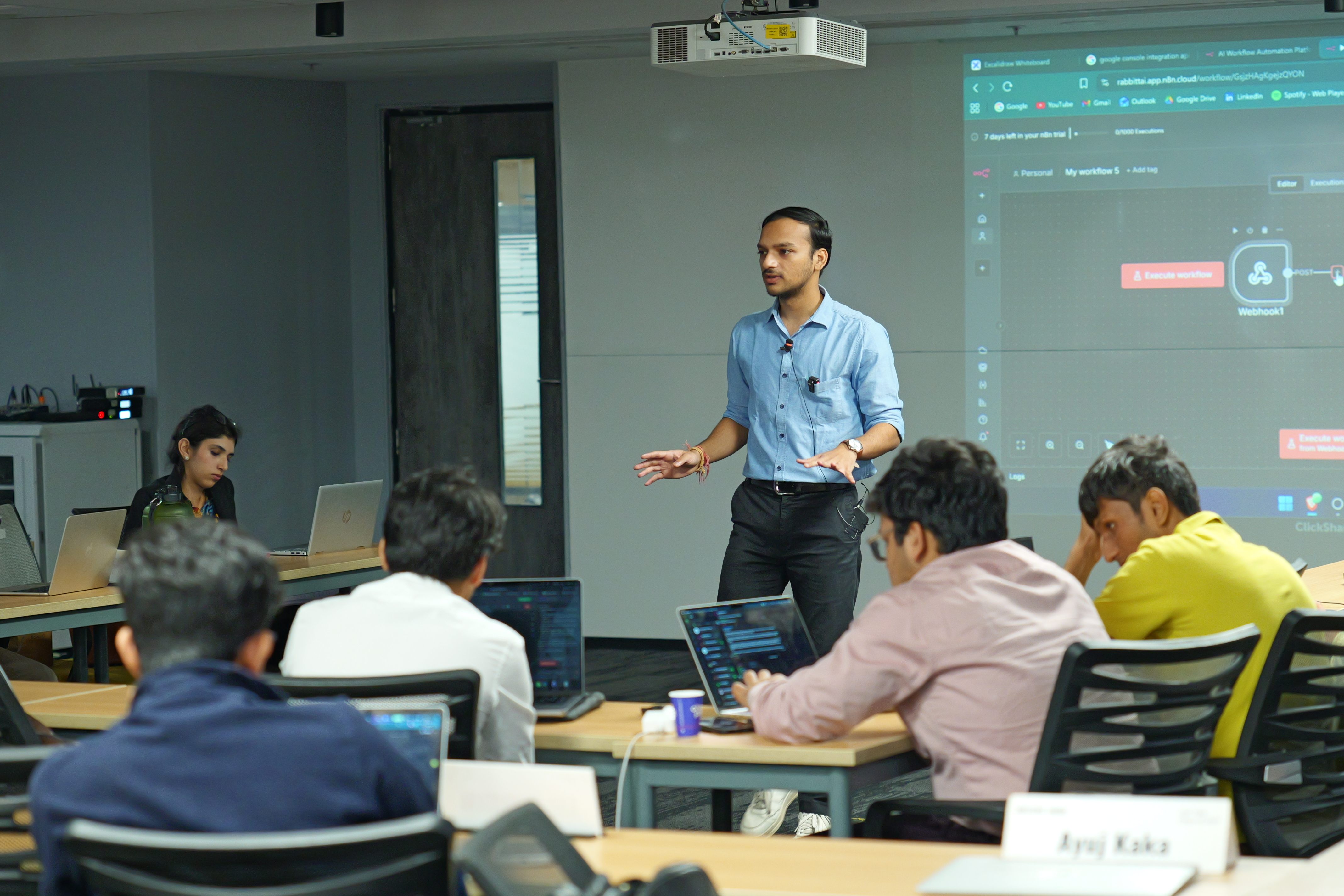
Monday morning at a mid-sized logistics firm in Bengaluru. The operations head does not open a dashboard. Instead, she asks an AI agent to assess last week's delivery exceptions, identify the root causes, and draft a corrective action plan for the weekly review.
-
The AI agent fetches data from three internal systems
-
Cross-references it with external traffic and weather inputs
-
Produces a structured report in four minutes
-
No analyst was pulled away. No meeting was called.
This is how the operations team runs every Monday now. Organisations across industries are actively deploying agentic systems, and the professionals who can build and manage them are commanding serious attention. A recent study confirms what the market already signals: AI-skilled professionals earn nearly 23 percent more on average (World Economic Forum, Feb 2026)
And the gap between what organisations need and what the current talent pool can deliver is widening faster than most people realise.
How Businesses Are Actually Using Applied AI Today?
The conversation has shifted decisively. It is no longer about whether to adopt AI, it is about how quickly teams can deploy it and at what level of sophistication.
Banking
-
A leading private bank deployed an agentic system to manage the first three stages of its loan processing pipeline
-
The system retrieves applicant data, runs credit assessments, flags anomalies, and routes complex cases to human reviewers, without manual intervention at each step.
-
What previously required six analysts working across two days now completes in under an hour
Retail
-
Major e-commerce platforms use agentic AI to manage dynamic pricing, inventory reordering, and supplier communication simultaneously
-
The system makes hundreds of micro-decisions per hour based on live data feeds without human input at each step
Healthcare
-
Diagnostic support agents cross-reference patient histories, lab results, and clinical guidelines
-
Recommendations surface for physicians before they enter the consultation room
The common thread: businesses are not using AI as a tool that humans operate. They are building AI as a layer of the organisation that functions alongside humans autonomously, continuously, and at scale.
The Gap Nobody Is Talking About Loudly Enough
Most professionals today know what AI is. The gap is about depth - the difference between knowing AI exists and knowing how to architect a system that works inside a real organisation.
Gap 1: From Tool Users to System Builders
-
Most professionals have interacted with AI tools like ChatGPT, Copilot, Gemini
-
Very few understand how to integrate a language model with live data pipelines, internal APIs, and automated decision logic
-
Using a tool and building a deployable system are entirely different competencies
Gap 2: From Code Writers to Workflow Architects
-
Writing clean Python is useful
-
Designing an end-to-end AI workflow, where data ingestion, model inference, decision routing, and output formatting function reliably together, requires a different order of thinking
-
Most early-career professionals are trained in the former; organisations need the latter
Gap 3: From Static Models to Adaptive Agents
-
Traditional ML education focuses on training models on historical data
-
Agentic AI requires building systems that retrieve real-time information, reason over it, and take actions dynamically
-
Most curricula have not yet caught up with this shift
Gap 4: From Technical Execution to Ethical Accountability
-
As AI systems take on consequential decisions - in hiring, lending, healthcare triage, the professionals who build them must understand fairness, bias, and governance
-
This is not a soft skill addendum; it is a core engineering responsibility most technical professionals are underprepared for
What It Actually Takes to Build a Career in Applied AI and Agentic Systems?
Being career-ready in applied AI is not about collecting certifications. It is about building a specific combination of capabilities that together enable you to take an idea from concept to deployed system. These are not parallel tracks - they build in sequence. Systems thinking is the foundation. Everything else sits on top of it.
Systems Thinking Before Syntax
-
Understand the architecture of what you are building before writing a line of code
-
Know how data flows through the system, where decisions are made, and what happens when something fails
Python and Data Engineering Fluency
-
Python proficiency, API familiarity, and data pipeline management are non-negotiable
-
Without them, system-level work is not possible
Machine Learning in Context
-
Knowing which model to use for which problem matters more than knowing how every model works in theory
-
Applied ML is always in service of a business outcome
Agentic System Design
-
Proficiency in large language model integration, prompt engineering, workflow orchestration, and real-time data handling
-
This is the most under-supplied skill set in the market today
Responsible AI Practice
-
Identify bias in model outputs
-
Design for explainability
-
Apply governance frameworks that hold up under regulatory scrutiny
The Emerging Roles Nobody Is Talking About Yet
The job titles defining the next decade of AI careers do not yet appear on most placement brochures, but they are forming rapidly inside serious organisations.
-
AI Workflow Architect: designs the end-to-end logic of agentic systems; sits precisely between developer and strategist
-
Agentic Systems Reliability Engineer: ensures autonomous agents perform consistently, fail gracefully, and recover without human escalation
-
AI Ethics and Governance Specialist: sits inside technical teams; ensures systems are fair, auditable, and defensible as regulation tightens
-
Human-AI Collaboration Designer: designs workflows where humans and autonomous systems hand off tasks fluidly; extraordinarily rare today
-
LLM Systems Engineer: architects the instruction logic governing how LLMs behave inside complex, multi-step systems; already a full-time function at leading AI organisations
The businesses moving fastest on AI are not waiting for these roles to be formally defined. They are hiring the people who already have the underlying capabilities, and building the roles around them.
The question worth sitting with is straightforward: when these roles become standard, will you be the person organisations are looking for, or the one trying to catch up?
Because the reality is this, many of the professionals stepping into these roles today did not start years ago. They started early, when the shift was visible but not yet crowded.
In applied AI, a 12–15 month window of focused, system-level learning and building is often enough to move from understanding concepts to deploying real systems. That is the cycle at which the market is currently evolving.
The window is open right now. It will not stay this wide for long.
FAQs
1. What is Applied AI and why are businesses prioritising it now?
Applied AI is the practice of deploying machine learning, APIs, and data engineering to solve real-world business problems - from automating workflows to building decision-support systems. Businesses are prioritising it because it moves AI from experimentation to operational deployment, reducing dependency on manual processes and enabling faster, data-driven decision-making at scale.
2. What is an agentic AI system?
An agentic AI system is an autonomous AI that fetches data, reasons over it, and completes multi-step workflows without requiring human supervision at each stage. Unlike standard AI tools, agentic systems act, decide, and execute independently and continuously.
3. What is the talent gap in Applied AI today?
Most professionals can use AI tools but very few can build deployable AI systems. The gap lies in workflow architecture, agentic system design, real-time data handling, and responsible AI practice - competencies that organisations urgently need but the current talent pool largely lacks.
4. What skills are essential to build a career in Applied AI and Agentic Systems?
The core skills include Python and data engineering fluency, machine learning in applied contexts, agentic system design using LLMs and APIs, workflow orchestration, and AI ethics and governance. Systems thinking & understanding how components function together is the foundation beneath all of them.
5. What emerging roles are being created by the rise of Agentic AI?
Roles such as AI Workflow Architect, Agentic Systems Reliability Engineer, AI Ethics and Governance Specialist, Human-AI Collaboration Designer, and LLM Systems Engineer are forming rapidly inside organisations deploying AI at scale most of which do not yet appear on standard job boards.