


About us


-
See what students, mentors, alumni and recruiters say about Masters' Union University. Shared highlights and moments that reflect our culture, learning and community. Explore their voices.
OVERVIEW


-
See how Masters’ Union University is represented across leading news and media platforms. Explore articles, features, and press coverage that reflect our journey, initiatives, and growing impact in education, innovation, and industry engagement.
OVERVIEW

-
Explore the awards, rankings and accreditations that recognise the quality, impact and industry relevance of Masters' Union University programmes.
OVERVIEW

-
Explore the reports, brochures, policies, and publications that document Masters' Union University's outcomes, standards, and institutional commitments.
OVERVIEW


PROGRAMMEs
- Highlights
- Curriculum
- Admissions & Fees
- Immersions
- Entrepreneurship
- Careers
- Class Profile
PROGRAMME oVERVIEW
- Highlights
- Curriculum
- Admissions & Fees
- Immersions
- Entrepreneurship
- Career Prospects
- Class Profile
PROGRAMME oVERVIEW
- Highlights
- Curriculum & Faculty
- Immersions
- Admissions & Fees
- Career Prospects
- Class Profile
PROGRAMME oVERVIEW
- Highlights
- Curriculum
PROGRAMME oVERVIEW
- Home
PROGRAMME oVERVIEW
- Highlights
- Curriculum & Faculty
- Admissions & Fees
- Career Prospects
- Class Profile
PROGRAMME oVERVIEW
- Highlights
- Curriculum & Faculty
- Admissions & Fees
- Career Prospects
- Class Profile
PROGRAMME oVERVIEW
- Highlights
- Curriculum
- Admissions & Fees
- Career Prospects
- Class Profile
PROGRAMME oVERVIEW
PROGRAMMEs
- Highlights
- Curriculum & Faculty
- Admissions & Fees
- Career Prospects
- Class Profile
PROGRAMME oVERVIEW
- Highlights
- Curriculum & Faculty
- Admissions & Fees
- Career Prospects
- Class Profile
PROGRAMME oVERVIEW
- Highlights
- Curriculum
- Admissions & Fees
- Career Prospects
- Class Profile
PROGRAMME oVERVIEW
- Highlights
- Curriculum & Faculty
- Admissions & Fees
- Career Prospects
- Class Profile
PROGRAMME oVERVIEW
- Highlights
- Curriculum & Faculty
- Admissions & Fees
- Career Prospects
- Class Profile
PROGRAMME oVERVIEW
- Highlights
- Curriculum
- Admissions & Fees
- Career Prospects
- Class Profile
PROGRAMME oVERVIEW
- Highlights
- Curriculum
- Admissions & Fees
- Career Prospects
- Class Profile
PROGRAMME oVERVIEW
PROGRAMMES
-
PGP in
Technology & Business Management

-
PGP in
Technology & Business Management
(Young Leaders Cohort)
-
MBA in Finance with CFA Pathway
-
Post Graduate Diploma (Human Resources and Organisation Strategy)
-
Post Graduate Diploma (Sports Management and Gaming)
-
PGP in
Applied AI & Agentic Systems
-
PGP in Sustainability &
Business Management
-
Four Nations Global
Business Programme
- Highlights
- Curriculum
- Immersions
- Admissions & Fees
- Career Prospects
- Cohort Profile
PROGRAMME oVERVIEW
- Home
PROGRAMME OVERVIEW
- Highlights
- Curriculum
- Immersions
- Admissions & Fees
- Career Prospects
- Faculty & Student Stories
PROGRAMME oVERVIEW
- Highlights
- Curriculum
- Immersions
- Admissions & Fees
- Career Prospects
PROGRAMME oVERVIEW
- Highlights
- Curriculum & Faculty
- Admissions & Fees
- Career Prospects
PROGRAMME oVERVIEW
- Highlights
- Curriculum & Faculty
- Admissions & Fees
- Career Prospects
PROGRAMME OVERVIEW
- Highlights
- Curriculum & Faculty
- Admissions & Fees
PROGRAMME OVERVIEW
- Highlights
PROGRAMME OVERVIEW
- Highlights
- Curriculum
- Immersions
- Admissions & Fees
- Career Prospects
- Cohort Profile
PROGRAMME oVERVIEW
PROGRAMMES
-
Post Graduate Diploma (Rise General Management)
-
Post Graduate Diploma (Capital Markets & Trading)
-
PGP in US Capital Markets &
Trading
-
PGP
in Entrepreneurship & Business Acceleration
-
Post Graduate Diploma (Rise General Management Global)
-
AI First Operator Programme
-
Bloomberg Equity Research Programme
- Highlights
- Curriculum
- Faculty
- Admissions & Fees
- Career Prospects
- Cohort Profile
PROGRAMME oVERVIEW
- Home
PROGRAMME oVERVIEW
- Highlights
- Curriculum
- Admissions & Fees
PROGRAMME oVERVIEW
- Highlights
- Curriculum
- Admissions & Fees
PROGRAMME oVERVIEW
- Highlights
- Curriculum
- Immersions
- Faculty & Coaches
- Admissions & Fees
- Career Prospects
PROGRAMME oVERVIEW
- Highlights
- Curriculum
PROGRAMME oVERVIEW
- Home
PROGRAMME oVERVIEW
- Highlights
- Global Immersions
- Curriculum
- Faculty & Coaches
- Leadership Learning
- Admissions & Fees
PROGRAMME oVERVIEW
- Highlights
- Curriculum
- Admissions & Fees
PROGRAMME oVERVIEW
PROGRAMMES
- Highlights
- Curriculum
- Beyond Classroom
- Admissions & Fees
PROGRAMME oVERVIEW
- Highlights
- Curriculum
- Beyond Classroom
- Admissions & Fees
PROGRAMME oVERVIEW
- Home
PROGRAMME oVERVIEW
- Home
PROGRAMME oVERVIEW
PROGRAMMES
- Home
PROGRAMME oVERVIEW
- Highlights
- Curriculum
- Beyond Classroom
- Admissions & Fees
PROGRAMME oVERVIEW
- Home
PROGRAMME oVERVIEW
- Home
PROGRAMME oVERVIEW
STUDENT LIFE
- Student Premises
- Amenities
- Hostel Council
oVERVIEW


- Case Union
- UnMute
- Clubs & Committees
oVERVIEW

oVERVIEW

- Healthcare
- BFSI
- Technology
- Manufacturing
- Retail
Industry
- Governments
- Universities
- Startups
- SMEs
- Large Enterprises
Industry
oVERVIEW
PROGRAMMEs
- Highlights
- Curriculum & Faculty
- Admissions & Fees
- Career Prospects
- Class Profile
PROGRAMME oVERVIEW
- Highlights
- Curriculum & Faculty
- Admissions & Fees
- Career Prospects
- Class Profile
PROGRAMME oVERVIEW
- Highlights
- Curriculum
- Admissions & Fees
- Career Prospects
- Class Profile
PROGRAMME oVERVIEW
- Highlights
- Curriculum & Faculty
- Admissions & Fees
- Career Prospects
- Class Profile
PROGRAMME oVERVIEW
- Highlights
- Curriculum & Faculty
- Admissions & Fees
- Career Prospects
- Class Profile
PROGRAMME oVERVIEW
- Highlights
- Curriculum
- Admissions & Fees
- Career Prospects
- Class Profile
PROGRAMME oVERVIEW
- Highlights
- Curriculum
- Admissions & Fees
- Career Prospects
- Class Profile
PROGRAMME oVERVIEW
PROGRAMMES
- Highlights
- Curriculum
- Immersions
- Admissions & Fees
- Career Prospects
- Cohort Profile
PROGRAMME oVERVIEW
- Home
PROGRAMME OVERVIEW
- Highlights
- Curriculum
- Immersions
- Admissions & Fees
- Career Prospects
- Faculty & Student Stories
PROGRAMME oVERVIEW
- Highlights
- Curriculum
- Immersions
- Admissions & Fees
- Career Prospects
PROGRAMME oVERVIEW
- Highlights
- Curriculum & Faculty
- Admissions & Fees
- Career Prospects
PROGRAMME oVERVIEW
- Highlights
- Curriculum
- Immersions
- Admissions & Fees
- Career Prospects
- Cohort Profile
PROGRAMME oVERVIEW
PROGRAMMES
- Highlights
- Curriculum
- Faculty
- Admissions & Fees
- Career Prospects
- Cohort Profile
PROGRAMME oVERVIEW
- Highlights
- Curriculum
- Admissions & Fees
PROGRAMME oVERVIEW
- Highlights
- Curriculum
- Admissions & Fees
PROGRAMME oVERVIEW
- Highlights
- Curriculum
- Immersions
- Faculty & Coaches
- Admissions & Fees
- Career Prospects
PROGRAMME oVERVIEW
- Highlights
- Global Immersions
- Curriculum
- Faculty & Coaches
- Leadership Learning
- Admissions & Fees
PROGRAMME oVERVIEW
- Highlights
- Curriculum
- Admissions & Fees
PROGRAMME oVERVIEW


About Us

Undergraduate
Postgraduate
PGP in Technology & Business Management
PGP in Technology & Business Management
(Young Leaders Cohort)
MBA in Finance with CFA Pathway
Post Graduate Diploma (Human Resources and Organisation Strategy)
Post Graduate Diploma (Sports Management and Gaming)
PGP in Applied AI & Agentic Systems
PGP in Sustainability & Business Management
Four Nations Global Business Programme
Executive
Post Graduate Diploma (Rise General Management)
Post Graduate Diploma (Capital Markets & Trading)
PGP in US Capital Markets & Trading
PGP in Entrepreneurship & Business Acceleration
Post Graduate Diploma (Rise General Management Global)
AI First Operator Programme
Bloomberg Equity Research Programme
Family Business
Immersions
1:1 Executive Coaching
Careers
Innovations
Faculty
MU Ventures
Enterprise L&D
Student Life
Jobs
Become a Master
Merch Store
events
For Companies
Blog
Coach LMS
Business
Reebok Co-Founder Joe Foster on Building a Global Brand at Masters’ Union
March 13, 2026
There’s a classic story about two salespeople who land in a city where no one wears shoes. One sees it as a dead end - no demand, no market. The other sees it as an untapped opportunity waiting to be created. The difference isn’t the market but the mindset.
That mindset builds brands like Reebok.
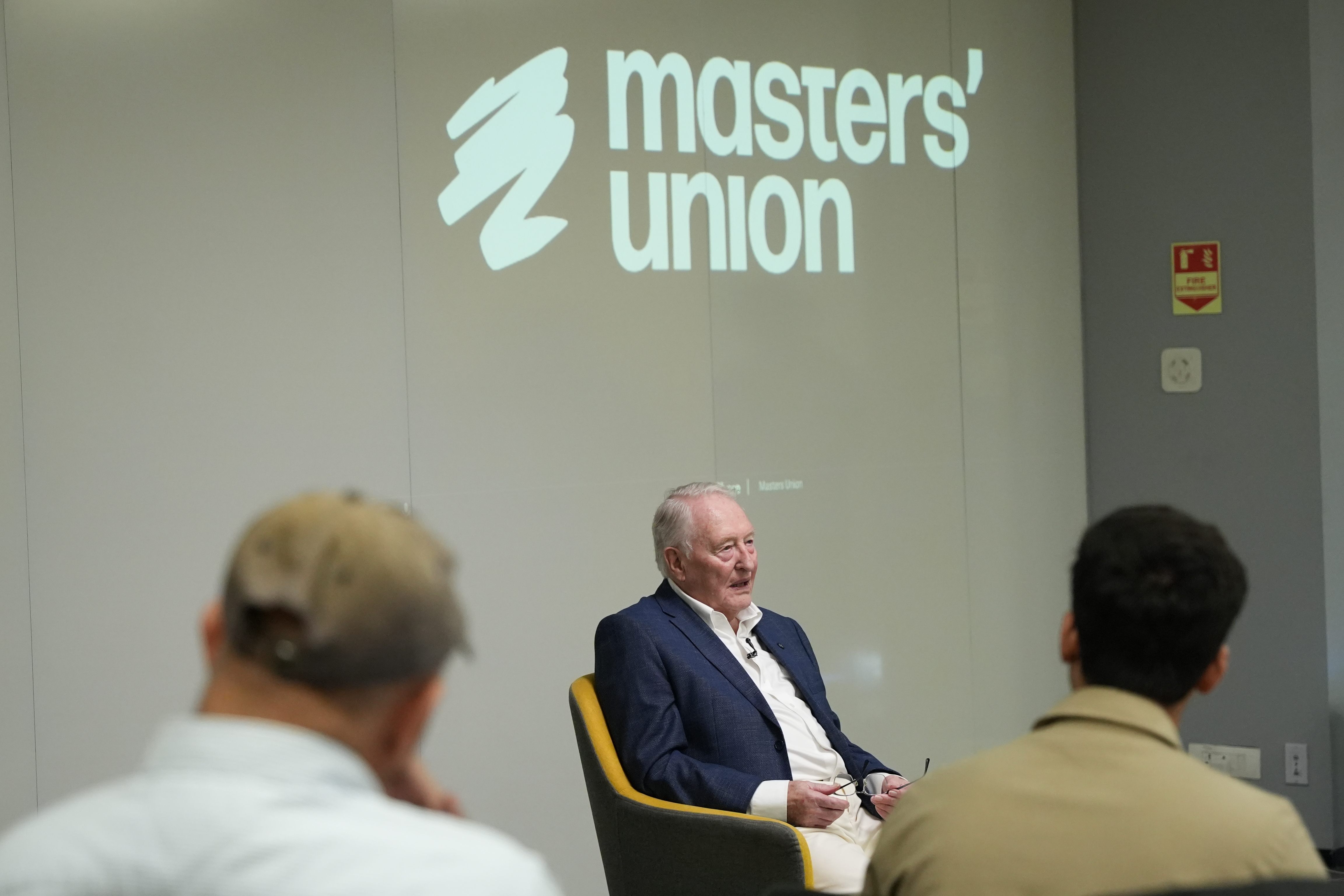
When Joe Foster, Co-founder of Reebok, walked into Masters’ Union, he deconstructed how a family-run shoemaking business transformed into a global cultural icon - a rise of a sportswear brand. From redefining athletic identity to mastering global expansion, he revealed how storytelling, accurate timing and bold bets turned Reebok into a brand trusted by athletes and embraced by generations.
For our students, it was a front-row seat to entrepreneurial instinct in action. They gained first-hand insights into product innovation, audience psychology and operational agility - the principles that guided every pivotal decision in Reebok’s journey from local craftsmanship to worldwide dominance.
Reebok Origins: The Journey from Local Store to Global Brand
Joe Foster’s journey began with his grandfather, who repaired cricket boots and later invented the spike running shoe. By the 1920s, the family supplied running shoes for British Olympic athletes, including Harold Abrahams and Eric Liddell, immortalised in Chariots of Fire.
After World War Two, Foster and his brother joined the family business. Inspired by innovations in Germany from Adidas and Puma, they modernised shoemaking. When the family resisted change, the brothers left to create Mercury Sports Footwear, initially producing cycle shoes and later expanding into running shoes.
Fundamental Principles and Early Lessons
Reebok emerged after registering the brand following initial success with Mercury. He told students, “Just do it. Don’t let anyone talk you out of it.” Belief in the product and determination were non-negotiable. The following principles became the foundation that transformed a small workshop into a global brand.
-
Know your craft: Attending night school to improve shoemaking skills
-
Understand your market: Identifying where and how to sell products
-
Engage directly with the audience: Connecting with athletes at clubs and competitions rather than relying solely on retailers
Reebok’s Startup Approach towards Global Brand Identity
Reebok may now be a global company, but its early growth relied on a small, hands-on team. While addressing students, Joe Foster drew a contrast between Reebok’s approach and the slower, more rigid systems of legacy sports companies.
In larger corporations, product innovation is often delayed by layers of approvals and outdated processes. Reebok prioritised speed, direct athlete feedback and hands-on testing, even if that meant rethinking designs mid-production.
Why Reebok Worked Like a Startup
-
Big scale doesn’t mean slow decisions
-
Direct audience engagement drives product innovation
-
White space identification shapes growth strategy
-
Operational agility is a long-term advantage, not a temporary fix
Audience Engagement and Product Innovation
From the beginning, Reebok focused on athletes as the core audience. Direct engagement allowed the team to refine spikes, heel counters and shoe designs based on performance needs.
Working with the audience created innovations later copied by competitors. Foster emphasised that understanding the customer is the foundation for product differentiation. Running clubs, cycling teams, and aerobics participants all influenced design decisions.
Why Audience Focus Worked
-
Customer insight drives better product development
-
Engaged users become brand advocates
-
Product tweaks based on feedback create a competitive advantage
Marketing, White Space and Rapid Growth
Reebok discovered white space in under-served sports segments. While competitors dominated football and general running markets, Reebok explored fell running, orienteering, and later aerobics.
Aerobics in the US became a breakthrough. A small team demonstrating routines created a global trend. Within four years, Reebok grew from nine million to nine hundred million dollars in revenue.
Why White Space Matters
-
Identifying gaps enables rapid market entry
-
Small, focused teams can exploit opportunities faster
-
Differentiation drives brand recognition and growth
Global Expansion and Operational Agility
Scaling Reebok internationally required operational efficiency. Increasing production from nine million to hundreds of millions in revenue demanded factories capable of meeting demand. Reebok partnered with South Korean factories, enabling global growth.
Foster noted that preparation and hard work, combined with timing and a bit of luck, allowed Reebok to expand almost by accident. Belief in the product and responsiveness to audience needs were decisive.
Why Operational Agility Matters
-
Production and supply must scale with demand
-
Flexibility enables global responsiveness
-
Agility turns challenges into growth opportunities
Lessons to Note for Establishing a Global Dominance
At Masters’ Union, students saw how practical decisions shape long-term success. Big scale does not mean slow decisions, and direct engagement with your audience drives product innovation. Identifying white space in the market is critical for growth, while operational agility often outweighs rigid strategies. Global expansion, as Foster explained, tends to follow demand rather than detailed plans.
Joe Foster’s masterclass showed that building a global brand relies on craftsmanship, deep audience understanding, and timely innovation. Reebok’s growth shows that scale follows function, not ambition.
These are the same capabilities that Masters’ Union develops in its PGP Rise: Owners and Promoters Management programme. The course equips founders and business leaders with skills in strategic decision‑making, market analysis, product positioning, and scaling operations, all through experiential projects that reflect real challenges. For anyone looking to lead a business with clarity and agility, the programme mirrors the mindset Foster described in the session.
For students, the message is clear: know your product, stay close to your audience, act decisively, and remain open to opportunity. Sessions like this at Masters’ Union connect classroom learning with real‑world business, preparing future leaders to create brands that endure.