


About us


-
See what students, mentors, alumni and recruiters say about Masters' Union University. Shared highlights and moments that reflect our culture, learning and community. Explore their voices.
OVERVIEW


-
See how Masters’ Union University is represented across leading news and media platforms. Explore articles, features, and press coverage that reflect our journey, initiatives, and growing impact in education, innovation, and industry engagement.
OVERVIEW

-
Explore the awards, rankings and accreditations that recognise the quality, impact and industry relevance of Masters' Union University programmes.
OVERVIEW

-
Explore the reports, brochures, policies, and publications that document Masters' Union University's outcomes, standards, and institutional commitments.
OVERVIEW


PROGRAMMEs
- Highlights
- Curriculum
- Admissions & Fees
- Immersions
- Entrepreneurship
- Careers
- Class Profile
PROGRAMME oVERVIEW
- Highlights
- Curriculum
- Admissions & Fees
- Immersions
- Entrepreneurship
- Career Prospects
- Class Profile
PROGRAMME oVERVIEW
- Highlights
- Curriculum & Faculty
- Immersions
- Admissions & Fees
- Career Prospects
- Class Profile
PROGRAMME oVERVIEW
- Highlights
- Curriculum
PROGRAMME oVERVIEW
- Home
PROGRAMME oVERVIEW
- Highlights
- Curriculum & Faculty
- Admissions & Fees
- Career Prospects
- Class Profile
PROGRAMME oVERVIEW
- Highlights
- Curriculum & Faculty
- Admissions & Fees
- Career Prospects
- Class Profile
PROGRAMME oVERVIEW
- Highlights
- Curriculum
- Admissions & Fees
- Career Prospects
- Class Profile
PROGRAMME oVERVIEW
PROGRAMMEs
- Highlights
- Curriculum & Faculty
- Admissions & Fees
- Career Prospects
- Class Profile
PROGRAMME oVERVIEW
- Highlights
- Curriculum & Faculty
- Admissions & Fees
- Career Prospects
- Class Profile
PROGRAMME oVERVIEW
- Highlights
- Curriculum
- Admissions & Fees
- Career Prospects
- Class Profile
PROGRAMME oVERVIEW
- Highlights
- Curriculum & Faculty
- Admissions & Fees
- Career Prospects
- Class Profile
PROGRAMME oVERVIEW
- Highlights
- Curriculum & Faculty
- Admissions & Fees
- Career Prospects
- Class Profile
PROGRAMME oVERVIEW
- Highlights
- Curriculum
- Admissions & Fees
- Career Prospects
- Class Profile
PROGRAMME oVERVIEW
- Highlights
- Curriculum
- Admissions & Fees
- Career Prospects
- Class Profile
PROGRAMME oVERVIEW
PROGRAMMES
-
PGP in
Technology & Business Management

-
PGP in
Technology & Business Management
(Young Leaders Cohort)
-
PGP in
Human Resources & Organisation Strategy
-
PGP in Sports
Management & Gaming
-
PGP in
Applied AI & Agentic Systems
-
PGP in Sustainability &
Business Management
-
Four Nations Global
Business Programme
- Highlights
- Curriculum
- Immersions
- Admissions & Fees
- Career Prospects
- Cohort Profile
PROGRAMME oVERVIEW
- Highlights
- Curriculum
- Immersions
- Admissions & Fees
- Career Prospects
- Faculty & Student Stories
PROGRAMME oVERVIEW
- Highlights
- Curriculum
- Immersions
- Admissions & Fees
- Career Prospects
PROGRAMME oVERVIEW
- Highlights
- Curriculum & Faculty
- Admissions & Fees
- Career Prospects
PROGRAMME oVERVIEW
- Highlights
- Curriculum & Faculty
- Admissions & Fees
- Career Prospects
PROGRAMME OVERVIEW
- Highlights
- Curriculum & Faculty
- Admissions & Fees
PROGRAMME OVERVIEW
- Highlights
PROGRAMME OVERVIEW
- Highlights
- Curriculum
- Immersions
- Admissions & Fees
- Career Prospects
- Cohort Profile
PROGRAMME oVERVIEW
PROGRAMMES
- Highlights
- Curriculum
- Faculty
- Admissions & Fees
- Career Prospects
- Cohort Profile
PROGRAMME oVERVIEW
- Home
PROGRAMME oVERVIEW
- Highlights
- Curriculum
- Admissions & Fees
PROGRAMME oVERVIEW
- Highlights
- Curriculum
- Admissions & Fees
PROGRAMME oVERVIEW
- Highlights
- Curriculum
- Immersions
- Faculty & Coaches
- Admissions & Fees
- Career Prospects
PROGRAMME oVERVIEW
- Highlights
- Curriculum
PROGRAMME oVERVIEW
- Home
PROGRAMME oVERVIEW
- Highlights
- Global Immersions
- Curriculum
- Faculty & Coaches
- Leadership Learning
- Admissions & Fees
PROGRAMME oVERVIEW
- Highlights
- Curriculum
- Admissions & Fees
PROGRAMME oVERVIEW
PROGRAMMES
- Highlights
- Curriculum
- Beyond Classroom
- Admissions & Fees
PROGRAMME oVERVIEW
- Highlights
- Curriculum
- Beyond Classroom
- Admissions & Fees
PROGRAMME oVERVIEW
- Home
PROGRAMME oVERVIEW
- Home
PROGRAMME oVERVIEW
PROGRAMMES
- Home
PROGRAMME oVERVIEW
- Highlights
- Curriculum
- Beyond Classroom
- Admissions & Fees
PROGRAMME oVERVIEW
- Home
PROGRAMME oVERVIEW
- Home
PROGRAMME oVERVIEW
STUDENT LIFE
- Student Premises
- Amenities
- Hostel Council
oVERVIEW


- Case Union
- UnMute
- Clubs & Committees
oVERVIEW


oVERVIEW

- Healthcare
- BFSI
- Technology
- Manufacturing
- Retail
Industry
- Governments
- Universities
- Startups
- SMEs
- Large Enterprises
Industry
oVERVIEW
PROGRAMMEs
- Highlights
- Curriculum & Faculty
- Admissions & Fees
- Career Prospects
- Class Profile
PROGRAMME oVERVIEW
- Highlights
- Curriculum & Faculty
- Admissions & Fees
- Career Prospects
- Class Profile
PROGRAMME oVERVIEW
- Highlights
- Curriculum
- Admissions & Fees
- Career Prospects
- Class Profile
PROGRAMME oVERVIEW
- Highlights
- Curriculum & Faculty
- Admissions & Fees
- Career Prospects
- Class Profile
PROGRAMME oVERVIEW
- Highlights
- Curriculum & Faculty
- Admissions & Fees
- Career Prospects
- Class Profile
PROGRAMME oVERVIEW
- Highlights
- Curriculum
- Admissions & Fees
- Career Prospects
- Class Profile
PROGRAMME oVERVIEW
- Highlights
- Curriculum
- Admissions & Fees
- Career Prospects
- Class Profile
PROGRAMME oVERVIEW
PROGRAMMES
- Highlights
- Curriculum
- Immersions
- Admissions & Fees
- Career Prospects
- Cohort Profile
PROGRAMME oVERVIEW
- Highlights
- Curriculum
- Immersions
- Admissions & Fees
- Career Prospects
- Faculty & Student Stories
PROGRAMME oVERVIEW
- Highlights
- Curriculum
- Immersions
- Admissions & Fees
- Career Prospects
PROGRAMME oVERVIEW
- Highlights
- Curriculum & Faculty
- Admissions & Fees
- Career Prospects
PROGRAMME oVERVIEW
- Highlights
- Curriculum
- Immersions
- Admissions & Fees
- Career Prospects
- Cohort Profile
PROGRAMME oVERVIEW
PROGRAMMES
- Highlights
- Curriculum
- Faculty
- Admissions & Fees
- Career Prospects
- Cohort Profile
PROGRAMME oVERVIEW
- Highlights
- Curriculum
- Admissions & Fees
PROGRAMME oVERVIEW
- Highlights
- Curriculum
- Admissions & Fees
PROGRAMME oVERVIEW
- Highlights
- Curriculum
- Immersions
- Faculty & Coaches
- Admissions & Fees
- Career Prospects
PROGRAMME oVERVIEW
- Highlights
- Global Immersions
- Curriculum
- Faculty & Coaches
- Leadership Learning
- Admissions & Fees
PROGRAMME oVERVIEW
- Highlights
- Curriculum
- Admissions & Fees
PROGRAMME oVERVIEW


About Us

Undergraduate
Postgraduate
PGP in Technology & Business Management
PGP in Technology & Business Management
(Young Leaders Cohort)
PGP in Human Resources & Organisation Strategy
PGP in Sports Management & Gaming
PGP in Applied AI & Agentic Systems
PGP in Sustainability & Business Management
Four Nations Global Business Programme
Executive
Family Business
Immersions
1:1 Executive Coaching
Careers
Innovations
Faculty
MU Ventures
Enterprise L&D
Student Life
Jobs
Become a Master
Merch Store
events
For Companies
Blog
Coach LMS
Sustainability
Climate Startups in India: How AI & Energy Are Reshaping Industries
May 1, 2026
You check the air quality before stepping out. You worry about electricity bills every summer. You hear that AI is changing everything. Most people experience these as separate concerns. One is about health, another about cost, and the third about technology. But the truth is that they are part of the same system.
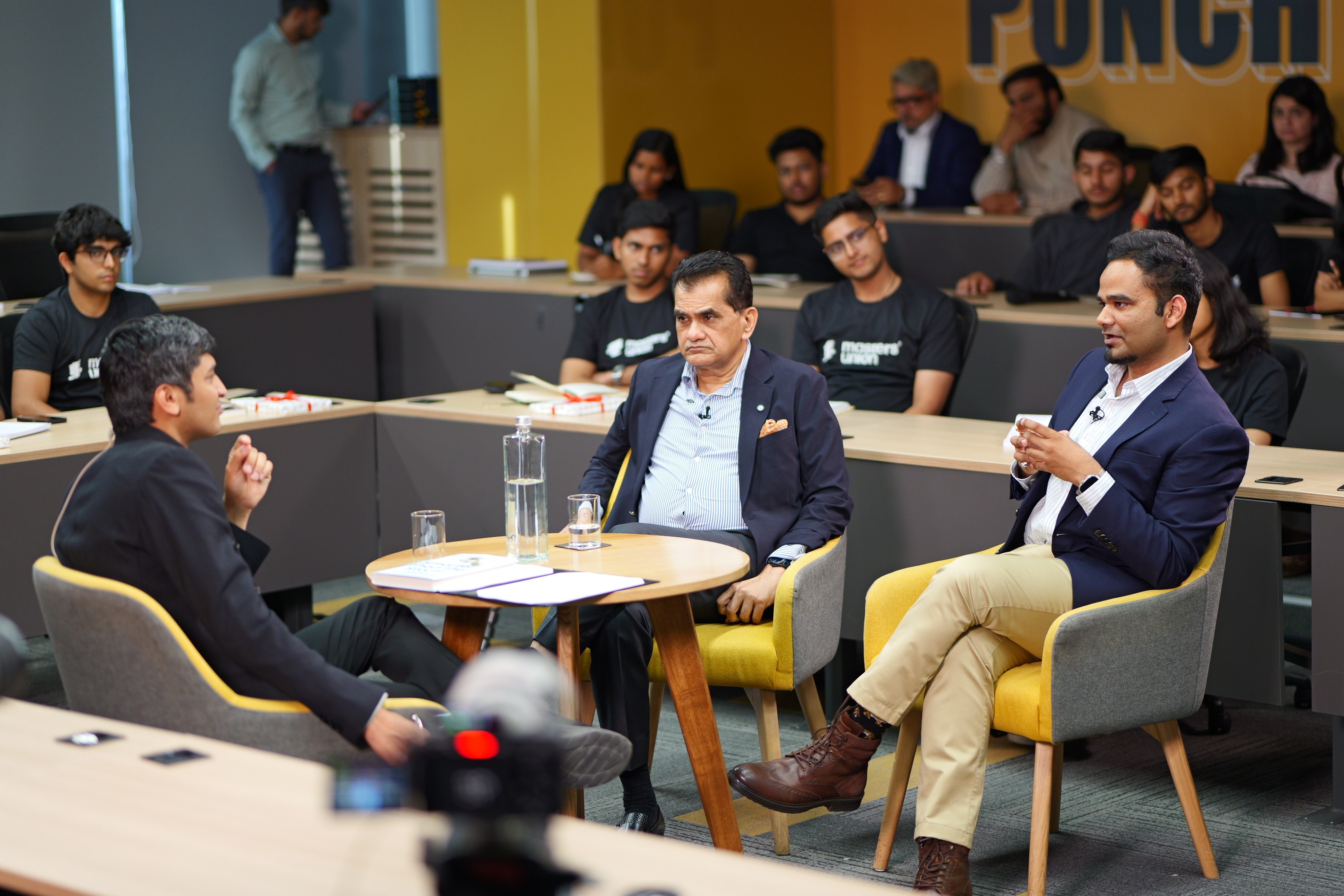
At a Masters’ Union session led by Pratham Mittal, Founder & CEO - Masters’ Union, with Amitabh Kant, former CEO, NITI Aayog, and Siddharth Sinha, AVP, Greenko Group, a clearer picture emerged. The next generation of climate startups in India will not come from isolated ideas. They will come from founders who understand how everyday problems connect through energy, data, and infrastructure.
Air quality stops being abstract the moment you check it before leaving home. Electricity stops being a background utility when your bill spikes in peak summer. And AI stops being a buzzword when you realise it is quietly shaping how both of these are managed behind the scenes. These are not separate problems. They are part of the same system, whether we notice it or not. The shift has already begun. Most people have not connected the dots yet.
Why Climate Startups in India Are Now a Deep Tech Opportunity
For a long time, climate businesses were seen as slow, policy-driven, and dependent on subsidies. That perception discouraged many founders. It no longer holds.
Today, climate problems demand technical depth. They involve modelling, optimisation, hardware integration, and large-scale data interpretation. This places them firmly in the domain of deep tech.
During the discussion, Amitabh Kant pointed out that artificial intelligence cannot scale without reliable energy. At the same time, clean energy systems cannot operate efficiently without intelligent optimisation. This creates a loop where both depend on each other.
This interdependence changes the nature of opportunity. Climate startups in India are no longer niche ventures. They are becoming core infrastructure businesses that underpin future economies.
Why Climate in India Is Now a Deep Tech and Systems Challenge:
-
Climate challenges now require deep technical capabilities
-
AI and energy systems are structurally linked
-
Climate startups are moving from niche to core infrastructure
How AI is Quietly Reshaping Climate Solutions in India
The most convincing way to understand this shift is through real examples. One case discussed was the creation of hyperlocal air quality data using mobile sensors. Instead of relying only on expensive monitoring stations, sensors were placed on buses moving across cities. These sensors collected continuous data, which was then combined with weather patterns and wind direction.
The result was not just more data, but better decisions. Cities could understand pollution at a granular level. Individuals could see real-time conditions in their immediate surroundings. This approach reflects a broader pattern. AI is not solving climate problems in isolation. It is enhancing existing systems by making them more responsive, adaptive, and precise.
Siddharth Sinha extended this idea to data centres. These facilities power AI models but consume significant energy. Their long-term viability depends on access to affordable and renewable power sources. This means that every AI breakthrough indirectly increases pressure on energy systems.
How AI Is Already Changing the Way India Understands Climate Data:
-
AI enables real-time, high-resolution environmental insights
-
Climate solutions are becoming data-driven rather than static
-
Growth in AI increases the urgency for clean energy systems
Energy Is Becoming the Starting Point for Climate Startups in India
Every major theme in the conversation eventually returned to energy. India’s dependence on imported batteries, solar components, and critical minerals highlights a structural gap. This gap is not only a policy concern. It is a business opportunity. Founders entering this space can build across multiple layers. They can work on generation through solar or wind. They can explore storage through battery innovation. They can optimise distribution using software and smart grids.
There is also a shift towards decentralisation. A single household can now produce energy through rooftop solar. The next step is aggregation, where entire communities become micro energy networks capable of producing, storing, and trading power. This transforms energy from a cost centre into a revenue opportunity.
Why Energy Infrastructure Is Defining the Next Wave of Climate Startups:
-
Energy systems define the future of climate entrepreneurship
-
Import dependence creates opportunities for local innovation
-
Decentralised energy models are becoming commercially viable
Why Capital Is Not the Real Constraint for Founders
Many students and early-stage founders believe that climate startups require large upfront capital, making them inaccessible. The discussion offered a more nuanced view. Capital is available, but it flows towards clarity. Investors are willing to support strong business models that demonstrate early viability. Family offices and domestic investors are increasingly active in backing new ventures.
The real challenge lies in translating ideas into structured opportunities that investors can understand and trust. This requires clear problem definition, measurable outcomes, and a path to scalability. In other words, capital follows conviction. Conviction comes from execution, not ambition alone.
Why Climate Startups Fail on Clarity, Not Capital:
-
Early-stage capital exists but demands clarity and structure
-
Investors are increasingly open to climate and deep tech ideas
-
Strong execution builds investor confidence
What Founders Miss About Governance and Systems Thinking
A less obvious but critical theme was governance. Amitabh Kant spoke about the aspirational districts programme, where performance was tracked using real-time data and clear outcomes. Districts improved not because of abstract goals, but because of measurable targets and constant comparison. This model is directly relevant to founders.
Climate startups often operate within public systems such as cities, utilities, and agricultural networks. Success in these environments requires understanding how governance works, how data flows, and how incentives are structured. Founders who ignore this layer struggle to scale. Those who engage with it can unlock far larger opportunities.
Why Governance Is a Hidden Layer in Climate Entrepreneurship:
-
Governance systems shape the success of climate solutions
-
Data transparency drives performance and accountability
-
Founders must build with system-level awareness
From Easy Ideas to Necessary Problems: A Shift in Founder Mindset
India’s startup ecosystem has grown rapidly by focusing on consumer convenience. Food delivery, e-commerce, and digital services have created massive value. But these sectors are now crowded.
The next wave of opportunity lies in areas that are harder to enter but far more impactful. Climate, energy, and deep tech fall into this category. These are not quick-build businesses. They require patience, technical understanding, and long-term thinking. But they also create defensibility and relevance that convenience-led models cannot match.
The conversation made one thing clear. The question for founders is no longer what can be built quickly. It is what needs to be built for the system to function in the future.
Why Founders Are Moving From Convenience to Necessity:
-
Convenience-driven sectors are reaching saturation
-
Climate and deep tech offer long-term, defensible opportunities
-
Founders must shift from speed to significance
Where This Leaves the Next Generation of Founders
The session closed with a focus on outcomes. Not ideas, not intent, but tangible results. The expectation was simple. If even a handful of startups emerge from this conversation, solving real problems in energy, climate, or infrastructure, the effort would have been worthwhile. For students and early founders, this creates a clear direction. Exposure to real-world systems, interdisciplinary thinking, and applied learning are no longer optional. They are prerequisites.
Masters’ Union is building programmes that place students inside these systems. Instead of learning about industries in theory, students engage with live problems across energy, technology, and business. The aim is not to encourage entrepreneurship as a trend. It is to prepare founders who can operate where complexity is unavoidable.
 QUERIES
Frequently Asked Questions
