


About us


-
See what students, mentors, alumni and recruiters say about Masters' Union University. Shared highlights and moments that reflect our culture, learning and community. Explore their voices.
OVERVIEW


-
See how Masters’ Union University is represented across leading news and media platforms. Explore articles, features, and press coverage that reflect our journey, initiatives, and growing impact in education, innovation, and industry engagement.
OVERVIEW

-
Explore the awards, rankings and accreditations that recognise the quality, impact and industry relevance of Masters' Union University programmes.
OVERVIEW

-
Explore the reports, brochures, policies, and publications that document Masters' Union University's outcomes, standards, and institutional commitments.
OVERVIEW


PROGRAMMEs
- Highlights
- Curriculum
- Admissions & Fees
- Immersions
- Entrepreneurship
- Careers
- Class Profile
PROGRAMME oVERVIEW
- Highlights
- Curriculum
- Admissions & Fees
- Immersions
- Entrepreneurship
- Career Prospects
- Class Profile
PROGRAMME oVERVIEW
- Highlights
- Curriculum & Faculty
- Immersions
- Admissions & Fees
- Career Prospects
- Class Profile
PROGRAMME oVERVIEW
- Highlights
- Curriculum
PROGRAMME oVERVIEW
- Home
PROGRAMME oVERVIEW
- Highlights
- Curriculum & Faculty
- Admissions & Fees
- Career Prospects
- Class Profile
PROGRAMME oVERVIEW
- Highlights
- Curriculum & Faculty
- Admissions & Fees
- Career Prospects
- Class Profile
PROGRAMME oVERVIEW
- Highlights
- Curriculum
- Admissions & Fees
- Career Prospects
- Class Profile
PROGRAMME oVERVIEW
PROGRAMMEs
- Highlights
- Curriculum & Faculty
- Admissions & Fees
- Career Prospects
- Class Profile
PROGRAMME oVERVIEW
- Highlights
- Curriculum & Faculty
- Admissions & Fees
- Career Prospects
- Class Profile
PROGRAMME oVERVIEW
- Highlights
- Curriculum
- Admissions & Fees
- Career Prospects
- Class Profile
PROGRAMME oVERVIEW
- Highlights
- Curriculum & Faculty
- Admissions & Fees
- Career Prospects
- Class Profile
PROGRAMME oVERVIEW
- Highlights
- Curriculum & Faculty
- Admissions & Fees
- Career Prospects
- Class Profile
PROGRAMME oVERVIEW
- Highlights
- Curriculum
- Admissions & Fees
- Career Prospects
- Class Profile
PROGRAMME oVERVIEW
- Highlights
- Curriculum
- Admissions & Fees
- Career Prospects
- Class Profile
PROGRAMME oVERVIEW
PROGRAMMES
-
PGP in
Technology & Business Management

-
PGP in
Technology & Business Management
(Young Leaders Cohort)
-
MBA in Finance with CFA Pathway
-
Post Graduate Diploma (Human Resources and Organisation Strategy)
-
Post Graduate Diploma (Sports Management and Gaming)
-
PGP in
Applied AI & Agentic Systems
-
PGP in Sustainability &
Business Management
-
Four Nations Global
Business Programme
- Highlights
- Curriculum
- Immersions
- Admissions & Fees
- Career Prospects
- Cohort Profile
PROGRAMME oVERVIEW
- Home
PROGRAMME OVERVIEW
- Highlights
- Curriculum
- Immersions
- Admissions & Fees
- Career Prospects
- Faculty & Student Stories
PROGRAMME oVERVIEW
- Highlights
- Curriculum
- Immersions
- Admissions & Fees
- Career Prospects
PROGRAMME oVERVIEW
- Highlights
- Curriculum & Faculty
- Admissions & Fees
- Career Prospects
PROGRAMME oVERVIEW
- Highlights
- Curriculum & Faculty
- Admissions & Fees
- Career Prospects
PROGRAMME OVERVIEW
- Highlights
- Curriculum & Faculty
- Admissions & Fees
PROGRAMME OVERVIEW
- Highlights
PROGRAMME OVERVIEW
- Highlights
- Curriculum
- Immersions
- Admissions & Fees
- Career Prospects
- Cohort Profile
PROGRAMME oVERVIEW
PROGRAMMES
-
Post Graduate Diploma (Rise General Management)
-
Post Graduate Diploma (Capital Markets & Trading)
-
PGP in US Capital Markets &
Trading
-
PGP
in Entrepreneurship & Business Acceleration
-
Post Graduate Diploma (Rise General Management Global)
-
AI First Operator Programme
-
Bloomberg Equity Research Programme
- Highlights
- Curriculum
- Faculty
- Admissions & Fees
- Career Prospects
- Cohort Profile
PROGRAMME oVERVIEW
- Home
PROGRAMME oVERVIEW
- Highlights
- Curriculum
- Admissions & Fees
PROGRAMME oVERVIEW
- Highlights
- Curriculum
- Admissions & Fees
PROGRAMME oVERVIEW
- Highlights
- Curriculum
- Immersions
- Faculty & Coaches
- Admissions & Fees
- Career Prospects
PROGRAMME oVERVIEW
- Highlights
- Curriculum
PROGRAMME oVERVIEW
- Home
PROGRAMME oVERVIEW
- Highlights
- Global Immersions
- Curriculum
- Faculty & Coaches
- Leadership Learning
- Admissions & Fees
PROGRAMME oVERVIEW
- Highlights
- Curriculum
- Admissions & Fees
PROGRAMME oVERVIEW
PROGRAMMES
- Highlights
- Curriculum
- Beyond Classroom
- Admissions & Fees
PROGRAMME oVERVIEW
- Highlights
- Curriculum
- Beyond Classroom
- Admissions & Fees
PROGRAMME oVERVIEW
- Home
PROGRAMME oVERVIEW
- Home
PROGRAMME oVERVIEW
PROGRAMMES
- Home
PROGRAMME oVERVIEW
- Highlights
- Curriculum
- Beyond Classroom
- Admissions & Fees
PROGRAMME oVERVIEW
- Home
PROGRAMME oVERVIEW
- Home
PROGRAMME oVERVIEW
STUDENT LIFE
- Student Premises
- Amenities
- Hostel Council
oVERVIEW


- Case Union
- UnMute
- Clubs & Committees
oVERVIEW


oVERVIEW

- Healthcare
- BFSI
- Technology
- Manufacturing
- Retail
Industry
- Governments
- Universities
- Startups
- SMEs
- Large Enterprises
Industry
oVERVIEW
PROGRAMMEs
- Highlights
- Curriculum & Faculty
- Admissions & Fees
- Career Prospects
- Class Profile
PROGRAMME oVERVIEW
- Highlights
- Curriculum & Faculty
- Admissions & Fees
- Career Prospects
- Class Profile
PROGRAMME oVERVIEW
- Highlights
- Curriculum
- Admissions & Fees
- Career Prospects
- Class Profile
PROGRAMME oVERVIEW
- Highlights
- Curriculum & Faculty
- Admissions & Fees
- Career Prospects
- Class Profile
PROGRAMME oVERVIEW
- Highlights
- Curriculum & Faculty
- Admissions & Fees
- Career Prospects
- Class Profile
PROGRAMME oVERVIEW
- Highlights
- Curriculum
- Admissions & Fees
- Career Prospects
- Class Profile
PROGRAMME oVERVIEW
- Highlights
- Curriculum
- Admissions & Fees
- Career Prospects
- Class Profile
PROGRAMME oVERVIEW
PROGRAMMES
- Highlights
- Curriculum
- Immersions
- Admissions & Fees
- Career Prospects
- Cohort Profile
PROGRAMME oVERVIEW
- Home
PROGRAMME OVERVIEW
- Highlights
- Curriculum
- Immersions
- Admissions & Fees
- Career Prospects
- Faculty & Student Stories
PROGRAMME oVERVIEW
- Highlights
- Curriculum
- Immersions
- Admissions & Fees
- Career Prospects
PROGRAMME oVERVIEW
- Highlights
- Curriculum & Faculty
- Admissions & Fees
- Career Prospects
PROGRAMME oVERVIEW
- Highlights
- Curriculum
- Immersions
- Admissions & Fees
- Career Prospects
- Cohort Profile
PROGRAMME oVERVIEW
PROGRAMMES
- Highlights
- Curriculum
- Faculty
- Admissions & Fees
- Career Prospects
- Cohort Profile
PROGRAMME oVERVIEW
- Highlights
- Curriculum
- Admissions & Fees
PROGRAMME oVERVIEW
- Highlights
- Curriculum
- Admissions & Fees
PROGRAMME oVERVIEW
- Highlights
- Curriculum
- Immersions
- Faculty & Coaches
- Admissions & Fees
- Career Prospects
PROGRAMME oVERVIEW
- Highlights
- Global Immersions
- Curriculum
- Faculty & Coaches
- Leadership Learning
- Admissions & Fees
PROGRAMME oVERVIEW
- Highlights
- Curriculum
- Admissions & Fees
PROGRAMME oVERVIEW


About Us

Undergraduate
Postgraduate
PGP in Technology & Business Management
PGP in Technology & Business Management
(Young Leaders Cohort)
MBA in Finance with CFA Pathway
Post Graduate Diploma (Human Resources and Organisation Strategy)
Post Graduate Diploma (Sports Management and Gaming)
PGP in Applied AI & Agentic Systems
PGP in Sustainability & Business Management
Four Nations Global Business Programme
Executive
Post Graduate Diploma (Rise General Management)
Post Graduate Diploma (Capital Markets & Trading)
PGP in US Capital Markets & Trading
PGP in Entrepreneurship & Business Acceleration
Post Graduate Diploma (Rise General Management Global)
AI First Operator Programme
Bloomberg Equity Research Programme
Family Business
Immersions
1:1 Executive Coaching
Careers
Innovations
Faculty
MU Ventures
Enterprise L&D
Student Life
Jobs
Become a Master
Merch Store
events
For Companies
Blog
Coach LMS
Campus Learnings
Business Idea Generation to Impact: Masterclass from GDi’s CEO
January 16, 2025
.jpg)
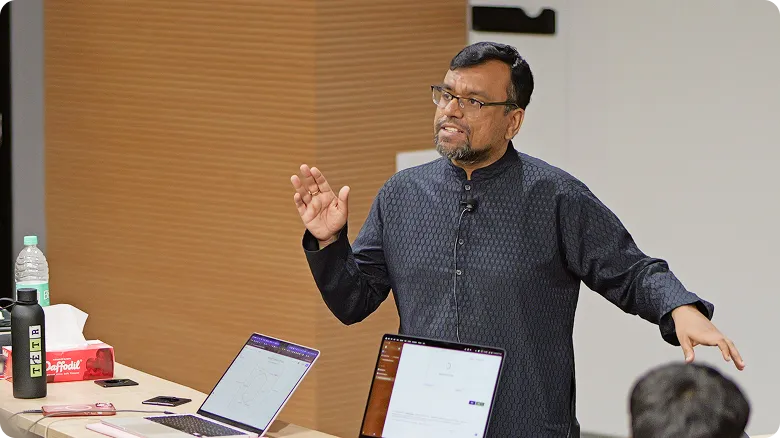
A top industry leader, Ankur Bansal, the founder and CEO of GDi Partners, recently shared his lessons on entrepreneurship and business with students at Masters’ Union. The session was a unique blend of intellectual challenge, professional insight, and career opportunity. It provided a direct look into the world of governance consulting and a new generation entrepreneurship. This was not just a pre-placement talk; it was a masterclass on how to build a career while creating meaningful societal impact. The collaboration between academia and industry is vital for equipping students to thrive in an ever-evolving landscape.
From Idea Generation to Action: A Masterclass in Entrepreneurship
The session kicked off with a compelling case study on "Governance Consulting for Entrepreneurship Generation." The challenge was designed by Ankur Bansal to push students beyond conventional thinking. He emphasized that the idea generation in entrepreneurship is not merely about coming up with a novel product. Instead, it’s about identifying a complex problem and then crafting an actionable framework to solve it. For a new generation entrepreneurship, the focus must be on creating an equitable and inclusive ecosystem. This approach shifts the emphasis from simply creating profit to building sustainable value.
Students were tasked with developing strategies for fostering entrepreneurial ventures while embedding principles of good governance. This challenge provided a practical application of the theoretical knowledge they have acquired. The idea generation process of entrepreneurship are deeply rooted in a problem-solving mindset, and the teams at Masters’ Union demonstrated this with their innovative presentations. They dissected multifaceted governance challenges and proposed tangible, impactful solutions. The executive noted that the quality of presentations highlighted creativity and vision, reflecting the analytical prowess and strategic thinking fostered at the institution.
The Methods of Generating Ideas in Entrepreneurship
The executive explained that there are various methods of generating ideas in entrepreneurship, but the most effective ones are grounded in real-world problems. They must focus on creating sustainable and scalable solutions.
.1. Problem Identification: This is the crucial first step. Identify a societal or market gap that is structurally complex. GDi Partners, for instance, focuses on complex governance issues that affect millions of lives. The initial step is to understand the problem in depth, often requiring extensive field research.
2. Stakeholder Analysis: Map out all relevant stakeholders—from government bodies and civil society organizations to the communities themselves. This provides a holistic view of the challenge and reveals potential implementation hurdles.
3. Solution Brainstorming: Generate ideas that are not only innovative but also practical and scalable within the existing governance framework. The executive noted that many excellent ideas fail because they lack a clear path to implementation or resource mobilization.
4. Prototyping and Testing: Develop a small-scale model of the solution and test it in a controlled environment to gather feedback. This iterative process is crucial for refining the final product or strategy and ensuring it meets real-world constraints.
Principles of Idea Execution
-
Entrepreneurial success starts with a deep understanding of a complex problem, not just a product idea
-
The idea generation process should be systematic, moving from detailed problem identification to scalable solutions
-
Practical application, as seen in the case study, is essential for transforming abstract ideas into tangible results and real impact
From Academia to Industry: A Gateway to a Career
The session was much more than an academic exercise; it was a direct gateway to career opportunities. Ankur Bansal highlighted how the case study competition served as a live interview, allowing him to see the students' skills in action. He announced the promise of an internship opportunity at GDi Partners for the winning team, raising the stakes and encouraging participants to bring their best. This practical approach, he explained, helps bridge the gap between education and industry expectations.
For students aspiring to an education consultant career or a role in governance, this session provided invaluable insight into a niche but rapidly growing field. Ankur Bansal gave a detailed pre-placement talk, offering a glimpse into GDi Partners’ culture, mission, and the type of talent they seek. He spoke about the firm's mission to drive sustainable change by leveraging private-sector dynamism to solve public-sector problems. He stressed that they look for individuals who are not just intellectually sharp but also driven by a desire for societal impact.
This alignment of values and capabilities is paramount for success in GDi. The lively Q&A session allowed students to delve deeper into the world of GDi Partners and gain clarity on what it takes to succeed in such a dynamic environment and align their aspirations with the available opportunities. The caliber of talent at Masters' Union was evident in the competition, showcasing future leaders.
Building a Career in Impact Consulting
The executive shared his philosophy on what it takes to build a successful career in a firm like GDi. This is not a typical corporate career; it demands a unique combination of skills.
1. Impact-Oriented Mindset: The primary motivation should be to create positive, large-scale change, thinking beyond quarterly financial results.
2. Analytical Rigor: The ability to dissect a complex, unstructured problem, analyze large and often messy data sets, and build a logical, evidence-based framework is non-negotiable.
3. Strategic Thinking: One must be able to see the bigger picture and connect seemingly disparate governance or socioeconomic elements to create a cohesive national or regional strategy.
4. Execution Focus: Ideas are only as good as their execution. The ability to work on-ground with government counterparts, manage stakeholders, and see a project through to completion is vital for a successful outcome. This requires resilience and a pragmatic approach.
Professional Blueprint for Impact
-
The case study served as a direct pathway, connecting academic performance with internship and career opportunities at GDi
-
The executive's talk provided a professional look into the firm's culture, focusing on mission-driven work and required skills
-
An impactful career in governance consulting requires a blend of high-level analytical skills, strategic thinking, and a strong drive for execution
The Vision in Action: Transforming Communities Through Governance
Beyond the case study, Ankur Bansal provided a powerful session on how GDi Partners turns its vision into reality. He drew on real-world examples to illustrate how the firm collaborates with governments and organizations to transform lives, bridge socioeconomic gaps, and drive sustainable change. He highlighted that good governance is not an abstract concept; it has a tangible ripple effect on individuals and societies, from improved education consultant career pathways to better public service delivery.
The executive's insights underscored the transformative power of a well-designed and properly implemented governance strategy. This segment inspired students to think beyond traditional corporate roles and consider the immense potential of mission-driven careers. The key, he explained, is to blend technical expertise with empathy and a deep commitment to on-the-ground execution. This holistic view is necessary for the new generation entrepreneurship that seeks to solve systemic problems. The collaboration with organizations is key to multiplying the impact across various sectors.
The session reinforced that success in this field means measuring impact not just in financial terms but in the number of lives positively affected. The executive's insights inspired students to think beyond the corporate sphere and towards societal betterment.
The Transformative Power of Governance Consulting
The field of governance consulting focuses on improving the structures and processes through which decisions are made and implemented. This has a profound effect on national and regional development.
Bridging Socioeconomic Gaps: Effective governance ensures that public resources are distributed equitably, leading to better outcomes for marginalized communities. This can involve reforming delivery systems for subsidies or essential services.
Driving Sustainable Change: By building robust, long-lasting systems rather than temporary fixes, firms like GDi ensure that the positive change persists long after the project team moves on. Sustainability is embedded into the very design of the solution.
Scaling Entrepreneurship: A well-governed system, as explored in the case study, provides a stable, transparent environment for idea generation in entrepreneurship to flourish. This accelerates economic development by reducing bureaucratic friction.
Mandate for Sustainable Impact
-
The firm's mission is to use governance consulting to transform communities and bridge socioeconomic gaps globally
-
The work relies on collaborating with governments to ensure solutions drive sustained, measurable change
-
Success is defined by the measurable, positive ripple effect of good governance on individuals and society
FAQs
Q1: Who is Ankur Bansal?
A: Ankur Bansal is the founder and CEO of GDi Partners, a governance consulting firm. He is an industry expert focused on creating impactful solutions to complex societal and governmental problems.
Q2: What is GDi Partners?
A: GDi Partners is a consulting firm that works with governments and development organizations to design and execute large-scale, impactful development programs. Its mission is to improve governance and create a more equitable world.
Q3: What are the main methods of generating ideas in entrepreneurship?
A: The main methods of generating ideas in entrepreneurship involve a structured process of problem identification, thorough stakeholder analysis, innovative solution brainstorming, and rigorous real-world prototyping to ensure practicality and scalability.
Q4: What is the idea generation process of entrepreneurship?
A: The idea generation process of entrepreneurship is a systematic approach that begins with identifying a significant, systemic problem. It then moves to understanding the needs of the community, brainstorming innovative solutions, and iteratively testing those solutions to ensure they are practical and scalable under governmental constraints.
Q5: What are the key skills needed for a new generation entrepreneurship career?
A: A successful career in a new generation entrepreneurship requires strong analytical skills, advanced strategic thinking, and an unwavering focus on execution. A deep-seated desire to create positive societal impact is also absolutely essential.
Q6: Can a career as an education consultant be impactful?
A: Absolutely. An education consultant career within a firm like GDi can be highly impactful, especially when working on large-scale government projects. Such a role involves designing strategies and programs that can significantly improve educational outcomes for millions of students across a region or nation.
Q7: What is the core difference between GDi and traditional consulting?
A: GDi Partners focuses specifically on governance consulting and social impact. Unlike many traditional firms, GDi works directly with government bodies to implement long-term solutions, driving tangible, sustained change rather than merely providing advisory reports.