


About us

-
See what students, mentors, alumni and recruiters say about Masters' Union University. Shared highlights and moments that reflect our culture, learning and community. Explore their voices.
OVERVIEW


-
See how Masters’ Union University is represented across leading news and media platforms. Explore articles, features, and press coverage that reflect our journey, initiatives, and growing impact in education, innovation, and industry engagement.
OVERVIEW
-
Explore the awards, rankings and accreditations that recognise the quality, impact and industry relevance of Masters' Union University programmes.
OVERVIEW
-
Explore the reports, brochures, policies, and publications that document Masters' Union University's outcomes, standards, and institutional commitments.
OVERVIEW


PROGRAMMEs
- Highlights
- Curriculum
- Admissions & Fees
- Immersions
- Entrepreneurship
- Careers
- Class Profile
PROGRAMME oVERVIEW
- Highlights
- Curriculum
- Admissions & Fees
- Immersions
- Entrepreneurship
- Career Prospects
- Class Profile
PROGRAMME oVERVIEW
- Highlights
- Curriculum & Faculty
- Immersions
- Admissions & Fees
- Career Prospects
- Class Profile
PROGRAMME oVERVIEW
- Highlights
- Curriculum
PROGRAMME oVERVIEW
- Home
PROGRAMME oVERVIEW
- Highlights
- Curriculum & Faculty
- Admissions & Fees
- Career Prospects
- Class Profile
PROGRAMME oVERVIEW
- Highlights
- Curriculum & Faculty
- Admissions & Fees
- Career Prospects
- Class Profile
PROGRAMME oVERVIEW
- Highlights
- Curriculum
- Admissions & Fees
- Career Prospects
- Class Profile
PROGRAMME oVERVIEW
PROGRAMMEs
- Highlights
- Curriculum & Faculty
- Admissions & Fees
- Career Prospects
- Class Profile
PROGRAMME oVERVIEW
- Highlights
- Curriculum & Faculty
- Admissions & Fees
- Career Prospects
- Class Profile
PROGRAMME oVERVIEW
- Highlights
- Curriculum
- Admissions & Fees
- Career Prospects
- Class Profile
PROGRAMME oVERVIEW
- Highlights
- Curriculum & Faculty
- Admissions & Fees
- Career Prospects
- Class Profile
PROGRAMME oVERVIEW
- Highlights
- Curriculum & Faculty
- Admissions & Fees
- Career Prospects
- Class Profile
PROGRAMME oVERVIEW
- Highlights
- Curriculum
- Admissions & Fees
- Career Prospects
- Class Profile
PROGRAMME oVERVIEW
- Highlights
- Curriculum
- Admissions & Fees
- Career Prospects
- Class Profile
PROGRAMME oVERVIEW
PROGRAMMES
-
PGP in
Technology & Business Management

-
PGP in
Technology & Business Management
(Young Leaders Cohort)
-
MBA in Finance with CFA Pathway
-
Post Graduate Diploma (Human Resources and Organisation Strategy)
-
Post Graduate Diploma (Sports Management and Gaming)
-
PGP in
Applied AI & Agentic Systems
-
PGP in Sustainability &
Business Management
-
Four Nations Global
Business Programme
- Highlights
- Curriculum
- Immersions
- Admissions & Fees
- Career Prospects
- Cohort Profile
PROGRAMME oVERVIEW
- Home
PROGRAMME OVERVIEW
- Highlights
- Curriculum
- Immersions
- Admissions & Fees
- Career Prospects
- Faculty & Student Stories
PROGRAMME oVERVIEW
- Highlights
- Curriculum
- Immersions
- Admissions & Fees
- Career Prospects
PROGRAMME oVERVIEW
- Highlights
- Curriculum & Faculty
- Admissions & Fees
- Career Prospects
PROGRAMME oVERVIEW
- Highlights
- Curriculum & Faculty
- Admissions & Fees
- Career Prospects
PROGRAMME OVERVIEW
- Highlights
- Curriculum & Faculty
- Admissions & Fees
PROGRAMME OVERVIEW
- Highlights
PROGRAMME OVERVIEW
- Highlights
- Curriculum
- Immersions
- Admissions & Fees
- Career Prospects
- Cohort Profile
PROGRAMME oVERVIEW
PROGRAMMES
-
Post Graduate Diploma (Rise General Management)
-
Post Graduate Diploma (Capital Markets & Trading)
-
PGP in US Capital Markets &
Trading
-
PGP
in Entrepreneurship & Business Acceleration
-
Post Graduate Diploma (Rise General Management Global)
-
AI First Operator Programme
-
Bloomberg Equity Research Programme
- Highlights
- Curriculum
- Faculty
- Admissions & Fees
- Career Prospects
- Cohort Profile
PROGRAMME oVERVIEW
- Home
PROGRAMME oVERVIEW
- Highlights
- Curriculum
- Admissions & Fees
PROGRAMME oVERVIEW
- Highlights
- Curriculum
- Admissions & Fees
PROGRAMME oVERVIEW
- Highlights
- Curriculum
- Immersions
- Faculty & Coaches
- Admissions & Fees
- Career Prospects
PROGRAMME oVERVIEW
- Highlights
- Curriculum
PROGRAMME oVERVIEW
- Home
PROGRAMME oVERVIEW
- Highlights
- Global Immersions
- Curriculum
- Faculty & Coaches
- Leadership Learning
- Admissions & Fees
PROGRAMME oVERVIEW
- Highlights
- Curriculum
- Admissions & Fees
PROGRAMME oVERVIEW
PROGRAMMES
- Highlights
- Curriculum
- Beyond Classroom
- Admissions & Fees
PROGRAMME oVERVIEW
- Highlights
- Curriculum
- Beyond Classroom
- Admissions & Fees
PROGRAMME oVERVIEW
- Home
PROGRAMME oVERVIEW
- Home
PROGRAMME oVERVIEW
PROGRAMMES
- Home
PROGRAMME oVERVIEW
- Highlights
- Curriculum
- Beyond Classroom
- Admissions & Fees
PROGRAMME oVERVIEW
- Home
PROGRAMME oVERVIEW
- Home
PROGRAMME oVERVIEW
STUDENT LIFE
- Student Premises
- Amenities
- Hostel Council
oVERVIEW


- Case Union
- UnMute
- Clubs & Committees
oVERVIEW

oVERVIEW
- Healthcare
- BFSI
- Technology
- Manufacturing
- Retail
Industry
- Governments
- Universities
- Startups
- SMEs
- Large Enterprises
Industry
oVERVIEW
PROGRAMMEs
- Highlights
- Curriculum & Faculty
- Admissions & Fees
- Career Prospects
- Class Profile
PROGRAMME oVERVIEW
- Highlights
- Curriculum & Faculty
- Admissions & Fees
- Career Prospects
- Class Profile
PROGRAMME oVERVIEW
- Highlights
- Curriculum
- Admissions & Fees
- Career Prospects
- Class Profile
PROGRAMME oVERVIEW
- Highlights
- Curriculum & Faculty
- Admissions & Fees
- Career Prospects
- Class Profile
PROGRAMME oVERVIEW
- Highlights
- Curriculum & Faculty
- Admissions & Fees
- Career Prospects
- Class Profile
PROGRAMME oVERVIEW
- Highlights
- Curriculum
- Admissions & Fees
- Career Prospects
- Class Profile
PROGRAMME oVERVIEW
- Highlights
- Curriculum
- Admissions & Fees
- Career Prospects
- Class Profile
PROGRAMME oVERVIEW
PROGRAMMES
- Highlights
- Curriculum
- Immersions
- Admissions & Fees
- Career Prospects
- Cohort Profile
PROGRAMME oVERVIEW
- Home
PROGRAMME OVERVIEW
- Highlights
- Curriculum
- Immersions
- Admissions & Fees
- Career Prospects
- Faculty & Student Stories
PROGRAMME oVERVIEW
- Highlights
- Curriculum
- Immersions
- Admissions & Fees
- Career Prospects
PROGRAMME oVERVIEW
- Highlights
- Curriculum & Faculty
- Admissions & Fees
- Career Prospects
PROGRAMME oVERVIEW
- Highlights
- Curriculum
- Immersions
- Admissions & Fees
- Career Prospects
- Cohort Profile
PROGRAMME oVERVIEW
PROGRAMMES
- Highlights
- Curriculum
- Faculty
- Admissions & Fees
- Career Prospects
- Cohort Profile
PROGRAMME oVERVIEW
- Highlights
- Curriculum
- Admissions & Fees
PROGRAMME oVERVIEW
- Highlights
- Curriculum
- Admissions & Fees
PROGRAMME oVERVIEW
- Highlights
- Curriculum
- Immersions
- Faculty & Coaches
- Admissions & Fees
- Career Prospects
PROGRAMME oVERVIEW
- Highlights
- Global Immersions
- Curriculum
- Faculty & Coaches
- Leadership Learning
- Admissions & Fees
PROGRAMME oVERVIEW
- Highlights
- Curriculum
- Admissions & Fees
PROGRAMME oVERVIEW


About Us

Undergraduate
Postgraduate
PGP in Technology & Business Management
PGP in Technology & Business Management
(Young Leaders Cohort)
MBA in Finance with CFA Pathway
Post Graduate Diploma (Human Resources and Organisation Strategy)
Post Graduate Diploma (Sports Management and Gaming)
PGP in Applied AI & Agentic Systems
PGP in Sustainability & Business Management
Four Nations Global Business Programme
Executive
Post Graduate Diploma (Rise General Management)
Post Graduate Diploma (Capital Markets & Trading)
PGP in US Capital Markets & Trading
PGP in Entrepreneurship & Business Acceleration
Post Graduate Diploma (Rise General Management Global)
AI First Operator Programme
Bloomberg Equity Research Programme
Family Business
Immersions
1:1 Executive Coaching
Careers
Innovations
Faculty
MU Ventures
Enterprise L&D
Student Life
Jobs
Become a Master
Merch Store
events
For Companies
Blog
Coach LMS
Business
Intel India’s MD at Masters’ Union on Guiding How to Lead Businesses with AI Evolution
November 11, 2025

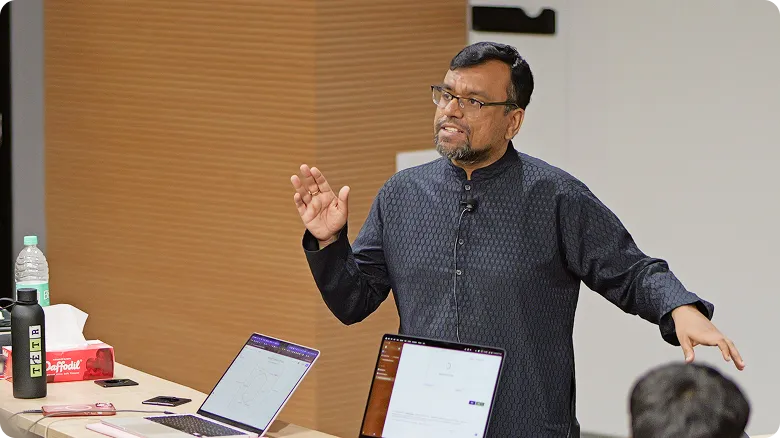
The future of business education lies in learning directly from those who are rewriting the rules of the industry. Masters’ Union hosted Santhosh Viswanathan, the Managing Director of Intel India, for a candid discussion on how artificial intelligence, ethics, and evolving talent needs are reshaping the modern workplace.
With over three decades of experience across biotech, FMCG, and media, he explored what it takes to stay relevant in an era where algorithms can outperform experience and adaptability defines success. The session offered a grounded view of how leaders and students alike can navigate transformation, not by resisting technology, but by learning to lead it.
AI in Business: Understanding the Real Impact
The conversation began with a sharp distinction between hype and application. Artificial intelligence isn’t a distant concept anymore; it’s reshaping every layer of the business model.
From LLMs that can draft scripts in minutes to automation reshaping creative workflows, AI is prompting companies to rethink value chains, job roles, and livelihoods. Yet, as Viswanathan pointed out, some developments are mere fads, while others will leave a lasting mark.
How companies can prepare for AI integration:
-
Embed AI into core processes, not as a parallel experiment
-
Upskill teams to understand LLMs and prompt engineering
-
Balance automation with human oversight and ethics
-
Use pilots to measure genuine productivity impact before scale
How Learning & Unlearning Technology by Leaders is Impacting Businesses
When asked what makes a great leader today, his response was both simple and revealing: excellence in skill, inspirational leadership, futuristic thinking, and a hint of maverick spirit.
He described exceptional leaders as those who dare to imagine the impossible, people who can picture 2050 and begin preparing today. The skill to anticipate, experiment, and adapt early is what sets visionary leaders apart from competent managers.
Key leadership traits for a changing world:
-
Deep understanding of the business model, not just function
-
Agility to roll up sleeves and work close to the consumer
-
Balance between realism and imagination, what he called maverism
-
Resilience to survive market cycles and stay grounded
Building Employer Value in a Transparent World
Students asked what attracts talent today. His answer: authenticity. In an age where Glassdoor reviews and LinkedIn chatter shape perception, brand image is no longer controlled by the organisation; it’s built by employees. He emphasised that employer value now lies in purpose and youth connection. “Even a hundred-year-old company must feel young,” he noted, citing Sony’s global rebrand to appeal to younger audiences.
Modern employer branding essentials:
-
Define a clear purpose beyond profit
-
Build authenticity through employee advocacy
-
Engage youth audiences with relevant, forward-looking narratives
-
Keep ethical and sustainable practices visible and verifiable
Adaptability and Super-Specialisation in Careers
Shifting across industries, from biotech to fintech to FMCG, he credited his journey to curiosity and business acumen. He emphasised that knowing your consumer is essential: being out of touch with them makes success impossible.
In the AI era, adaptability now means super-specialization. Mid-level managers must evolve from coordinators to doers, mastering deep skills that add tangible value.
For students entering the workforce:
-
Cultivate a deep skill that defines your professional identity
-
Learn the fundamentals of business models, not just job roles
-
Treat curiosity as currency; explore industries before committing
-
Balance learning breadth early with expertise depth later
AI Ethics, Deepfakes, and the Future of Work
The discussion turned to ethics, a pressing issue in technology today. He spoke about deepfake misuse in media and the urgent need for boundaries. From bans on AI-generated likenesses in California to internal policies in Indian media, the conversation highlighted the thin line between innovation and exploitation.
His message was clear: technology’s ethics are as vital as its efficiency. For the next generation of leaders, understanding where to draw that line will define both trust and sustainability.
Ethical guardrails for responsible innovation:
-
Establish transparent policies for AI content creation
-
Protect personal likeness and data through regulation
-
Use technology to enhance creativity, not replace humanity
From Volatility to Vision: What Remains Constant
Across industries, he observed that the fundamentals of leadership don’t change: performance, agility, and empathy remain constant. What shifts is the context. Stable sectors value experience and depth; fast-moving industries reward speed and experimentation.
His advice to students was straightforward but powerful: stick around long enough to witness the full cycle, true leadership comes from navigating both the peaks and the valleys.
The world of work is shifting faster than any syllabus can keep up. But as this conversation showed, the fundamentals endure: purpose, learning, and adaptability. AI may reshape jobs, but human judgement, empathy, and resilience remain irreplaceable.
At Masters’ Union, these sessions aim to prepare students not just for today’s workplace but for tomorrow’s possibilities, where technology and leadership move hand in hand.