


About us

-
See what students, mentors, alumni and recruiters say about Masters' Union University. Shared highlights and moments that reflect our culture, learning and community. Explore their voices.
OVERVIEW


-
See how Masters’ Union University is represented across leading news and media platforms. Explore articles, features, and press coverage that reflect our journey, initiatives, and growing impact in education, innovation, and industry engagement.
OVERVIEW
-
Explore the awards, rankings and accreditations that recognise the quality, impact and industry relevance of Masters' Union University programmes.
OVERVIEW
-
Explore the reports, brochures, policies, and publications that document Masters' Union University's outcomes, standards, and institutional commitments.
OVERVIEW


PROGRAMMEs
- Highlights
- Curriculum
- Admissions & Fees
- Immersions
- Entrepreneurship
- Careers
- Class Profile
PROGRAMME oVERVIEW
- Highlights
- Curriculum
- Admissions & Fees
- Immersions
- Entrepreneurship
- Career Prospects
- Class Profile
PROGRAMME oVERVIEW
- Highlights
- Curriculum & Faculty
- Immersions
- Admissions & Fees
- Career Prospects
- Class Profile
PROGRAMME oVERVIEW
- Highlights
- Curriculum
PROGRAMME oVERVIEW
- Home
PROGRAMME oVERVIEW
- Highlights
- Curriculum & Faculty
- Admissions & Fees
- Career Prospects
- Class Profile
PROGRAMME oVERVIEW
- Highlights
- Curriculum & Faculty
- Admissions & Fees
- Career Prospects
- Class Profile
PROGRAMME oVERVIEW
- Highlights
- Curriculum
- Admissions & Fees
- Career Prospects
- Class Profile
PROGRAMME oVERVIEW
PROGRAMMEs
- Highlights
- Curriculum & Faculty
- Admissions & Fees
- Career Prospects
- Class Profile
PROGRAMME oVERVIEW
- Highlights
- Curriculum & Faculty
- Admissions & Fees
- Career Prospects
- Class Profile
PROGRAMME oVERVIEW
- Highlights
- Curriculum
- Admissions & Fees
- Career Prospects
- Class Profile
PROGRAMME oVERVIEW
- Highlights
- Curriculum & Faculty
- Admissions & Fees
- Career Prospects
- Class Profile
PROGRAMME oVERVIEW
- Highlights
- Curriculum & Faculty
- Admissions & Fees
- Career Prospects
- Class Profile
PROGRAMME oVERVIEW
- Highlights
- Curriculum
- Admissions & Fees
- Career Prospects
- Class Profile
PROGRAMME oVERVIEW
- Highlights
- Curriculum
- Admissions & Fees
- Career Prospects
- Class Profile
PROGRAMME oVERVIEW
PROGRAMMES
-
PGP in
Technology & Business Management

-
PGP in
Technology & Business Management
(Young Leaders Cohort)
-
MBA in Finance with CFA Pathway
-
Post Graduate Diploma (Human Resources and Organisation Strategy)
-
Post Graduate Diploma (Sports Management and Gaming)
-
PGP in
Applied AI & Agentic Systems
-
PGP in Sustainability &
Business Management
-
Four Nations Global
Business Programme
- Highlights
- Curriculum
- Immersions
- Admissions & Fees
- Career Prospects
- Cohort Profile
PROGRAMME oVERVIEW
- Home
PROGRAMME OVERVIEW
- Highlights
- Curriculum
- Immersions
- Admissions & Fees
- Career Prospects
- Faculty & Student Stories
PROGRAMME oVERVIEW
- Highlights
- Curriculum
- Immersions
- Admissions & Fees
- Career Prospects
PROGRAMME oVERVIEW
- Highlights
- Curriculum & Faculty
- Admissions & Fees
- Career Prospects
PROGRAMME oVERVIEW
- Highlights
- Curriculum & Faculty
- Admissions & Fees
- Career Prospects
PROGRAMME OVERVIEW
- Highlights
- Curriculum & Faculty
- Admissions & Fees
PROGRAMME OVERVIEW
- Highlights
PROGRAMME OVERVIEW
- Highlights
- Curriculum
- Immersions
- Admissions & Fees
- Career Prospects
- Cohort Profile
PROGRAMME oVERVIEW
PROGRAMMES
-
Post Graduate Diploma (Rise General Management)
-
Post Graduate Diploma (Capital Markets & Trading)
-
PGP in US Capital Markets &
Trading
-
PGP
in Entrepreneurship & Business Acceleration
-
Post Graduate Diploma (Rise General Management Global)
-
AI First Operator Programme
-
Bloomberg Equity Research Programme
- Highlights
- Curriculum
- Faculty
- Admissions & Fees
- Career Prospects
- Cohort Profile
PROGRAMME oVERVIEW
- Home
PROGRAMME oVERVIEW
- Highlights
- Curriculum
- Admissions & Fees
PROGRAMME oVERVIEW
- Highlights
- Curriculum
- Admissions & Fees
PROGRAMME oVERVIEW
- Highlights
- Curriculum
- Immersions
- Faculty & Coaches
- Admissions & Fees
- Career Prospects
PROGRAMME oVERVIEW
- Highlights
- Curriculum
PROGRAMME oVERVIEW
- Home
PROGRAMME oVERVIEW
- Highlights
- Global Immersions
- Curriculum
- Faculty & Coaches
- Leadership Learning
- Admissions & Fees
PROGRAMME oVERVIEW
- Highlights
- Curriculum
- Admissions & Fees
PROGRAMME oVERVIEW
PROGRAMMES
- Highlights
- Curriculum
- Beyond Classroom
- Admissions & Fees
PROGRAMME oVERVIEW
- Highlights
- Curriculum
- Beyond Classroom
- Admissions & Fees
PROGRAMME oVERVIEW
- Home
PROGRAMME oVERVIEW
- Home
PROGRAMME oVERVIEW
PROGRAMMES
- Home
PROGRAMME oVERVIEW
- Highlights
- Curriculum
- Beyond Classroom
- Admissions & Fees
PROGRAMME oVERVIEW
- Home
PROGRAMME oVERVIEW
- Home
PROGRAMME oVERVIEW
STUDENT LIFE
- Student Premises
- Amenities
- Hostel Council
oVERVIEW


- Case Union
- UnMute
- Clubs & Committees
oVERVIEW

oVERVIEW
- Healthcare
- BFSI
- Technology
- Manufacturing
- Retail
Industry
- Governments
- Universities
- Startups
- SMEs
- Large Enterprises
Industry
oVERVIEW
PROGRAMMEs
- Highlights
- Curriculum & Faculty
- Admissions & Fees
- Career Prospects
- Class Profile
PROGRAMME oVERVIEW
- Highlights
- Curriculum & Faculty
- Admissions & Fees
- Career Prospects
- Class Profile
PROGRAMME oVERVIEW
- Highlights
- Curriculum
- Admissions & Fees
- Career Prospects
- Class Profile
PROGRAMME oVERVIEW
- Highlights
- Curriculum & Faculty
- Admissions & Fees
- Career Prospects
- Class Profile
PROGRAMME oVERVIEW
- Highlights
- Curriculum & Faculty
- Admissions & Fees
- Career Prospects
- Class Profile
PROGRAMME oVERVIEW
- Highlights
- Curriculum
- Admissions & Fees
- Career Prospects
- Class Profile
PROGRAMME oVERVIEW
- Highlights
- Curriculum
- Admissions & Fees
- Career Prospects
- Class Profile
PROGRAMME oVERVIEW
PROGRAMMES
- Highlights
- Curriculum
- Immersions
- Admissions & Fees
- Career Prospects
- Cohort Profile
PROGRAMME oVERVIEW
- Home
PROGRAMME OVERVIEW
- Highlights
- Curriculum
- Immersions
- Admissions & Fees
- Career Prospects
- Faculty & Student Stories
PROGRAMME oVERVIEW
- Highlights
- Curriculum
- Immersions
- Admissions & Fees
- Career Prospects
PROGRAMME oVERVIEW
- Highlights
- Curriculum & Faculty
- Admissions & Fees
- Career Prospects
PROGRAMME oVERVIEW
- Highlights
- Curriculum
- Immersions
- Admissions & Fees
- Career Prospects
- Cohort Profile
PROGRAMME oVERVIEW
PROGRAMMES
- Highlights
- Curriculum
- Faculty
- Admissions & Fees
- Career Prospects
- Cohort Profile
PROGRAMME oVERVIEW
- Highlights
- Curriculum
- Admissions & Fees
PROGRAMME oVERVIEW
- Highlights
- Curriculum
- Admissions & Fees
PROGRAMME oVERVIEW
- Highlights
- Curriculum
- Immersions
- Faculty & Coaches
- Admissions & Fees
- Career Prospects
PROGRAMME oVERVIEW
- Highlights
- Global Immersions
- Curriculum
- Faculty & Coaches
- Leadership Learning
- Admissions & Fees
PROGRAMME oVERVIEW
- Highlights
- Curriculum
- Admissions & Fees
PROGRAMME oVERVIEW


About Us

Undergraduate
Postgraduate
PGP in Technology & Business Management
PGP in Technology & Business Management
(Young Leaders Cohort)
MBA in Finance with CFA Pathway
Post Graduate Diploma (Human Resources and Organisation Strategy)
Post Graduate Diploma (Sports Management and Gaming)
PGP in Applied AI & Agentic Systems
PGP in Sustainability & Business Management
Four Nations Global Business Programme
Executive
Post Graduate Diploma (Rise General Management)
Post Graduate Diploma (Capital Markets & Trading)
PGP in US Capital Markets & Trading
PGP in Entrepreneurship & Business Acceleration
Post Graduate Diploma (Rise General Management Global)
AI First Operator Programme
Bloomberg Equity Research Programme
Family Business
Immersions
1:1 Executive Coaching
Careers
Innovations
Faculty
MU Ventures
Enterprise L&D
Student Life
Jobs
Become a Master
Merch Store
events
For Companies
Blog
Coach LMS
Business
Indian Oil Ex-Chairman & Abbott India MD on Crisis Management
October 27, 2025
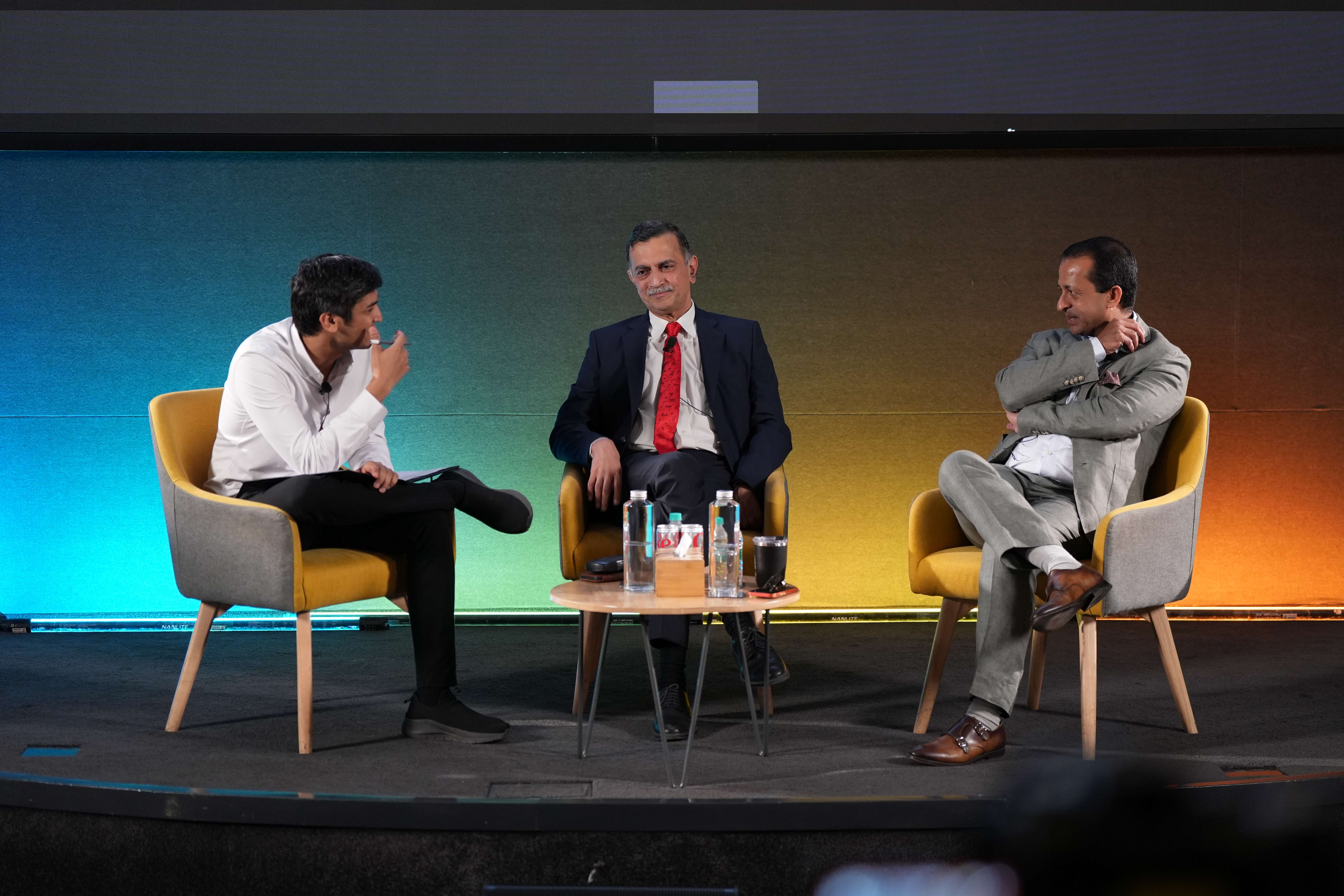
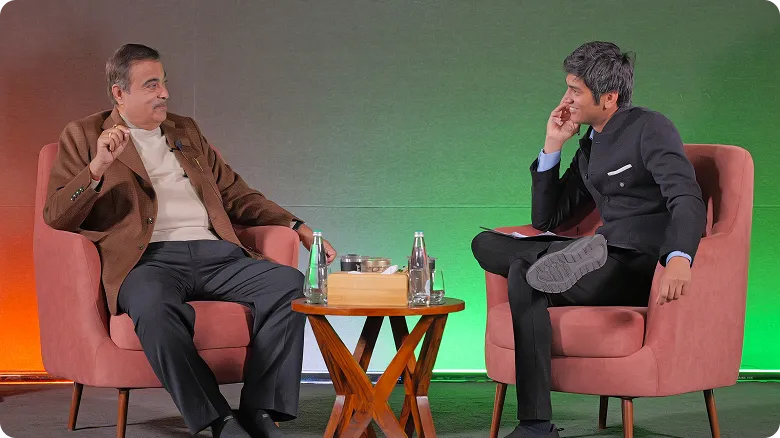
At Masters’ Union’s recent fireside chat, Mr. Shrikant M. Vaidya, Former Chairman of Indian Oil Corporation, and Mr. Neil George, Managing Director of Abbott India, shared their leadership journeys in a conversation hosted by Pratham Mittal, Founder of Masters’ Union.
The session explored powerful leadership lessons drawn from the energy and healthcare industries, focusing on how to manage crises, drive innovation, and build sustainable careers in dynamic environments.
Often perceived as traditional sectors where decisions are made with caution, these industries revealed a different side: one shaped by agility, resilience, and strategic foresight. The conversation offered students a rare insider’s view into how top leaders navigate challenges and lead with impact.
Here’s what aspiring professionals can take away from this insightful session to build a stellar career.
Crisis Leadership in Energy: Lessons from Indian Oil Ex-Chairman
Shrikant Vaidya recounted how Indian Oil navigated the COVID-19 oxygen shortage, oil price shocks, and long-term refinery investments. The session highlighted the importance of resilience, foresight, and ethical responsibility. He emphasised that crisis management is not about individual heroics but about building systems, empowering teams, and making fast, informed decisions.
Approaches to managing high-pressure situations
-
Establish informal data and communication networks for rapid response
-
Prioritise critical risks: human life, reputation, asset value, and legality
-
Make decisive moves even when there are financial implications
Innovation and Impact in Healthcare: Lessons from Abbott MD
Neil George shared how Abbott India tackled challenges in R&D, nutrition, and regulatory landscapes. He highlighted innovation in product development, efficient distribution channels, and navigating compliance while keeping patient welfare central. He also discussed leveraging technology for scalability and maintaining quality in regulated markets.
Guiding principles for driving healthcare impact
-
Invest in R&D to address unmet patient needs
-
Build robust distribution for consistent reach across geographies
-
Align compliance with innovation to safeguard reputation and quality
-
Adapt global solutions to local market conditions
Cross-Sector Leadership Insights
The discussion revealed parallels between Shrikant Vaidya’s and Niel George’s experiences. Both sectors require long-term vision, careful risk-taking, and stakeholder trust. Students were encouraged to compare fast-growth industries like e-commerce with slow-compounding sectors such as energy and healthcare, recognising that leadership skills are transferable but must be contextually applied.
How students can apply cross-sector insights
-
Recognise differences in industry pace and capital cycles
-
Balance short-term agility with long-term strategic planning
-
Build trust as the foundation for sustainable growth
-
Apply lessons from one sector to innovate responsibly in another
Building a Career: Skill, Will, and Commitment
Both leaders emphasised that success requires skill, continuous learning and will the determination to act. They advised students to choose between depth or breadth early in their careers, remain disciplined, and focus on long-term contribution rather than immediate recognition.
Practical guidance for career development
-
Develop both skill (through learning) and will (through disciplined application)
-
Remain open to feedback and adaptability in early years
-
Decide between generalist and specialist paths early on
-
Commit to long-term growth and consistency to reach leadership
Nurturing Teams and Organisational Culture
Shrikant Vaidya reflected on Indian Oil’s workforce culture, while Niel George spoke about Abbott India’s teams. Both emphasised that people are the true assets. Training, retention, and nurturing relationships drive operational excellence and ensure continuity in leadership and business practices.
Effective ways to manage people and culture
-
Retain and empower experienced employees for knowledge continuity
-
Foster respect, empathy, and accountability
-
Align operational discipline with human-centric leadership
Strategic Decision-Making in Complex Industries
Both speakers highlighted the need for calculated risks. Shrikant Vaidya cited Indian Oil’s ₹1.5 lakh crore refinery expansion, while Niel George discussed Abbott’s investment in localised R&D and nutrition programmes. Long-term strategy, combined with responsible risk management, ensures sustainable growth in any sector.
Principles for making strategic business decisions
-
Invest ahead of immediate returns for market leadership
-
Balance profitability with societal or environmental impact
-
Monitor long-term trends and act proactively rather than reactively
Staying Focused Amid Distractions
Shukla warned against being consumed by social media or superficial metrics. Leaders must prioritise attention and effort on meaningful work, focusing on their plan while filtering out noise.
Focus and attention management
-
Limit distractions from social media and external noise
-
Stick to documented plans with clear goals and mitigation strategies
-
Seek guidance from mentors while remaining accountable
Build A Leadership Mindset with Masters’ Union
The fireside chat at Masters’ Union illustrated that leadership is tested in uncertainty, whether managing national energy supply, pioneering healthcare innovation, or scaling complex businesses. Shrikant Vaidya and Neil George showed that resilience, foresight, and people-centric decision-making define enduring impact. Students were encouraged to cultivate skill and will, invest in relationships, and align short-term actions with long-term vision.
Leadership, as these industry stalwarts demonstrated, is not only about managing operations but it’s about shaping ecosystems, nurturing people, and making decisions that endure well beyond the boardroom.