


About us


-
See what students, mentors, alumni and recruiters say about Masters' Union University. Shared highlights and moments that reflect our culture, learning and community. Explore their voices.
OVERVIEW


-
See how Masters’ Union University is represented across leading news and media platforms. Explore articles, features, and press coverage that reflect our journey, initiatives, and growing impact in education, innovation, and industry engagement.
OVERVIEW

-
Explore the awards, rankings and accreditations that recognise the quality, impact and industry relevance of Masters' Union University programmes.
OVERVIEW

-
Explore the reports, brochures, policies, and publications that document Masters' Union University's outcomes, standards, and institutional commitments.
OVERVIEW


PROGRAMMEs
- Highlights
- Curriculum
- Admissions & Fees
- Immersions
- Entrepreneurship
- Careers
- Class Profile
PROGRAMME oVERVIEW
- Highlights
- Curriculum
- Admissions & Fees
- Immersions
- Entrepreneurship
- Career Prospects
- Class Profile
PROGRAMME oVERVIEW
- Highlights
- Curriculum & Faculty
- Immersions
- Admissions & Fees
- Career Prospects
- Class Profile
PROGRAMME oVERVIEW
- Highlights
- Curriculum
PROGRAMME oVERVIEW
- Home
PROGRAMME oVERVIEW
- Highlights
- Curriculum & Faculty
- Admissions & Fees
- Career Prospects
- Class Profile
PROGRAMME oVERVIEW
- Highlights
- Curriculum & Faculty
- Admissions & Fees
- Career Prospects
- Class Profile
PROGRAMME oVERVIEW
- Highlights
- Curriculum
- Admissions & Fees
- Career Prospects
- Class Profile
PROGRAMME oVERVIEW
PROGRAMMEs
- Highlights
- Curriculum & Faculty
- Admissions & Fees
- Career Prospects
- Class Profile
PROGRAMME oVERVIEW
- Highlights
- Curriculum & Faculty
- Admissions & Fees
- Career Prospects
- Class Profile
PROGRAMME oVERVIEW
- Highlights
- Curriculum
- Admissions & Fees
- Career Prospects
- Class Profile
PROGRAMME oVERVIEW
- Highlights
- Curriculum & Faculty
- Admissions & Fees
- Career Prospects
- Class Profile
PROGRAMME oVERVIEW
- Highlights
- Curriculum & Faculty
- Admissions & Fees
- Career Prospects
- Class Profile
PROGRAMME oVERVIEW
- Highlights
- Curriculum
- Admissions & Fees
- Career Prospects
- Class Profile
PROGRAMME oVERVIEW
- Highlights
- Curriculum
- Admissions & Fees
- Career Prospects
- Class Profile
PROGRAMME oVERVIEW
PROGRAMMES
-
PGP in
Technology & Business Management

-
PGP in
Technology & Business Management
(Young Leaders Cohort)
-
MBA in Finance with CFA Pathway
-
Post Graduate Diploma (Human Resources and Organisation Strategy)
-
Post Graduate Diploma (Sports Management and Gaming)
-
PGP in
Applied AI & Agentic Systems
-
PGP in Sustainability &
Business Management
-
Four Nations Global
Business Programme
- Highlights
- Curriculum
- Immersions
- Admissions & Fees
- Career Prospects
- Cohort Profile
PROGRAMME oVERVIEW
- Home
PROGRAMME OVERVIEW
- Highlights
- Curriculum
- Immersions
- Admissions & Fees
- Career Prospects
- Faculty & Student Stories
PROGRAMME oVERVIEW
- Highlights
- Curriculum
- Immersions
- Admissions & Fees
- Career Prospects
PROGRAMME oVERVIEW
- Highlights
- Curriculum & Faculty
- Admissions & Fees
- Career Prospects
PROGRAMME oVERVIEW
- Highlights
- Curriculum & Faculty
- Admissions & Fees
- Career Prospects
PROGRAMME OVERVIEW
- Highlights
- Curriculum & Faculty
- Admissions & Fees
PROGRAMME OVERVIEW
- Highlights
PROGRAMME OVERVIEW
- Highlights
- Curriculum
- Immersions
- Admissions & Fees
- Career Prospects
- Cohort Profile
PROGRAMME oVERVIEW
PROGRAMMES
-
Post Graduate Diploma (Rise General Management)
-
Post Graduate Diploma (Capital Markets & Trading)
-
PGP in US Capital Markets &
Trading
-
PGP
in Entrepreneurship & Business Acceleration
-
Post Graduate Diploma (Rise General Management Global)
-
AI First Operator Programme
-
Bloomberg Equity Research Programme
- Highlights
- Curriculum
- Faculty
- Admissions & Fees
- Career Prospects
- Cohort Profile
PROGRAMME oVERVIEW
- Home
PROGRAMME oVERVIEW
- Highlights
- Curriculum
- Admissions & Fees
PROGRAMME oVERVIEW
- Highlights
- Curriculum
- Admissions & Fees
PROGRAMME oVERVIEW
- Highlights
- Curriculum
- Immersions
- Faculty & Coaches
- Admissions & Fees
- Career Prospects
PROGRAMME oVERVIEW
- Highlights
- Curriculum
PROGRAMME oVERVIEW
- Home
PROGRAMME oVERVIEW
- Highlights
- Global Immersions
- Curriculum
- Faculty & Coaches
- Leadership Learning
- Admissions & Fees
PROGRAMME oVERVIEW
- Highlights
- Curriculum
- Admissions & Fees
PROGRAMME oVERVIEW
PROGRAMMES
- Highlights
- Curriculum
- Beyond Classroom
- Admissions & Fees
PROGRAMME oVERVIEW
- Highlights
- Curriculum
- Beyond Classroom
- Admissions & Fees
PROGRAMME oVERVIEW
- Home
PROGRAMME oVERVIEW
- Home
PROGRAMME oVERVIEW
PROGRAMMES
- Home
PROGRAMME oVERVIEW
- Highlights
- Curriculum
- Beyond Classroom
- Admissions & Fees
PROGRAMME oVERVIEW
- Home
PROGRAMME oVERVIEW
- Home
PROGRAMME oVERVIEW
STUDENT LIFE
- Student Premises
- Amenities
- Hostel Council
oVERVIEW


- Case Union
- UnMute
- Clubs & Committees
oVERVIEW



oVERVIEW

- Healthcare
- BFSI
- Technology
- Manufacturing
- Retail
Industry
- Governments
- Universities
- Startups
- SMEs
- Large Enterprises
Industry
oVERVIEW
PROGRAMMEs
- Highlights
- Curriculum & Faculty
- Admissions & Fees
- Career Prospects
- Class Profile
PROGRAMME oVERVIEW
- Highlights
- Curriculum & Faculty
- Admissions & Fees
- Career Prospects
- Class Profile
PROGRAMME oVERVIEW
- Highlights
- Curriculum
- Admissions & Fees
- Career Prospects
- Class Profile
PROGRAMME oVERVIEW
- Highlights
- Curriculum & Faculty
- Admissions & Fees
- Career Prospects
- Class Profile
PROGRAMME oVERVIEW
- Highlights
- Curriculum & Faculty
- Admissions & Fees
- Career Prospects
- Class Profile
PROGRAMME oVERVIEW
- Highlights
- Curriculum
- Admissions & Fees
- Career Prospects
- Class Profile
PROGRAMME oVERVIEW
- Highlights
- Curriculum
- Admissions & Fees
- Career Prospects
- Class Profile
PROGRAMME oVERVIEW
PROGRAMMES
- Highlights
- Curriculum
- Immersions
- Admissions & Fees
- Career Prospects
- Cohort Profile
PROGRAMME oVERVIEW
- Home
PROGRAMME OVERVIEW
- Highlights
- Curriculum
- Immersions
- Admissions & Fees
- Career Prospects
- Faculty & Student Stories
PROGRAMME oVERVIEW
- Highlights
- Curriculum
- Immersions
- Admissions & Fees
- Career Prospects
PROGRAMME oVERVIEW
- Highlights
- Curriculum & Faculty
- Admissions & Fees
- Career Prospects
PROGRAMME oVERVIEW
- Highlights
- Curriculum
- Immersions
- Admissions & Fees
- Career Prospects
- Cohort Profile
PROGRAMME oVERVIEW
PROGRAMMES
- Highlights
- Curriculum
- Faculty
- Admissions & Fees
- Career Prospects
- Cohort Profile
PROGRAMME oVERVIEW
- Highlights
- Curriculum
- Admissions & Fees
PROGRAMME oVERVIEW
- Highlights
- Curriculum
- Admissions & Fees
PROGRAMME oVERVIEW
- Highlights
- Curriculum
- Immersions
- Faculty & Coaches
- Admissions & Fees
- Career Prospects
PROGRAMME oVERVIEW
- Highlights
- Global Immersions
- Curriculum
- Faculty & Coaches
- Leadership Learning
- Admissions & Fees
PROGRAMME oVERVIEW
- Highlights
- Curriculum
- Admissions & Fees
PROGRAMME oVERVIEW


About Us

Undergraduate
Postgraduate
PGP in Technology & Business Management
PGP in Technology & Business Management
(Young Leaders Cohort)
MBA in Finance with CFA Pathway
Post Graduate Diploma (Human Resources and Organisation Strategy)
Post Graduate Diploma (Sports Management and Gaming)
PGP in Applied AI & Agentic Systems
PGP in Sustainability & Business Management
Four Nations Global Business Programme
Executive
Post Graduate Diploma (Rise General Management)
Post Graduate Diploma (Capital Markets & Trading)
PGP in US Capital Markets & Trading
PGP in Entrepreneurship & Business Acceleration
Post Graduate Diploma (Rise General Management Global)
AI First Operator Programme
Bloomberg Equity Research Programme
Family Business
Immersions
1:1 Executive Coaching
Careers
Innovations
Faculty
MU Ventures
Enterprise L&D
Student Life
Jobs
Become a Master
Merch Store
events
For Companies
Blog
Coach LMS
Business
Accenture Managing Director on AI in Consulting | Masters’ Union
December 18, 2025
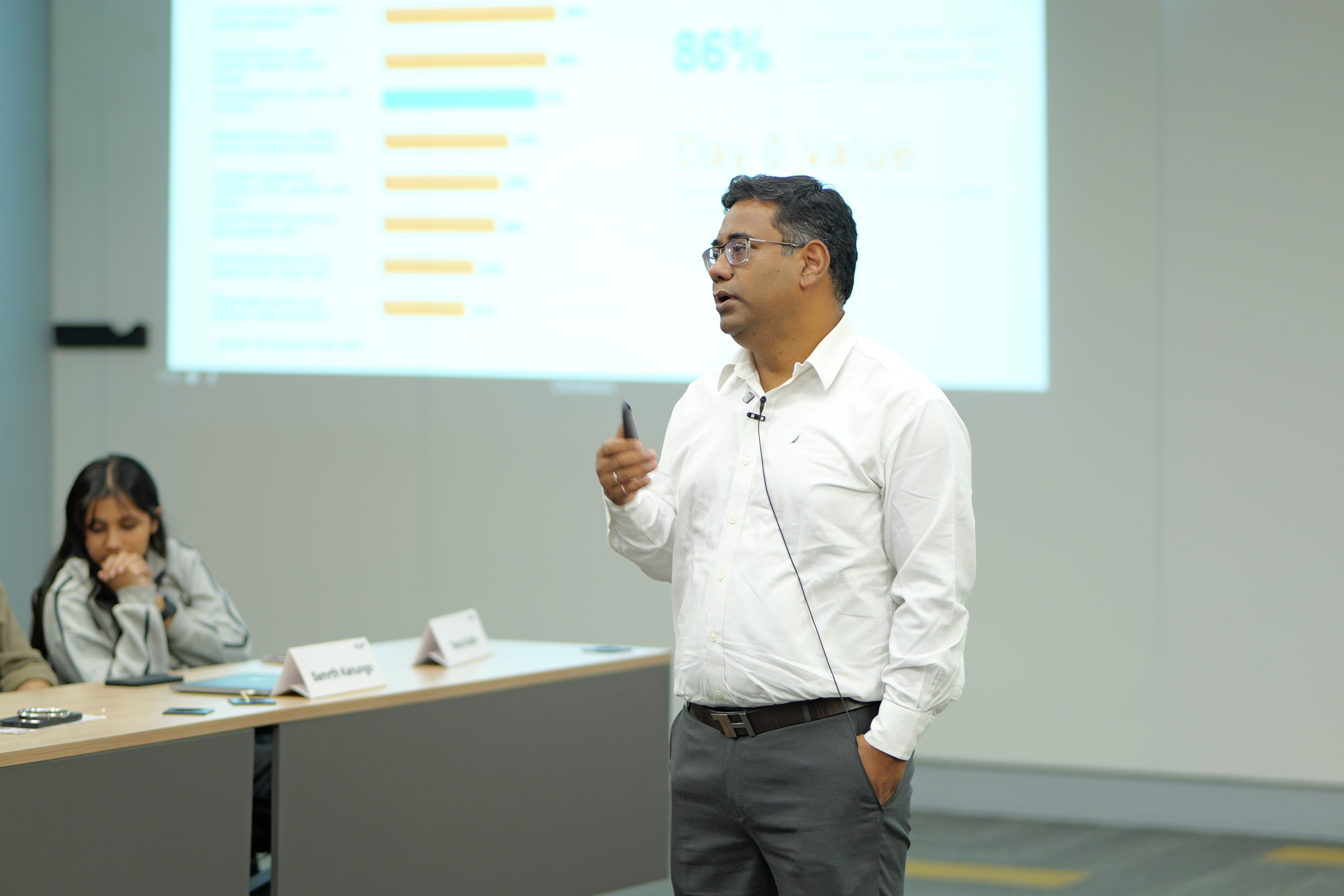
Consulting is no longer about diagnosing what went wrong but about designing the rescue playbook with AI.
Masters’ Union’s recent CXO Series session hosted Accenture’s Managing Director, Arijit Sur, Strategy practice, to speak about how AI is reshaping consulting as a career, and business models in real time.
The session addressed uncomfortable realities: shrinking project timelines, eroding differentiation and a consulting industry under pressure to reinvent itself.
Read ahead to know how to target consulting roles, what’s emerging, what remains constant, and where future value will be created.
How AI Became Non-Negotiable for Consulting Firms
Talking about Accenture, MD Arijit Sur explained that consulting firms are not spending on AI because it’s trendy. They are investing in AI because the consulting economics have shifted.
A decade ago, strategy projects ran for weeks. Today, clients expect similar outputs in a fraction of the time. In many cases, early-stage work is delivered at minimal or no cost just to remain competitive. Once one firm accelerates delivery, others must follow or risk exclusion.
AI has compressed consulting timelines and intensified competition, making efficiency a prerequisite for survival rather than a differentiator.
Consultancies Emerging Economics with AI
-
Project timelines have shortened drastically
-
Clients expect faster insights with the same rigour
-
Competitive advantages disappear quickly
-
Efficiency now determines relevance
Understand Consulting Firm Models with AI Adaption
In consulting, there are no patents protecting methods. Ideas travel fast, and differentiation is temporary. The firms that hesitate are quickly left behind.
Arijit Sur pointed to how early adoption by leading firms triggered a chain reaction across the industry.
Sur shared, McKinsey launched internal AI platforms accessed widely across its workforce. BCG built AI-focused divisions and committed to long-term investment. Accenture announced multi-billion-dollar spending on GenAI tools, talent, and platforms. Once these moves were made, others had no choice but to respond.
What Triggered the AI Race in Consulting
-
Early movers gained short-term speed advantages
-
Client expectations reset across the industry
-
AI became a baseline capability
-
Late adoption increased the risk of irrelevance
AI Value Chain in Consulting: Where Firms Create and Lose Value
Consulting no longer owns information. Its value lies in interpretation, judgment, and execution.
One of the most grounding insights from the session was Sur’s explanation of the AI value chain.
Most value today is captured at the lower layers: hardware manufacturers, cloud infrastructure providers, and foundation model builders. Consulting firms sit at the top, where value is thinner, and competition is intense.
This creates pressure from both directions. Companies below consultants are moving upward with platforms and AI services, while clients question why they need consultants when tools are increasingly accessible.
Understanding the AI Value Pyramid
-
Hardware and cloud players capture the largest share
-
Foundation models scale knowledge rapidly
-
Applications embed AI into workflows
-
Consultants compete on insight and context
How AI is Changing Consulting Work on the Ground
Beyond speed, the nature of improvement is changing. Instead of retrospective dashboards, AI-driven systems can predict issues before they surface, enabling proactive decision-making.
Arijit Sur walked students through a typical consulting engagement, from problem identification to continuous improvement. AI is already transforming the early stages.
Research, benchmarking, proposal creation, and data analysis are increasingly automated. Tasks that once required large junior teams can now be completed far more quickly with AI-enabled tools.
For students, this signals a shift in early consulting roles, away from manual execution and toward critical evaluation.
Consulting Work is Being Rewired
-
Research and benchmarking are automated first
-
Proposal building requires less manual effort
-
Continuous improvement becomes predictive
-
Junior roles focus more on judgment
Speed, Pricing, and the Consulting Business Model
MD Sur also highlighted a tension students rarely see: how consulting firms price their work.
While firms aspire to charge based on outcomes delivered, competition often forces pricing to be tied to effort and headcount. AI temporarily changes this equation by enabling faster results, allowing firms to argue for higher value based on speed.
However, this advantage rarely lasts. Competitors quickly catch up, and pricing pressure returns.
The Consulting Pricing Dilemma
-
Outcome-based pricing is difficult to sustain
-
Effort-based pricing remains dominant
-
AI enables faster delivery, not lasting premiums
-
Speed advantages are short-lived
Consulting Careers Are Shifting from Pyramid to Diamond
Traditional consulting firms relied on pyramids, where large cohorts of junior analysts handled execution-heavy work under a small group of senior leaders, creating clear entry points and long apprenticeship paths. As AI automates routine research, the base of the pyramid is shrinking. Firms risk becoming diamond-shaped, with a narrower entry layer, a concentration of mid-to-senior specialists, and fewer purely junior roles.
This raises challenges around talent development, progression, and leadership pipelines. Experience can no longer be built solely through repetitive execution.
AI Reinventing Consulting Careers and Promotion Models
-
Analyst-heavy models are shrinking
-
Middle layers are harder to build
-
Knowledge alone no longer defines seniority
-
Judgment and problem framing gain importance
Core Consulting Skills in the AI Era: Skills, Careers, and AI Impact
The CXO Series at Masters’ Union bridges classroom learning with real-world industry shifts. Arijit Sur’s session presented consulting as it operates today: faster, more competitive, and reshaped by AI. For PGP students, the key takeaway was not that consulting is disappearing, but that success now depends on how well one adapts as technology changes the nature of work.
Despite disruption, several consulting fundamentals remain constant. Structured thinking continues to sit at the core of the profession, including the ability to break down ambiguity, frame problems clearly, and communicate insights with precision. What has changed is how these skills are applied. Consultants must now understand how AI affects their clients’ businesses, not just their own workflows. The ability to question, guide, and validate AI-generated outputs is becoming essential, along with translating insights into clear decisions.
Inside Modern Consulting: Skills, Careers, and AI Impact
-
Structured problem-solving
-
Understanding AI’s business impact
-
Prompting and contextual judgment
-
Translating insights into decisions
Can AI Replace Consultants?
As an Accenture MD, Sur addressed this question directly. Today’s AI accelerates work, but it does not own accountability.
AI systems can hallucinate, misread context, and present confident but incorrect outputs. Responsibility for decisions, ethics, and outcomes remains with humans.
For now, AI is an enabler rather than a replacement. Consultants who rely on it blindly risk failure.
Limits of AI in Consulting Today
-
AI accelerates, but does not decide
-
Hallucination remains a real risk
-
Accountability stays with humans
-
Judgment cannot be fully automated
FAQs
-
What was the focus of Arijit Sur’s CXO Series session at Masters’ Union?
The session explored how AI is transforming consulting work, career paths, and business models, with direct relevance for PGP students. -
How is AI changing consulting careers?
AI is automating research and analysis, shifting consulting roles toward judgment, problem framing, and client-facing decision-making. -
Will AI replace consultants in the future?
Currently, AI acts as an accelerator, not a replacement. Consultants remain responsible for accountability and strategic judgment. -
What skills should PGP students focus on for consulting roles?
Structured thinking, understanding AI’s impact on business, prompt engineering, and translating insights into action. -
Why are consulting firms investing heavily in AI?
To remain competitive in an industry where speed, efficiency, and adaptability now define relevance. -
What consulting roles do Masters’ Union students typically pursue?
Masters’ Union students explore consulting roles across Big Four firms like Deloitte, EY, KPMG, and PwC, as well as strategy and transformation-focused consulting teams. Hiring often focuses on problem-solving skills, industry exposure, and project experience.