01 Research
Masters’ Union's research on education examines questions that sit at the intersection of access, technology, institutions and learning outcomes. The identified Sustainability Goal 4 portfolio includes five Scopus-indexed publications, with work spanning educational access, digital learning, technology in business education and student learning experiences. Two publications appear in ABDC A*-ranked journals, reflecting research that connects questions of education with wider economic and institutional systems.
One study examines whether restrictions on access to credit affect learning outcomes, linking household financial conditions with educational opportunity. Another investigates the political economy of education privatisation in India and the role local institutions can play in shaping access. Technology forms another part of the portfolio. Research on digital disruption explores how students experience technology-led change in education, while work on the metaverse examines how emerging digital environments can influence creativity and innovation in business education.
The portfolio also includes the international SMARVUS Dataset, focused on statistics and mathematics anxieties among university students. The publication recorded 20,151 views and 35 citations, creating an evidence base for understanding some of the psychological factors that can influence learning. Together, these studies approach educational quality from several directions. They ask who can access education, what can restrict learning, how technology changes the student experience and how institutions can design education more effectively.
Three further publications by Masters’ Union faculty address education directly. Dr Muneer Kalliyil, with Srividya Aluru of BITS Pilani Hyderabad and Soham Sahoo of IIM Bangalore, wrote a 2023 Springer chapter on regional patterns and dynamics of learning outcomes in India, published in Risks and Resilience of Emerging Economies. Dr Anushree Poddar’s 2019 chapter in Reimagining Sustainable Futures: The SDG Framework, published by Bloomsbury India, examines how far Indian firms’ CSR agenda is oriented towards SDG 4. Dr Bhasker Malu and K. Jayasankara Reddy are the authors of the 2025 Routledge textbook Multidisciplinary Perspectives in Social Cognition: Recent Advances and Future Questions.
02 Campus and stewardship
Access to education depends on more than gaining admission. Students also need financial support, academic resources, personalised guidance and systems that help them continue when they encounter difficulties. Masters’ Union uses scholarships, financing support, digital learning infrastructure and student support services to address different parts of that experience.
Broadening access to higher education
Scholarships are available across undergraduate and postgraduate programmes and recognise financial need alongside academic merit, leadership, entrepreneurship, technology, social contribution and diversity. The scholarship portfolio includes dedicated routes for women, candidates experiencing financial hardship, entrepreneurs, technology leaders, young leaders and students from underserved regions and communities. For postgraduate applicants, scholarships can cover between 10% and 100% of tuition, depending on the relevant assessment and admissions criteria. Education-loan partnerships can finance up to 95% of programme fees, providing another route for students who require financial support to participate. The approach recognises that talent and potential are not determined by a person's immediate ability to finance higher education.
Providing learning support throughout the academic journey
Once students enter Masters’ Union, support continues through academic mentoring, digital tools and individual interventions. The Accountability and Mentorship initiative, or ANM, provides structured one-to-one support for students who need additional guidance. Mentorship focuses on areas such as accountability, confidence, communication and academic progress, with repeated interactions used where students require continued support. Professional mental-health support through Amaha complements this academic framework, recognising that emotional well-being and the ability to learn are closely connected. Together, these systems are designed around a simple principle: students should not have to manage academic difficulty, uncertainty or personal pressure entirely on their own.
Infrastructure that supports learning in every format
Masters’ Union operates a digital-first learning ecosystem alongside its physical classrooms and labs. Digital-first also means online classes are set up to give remote students everything they need, from live participation to course material, assessments and support, so learning is not limited to those on campus. Students use an institutional Learning Management System for academic material, assessments and communication, while μ.AI provides AI-enabled learning support and feedback.
Coach, the in-house learning management system, was introduced in 2023 after its first use in the PGP-TBM. It now runs more than 90% of active programmes: five PGP programmes, seven undergraduate programmes and three executive programmes, alongside five pilot programmes. Specialised facilities extend learning into applied domains. Bloomberg infrastructure supports financial-market analysis, Maker Labs support prototyping, creative studios support content and digital communication, while investment and entrepreneurship facilities allow students to work on live commercial problems.
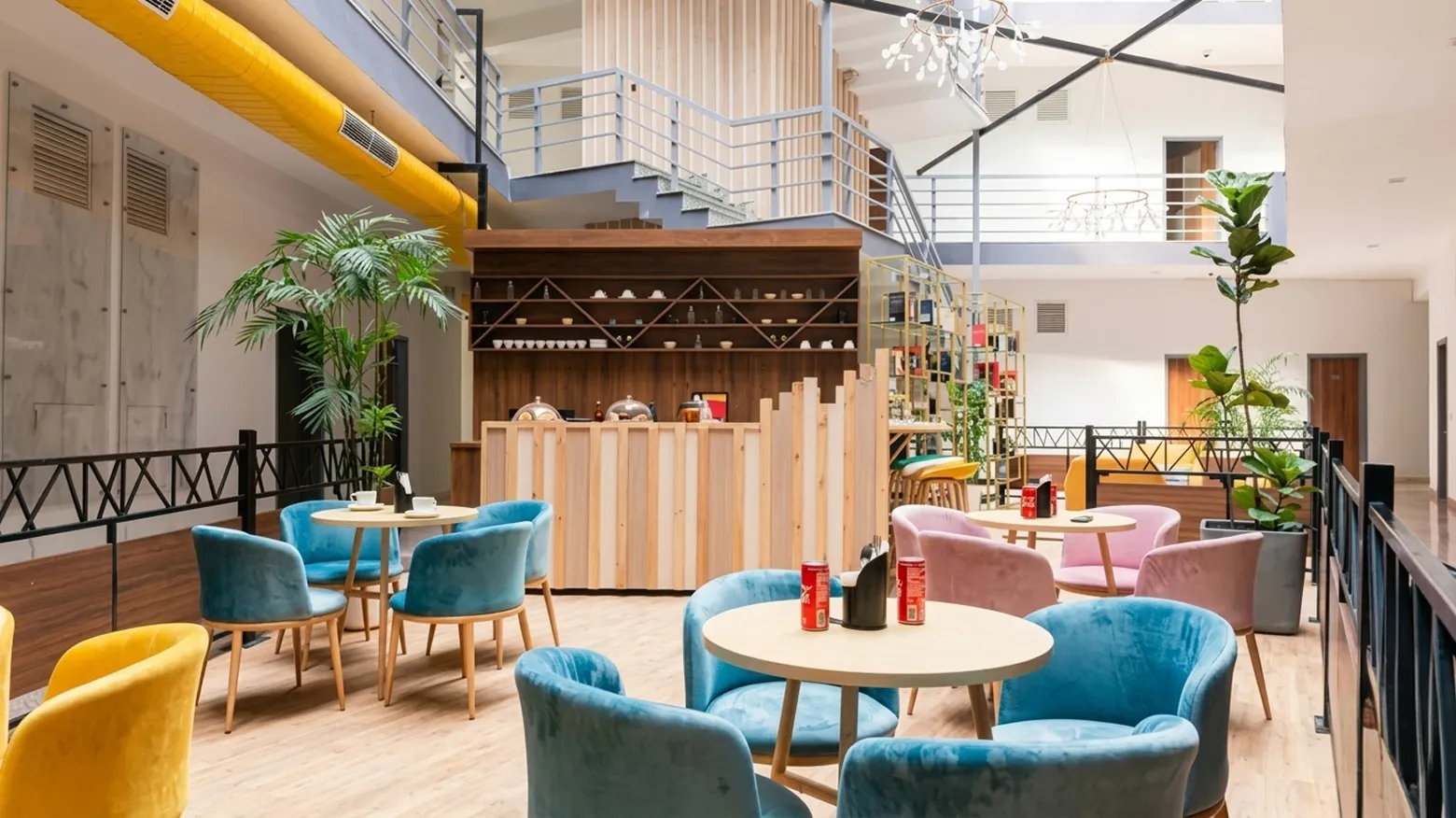
Students can therefore move between reading, analysis, simulation, experimentation and execution rather than relying on one mode of learning. Learning spaces at DLF Cyber Park and CDS Corporate Tower include three auditoriums that seat 250, 150 and 146 people, 18 classrooms, silent coworking and student workstation areas, and more than 30 breakout and meeting rooms. Every classroom is equipped for hybrid delivery, so remote participants and guest faculty can join. The facilities are built for Masters’ Union programmes and are not shared with other institutions, and the operations team schedules them centrally so that cohorts and specialisations have equal access. Virtual tours of the social and learning spaces are available: tour 1, tour 2 and tour 3.
Learning Development Centre
The Learning Development Centre brings academic support, skills development and career preparation together, so students build academic capability, applied skills and independent learning habits alongside professional readiness. It covers academic-writing support, tutoring and mentoring, skills-development resources, workshops and webinars, and individual consultations, with domain-specific skills, communication and etiquette, and mock simulations and role-play built into the programme. Career preparation is part of the same system and begins well before recruitment. Students work on resumes, professional profiles, domain knowledge and interview practice. Launchpad holds role insights and alumni interview transcripts, MentorUnion connects students with industry practitioners for career guidance and profile building, InterviewAI supports interview practice, and once an interview is secured, Last Mile Prep gives focused support for the role and organisation.
Hands-on labs extend that support into applied work: the Makers Lab for prototyping and product development, the AI Lab for applied AI, and the Bloomberg Lab for financial data and analytics. Students can draw on 18 career coaches and 2 academic advisers (full time), supported by 700 MentorUnion mentors, 720 alumni mentors, 159 industry mentors and 10 domain mentors (part time). The undergraduate programme draws on more than 800 industry experts, including more than 150 dedicated undergraduate mentors. Each student is mapped to a mentor in the field they are aiming for and has regular check-ins across the four years.
03 Beyond campus
Masters’ Union treats education as something that can continue before university, after graduation and throughout professional life. This is visible in the range of public learning opportunities, school programmes, professional education and digital resources through which people outside formal degree programmes engage with the institution.
Bringing entrepreneurship education to school students
The High School Startup League introduces students in Classes IX to XII to entrepreneurship before they enter university. Participants identify problems, develop ideas, build prototypes, receive mentorship and present ventures. The programme has reached more than 15,000 students across 300+ schools, 28 Indian states and more than five countries. Participants can win funding of up to ₹20 lakh and gain access to an incubator and accelerator.
The scale is significant, but the educational idea behind it matters more. Students experience entrepreneurship as a process of observation, experimentation, problem-solving and communication. Other programmes continue this progression. Startup Weekend gives school students an intensive introduction to problem identification, product development, AI tools, business models and pitching, while Summer Startup Week provides a longer venture-building experience culminating in presentations to mentors and investors. Together, these initiatives create opportunities for younger learners to experience applied business education before making decisions about university or careers.
Taking learning into schools and communities
Educational outreach also happens away from the Masters’ Union campus. Student ambassadors and institutional teams have engaged with schools across different parts of India, sharing perspectives on higher education, entrepreneurship, careers and practice-based learning. An outreach initiative in Nagaland, hosted at Tetso College in Dimapur, brought together prospective students, educators and learners from schools including Rincho Academy, Maple Tree School and Hope Academy. The engagement focused on future skills, entrepreneurship and higher-education pathways while also involving the regional educational community.
Community programmes extend learning into other settings. A Drone Making Practical Lab for girls from Udayan Care introduced participants to drone components, engineering principles and hands-on assembly. The programme used experimentation to build technical confidence and encourage interest in STEM. Through the SEWA Club's engagement with the Dream Girl Foundation, students also conducted art and painting activities with children, using creative learning as a way to support self-expression and participation. These initiatives show educational outreach in different forms, from career awareness and entrepreneurship to STEM and creative learning.
Student ventures building for education
Several student ventures work on learning itself. Bullspree, an investing-education platform founded by Dharmil Bavishi, has more than 10 lakh users and about ₹10 crore in annual recurring revenue. Hive School, founded by Nikhil Gaur, runs a sales school that includes BuildCamp. Archimedes Lab and Pixel School of Fashion are among the other ventures working on education and skills.
Savra, an AI co-pilot for teachers, saves educators 8 to 10 hours a week and has onboarded more than 7,000 teachers across schools including The Shri Ram School, Mayo College and Pathways School. Skill Before Degree teaches Vedic maths and logical reasoning online and has reached ₹45 lakh in revenue. Cospire helps high school students build standout profiles and has a community of more than 1,800 members.
Making knowledge and events open to the public
Learning beyond campus also happens digitally. Masters’ Union publishes business insights, research articles, practitioner conversations, podcasts, masterclasses and expert interviews that can be accessed by people who are not enrolled at the institution. Public AMA sessions give prospective students and families opportunities to ask questions about higher education, scholarships, careers, entrepreneurship and academic pathways. Other webinars and practitioner sessions make business and professional knowledge available to wider audiences. Several events are open to people outside the university: Intersect 4.0, the High School Startup League, Startup Weekend, Summer Startup Week, public Ask Me Anything sessions, Demo Day and the Dropshipping Mela. Free educational resources, public events, professional learning and school outreach make the institution’s educational contribution accessible beyond its own classrooms.
Continuing education through professional learning
Learning also continues after university. Masters’ Union's executive and professional education ecosystem serves working professionals, entrepreneurs and business leaders who need to update their capabilities as industries and technologies change. Programmes use practitioner-led teaching, cases, simulations, peer learning, live business problems and flexible formats intended to work alongside professional responsibilities. Masterclasses for working professionals sit alongside the longer programmes, offering shorter, focused learning on specific skills and topics.
This turns lifelong learning into more than a collection of occasional lectures. It creates a route through which professionals can return to structured education at different points in their careers. Public forums add another dimension. Intersect 4.0, held in February 2025, brought together more than 350 participants from over 15 countries for conversations between academia, industry and the wider professional community. Programmes open to people outside the degree cohorts include PGP Rise in General Management, PGP Rise in Capital Markets and Trading, PGP Rise in Owners and Promoters Management and the immersion-driven PGP Bharat.
Entrepreneurship education across Punjab
The Punjab Entrepreneurship Mindset Programme, which Masters’ Union built for the Government of Punjab from curriculum to app, has engaged 101,884 students across 47 universities and 1,695 colleges. It is taught in English, Hindi and Punjabi, bringing practical entrepreneurship education to students at public institutions across the state.
04 Teaching and learning
The PG Programme in Sustainability and Business Management maps each of its 40 courses to the goals it serves. 21 courses are mapped to this goal, including AI in Business (Term 1), Social Impact (Term 1), Market Research 1 (Term 2), Leadership and Negotiation (Term 2), Financial Risk Management (Term 2), Business Strategy (Term 2). AI in Business covers foundations of machine learning, generative AI and business automation, identifying high-value AI use cases across functions and industries and data readiness, model selection, experimentation and implementation. Leadership and Negotiation covers leadership styles, self-awareness and values-based leadership, influence, power, coalition-building and stakeholder management and negotiation preparation, interests, alternatives and value creation.
Learning business by doing business
The central idea behind teaching at Masters’ Union is that students understand concepts more deeply when they have to use them. The academic model therefore combines InClass learning, where students develop concepts and analytical frameworks, with OutClass learning, where those ideas are tested through companies, markets, projects and ventures. In practice, students operate e-commerce stores, take part in managing real investment capital, identify problems and build products for customers, and work on live challenges alongside the people who run organisations. This connection between understanding and execution runs through the academic experience.
Bringing practitioners into the learning process
Industry participation is embedded into teaching rather than restricted to occasional guest talks. More than 200 industry professionals teach complete courses. Founders, CXOs, investors, consultants and other practitioners contribute to delivery, mentoring, assessment and project feedback alongside academic faculty.
This gives students exposure to current operating realities while maintaining the conceptual and analytical foundations needed to understand them. Industry input also contributes to curriculum review. Feedback from employers, mentors, alumni, students, faculty and project partners helps programmes respond to changing skill requirements, technology and professional practice. As fields such as generative AI, data science, FinTech, product management, climate technology and digital commerce evolve, the curriculum can adapt alongside them rather than waiting for a long review cycle.
Assessing practical capability
Assessment extends beyond examinations. Students may be evaluated through business plans, consulting recommendations, investment decisions, prototypes, customer validation, pitches, portfolios and project outcomes. The purpose is to understand whether a learner can analyse a situation, make a decision, communicate an argument and execute under realistic constraints.
The student-managed investment fund, with an institutional corpus of ₹5 crore, illustrates this model. Students work on investment analysis, valuation, portfolio decisions and risk under professional guidance, applying finance concepts to actual capital allocation. Entrepreneurship follows the same logic. Through the Venture Initiation Programme, student founders move from problem identification through pre-seed development, minimum viable products, go-to-market execution and product-market fit. Student ventures have collectively secured more than ₹60 crore in external funding, while institutional grants and mentorship provide support during the early stages of building. These outcomes matter because they demonstrate what applied education can enable when students are given responsibility rather than simulated participation.
Using India and the world as learning environments
Learning also moves beyond a single campus. PGP immersions uses more than 25 business and cultural immersions across 20+ cities, bringing students into companies, public institutions, rural communities, manufacturing environments, markets and entrepreneurial ecosystems. Students learn from organisations as varied as technology companies, media businesses, government institutions and community-development organisations. An immersion with the Swades Foundation, for example, gives participants direct exposure to education initiatives within rural development, including early learning, digital literacy, teacher capacity and pathways to higher education and employment.
Student immersions have included visits to the Election Commission of India and the Parliament of India. Career counselling in local schools and cities, and the Demystifying Careers in Impact session, extend the same idea to learners outside the university. International learning expands the frame further. Global immersions have connected students with organisations and institutions across Europe and Asia, including engagements with the United Nations in Geneva, EDF, Rabobank, Porsche, Temasek, Honda, Daikin and international innovation ecosystems. Rather than treating international travel as separate from academics, these experiences are designed to help students compare how organisations, markets and institutions operate across different contexts.
Developing capabilities for work, entrepreneurship and continued learning
Quality education ultimately has to remain useful after the student leaves the classroom. Masters’ Union therefore develops professional capability alongside academic learning through domain exploration, portfolio development, live projects, mentoring, mock interviews and role-specific preparation. Students can explore pathways across consulting, finance, product management, marketing, technology, analytics, operations, human resources and entrepreneurship before building greater depth in areas relevant to their goals. The same flexibility appears in interdisciplinary learning, where finance can intersect with analytics, marketing with psychology and content, product management with design and engineering, and sustainability with finance, operations and strategy.













 Back to Sustainability
