


We value your privacy

We use cookies to improve your browsing experience, personalise content, and understand how our website is used. By clicking “Accept all cookies”, you agree to our use of cookies. Learn more in our Privacy Policy.

Careers

Faculty

MU Ventures

Jobs

Become a Master

Merch Store

events

For Companies

Blog

Coach LMS

Back to Sustainability

Sustainable Development Goal 12

Responsible Consumption and Production

Ensure sustainable consumption and production patterns

UN Sustainable Development Goal 12: Responsible Consumption and Production

Goal 12: Responsible Consumption and Production

Overview

Using resources more thoughtfully

Every product has a story before and after it is used. Materials have to be sourced, products made and transported, and packaging eventually dealt with as waste. At Masters’ Union, we explore responsible consumption and production through research, campus practices, sustainability education and hands-on business learning. Students examine the circular economy, responsible sourcing, sustainable supply chains and waste reduction, while the buildings we operate from provide systems for waste segregation, recycling and organic-waste processing. Beyond campus, our faculty work with students at other institutions on sustainability, circularity and responsible business.

Highlights

2,000

kg/day composting capacity

68%

Fly-ash content in AAC blocks

66

Hours of pro bono teaching

01 Research

Our faculty research looks at how businesses and consumers respond to questions of sustainability and responsibility.

Encouraging more responsible consumer behaviour

Faculty research examines how digital technology can encourage more active consumer participation in responsible consumption. The work looks at how technology can influence behaviour and create new ways for people to participate in more responsible forms of consumption.

How businesses respond to sustainability

Research published in 2025 examines how corporate social responsibility in India aligns with sustainability priorities across phases of the COVID-19 pandemic. The study looks at how business priorities and corporate responsibility change as organisations respond to wider social and environmental pressures. These areas of research connect consumer choices with the decisions businesses make about responsibility, products and the wider impact of their operations.

Dr Anushree Poddar’s 2019 Springer Nature chapter, written with Sapna Narula, studies corporate social responsibility and sustainable development goal practices across the states of India in the volume Mandated Corporate Social Responsibility: Evidence from India.

Dr Vipin Sreekumar presented Spatializing Ethics: Decoding Consumer Buycott and Boycott of (Un)Ethical Brands at ACR Latin America in São Paulo in 2025. At the same conference he presented Rethinking Lateral Exchange Markets: Platform Intermediation via Gamification, a paper he had first presented at ANZMAC in Tasmania in 2024.

02 Campus and stewardship

Separating and processing waste

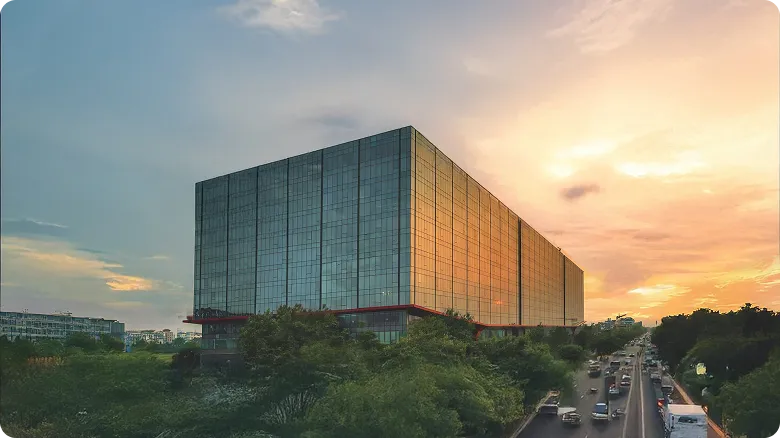
Part of the Masters’ Union campus operates within DLF Cyber Park, where waste-management infrastructure is provided at the building level. The development uses separate collection for dry and wet waste, supported by a central area for storing segregated material. An organic-waste composter with a processing capacity of 2,000 kilograms per day provides a route for organic material to be processed rather than treated as ordinary mixed waste. Within Masters’ Union spaces, colour-coded bins are used to separate wet and dry recyclable waste and make responsible disposal easier across the campus.

Reducing disposable items

Reusable plates and cutlery are used in relevant Masters’ Union dining settings, reducing reliance on single-use serviceware. Campus practices also encourage alternatives to unnecessary single-use plastics during everyday activities and events. These are simple changes, but they matter because many everyday waste streams are created by products that are used for only a few minutes before being discarded.

Thinking about materials from the beginning

Responsible consumption also starts with the materials used to build the environments in which we work and learn. At DLF Cyber Park, AAC blocks containing 68% fly ash were used for walling. The project also reports a 62% reduction in embodied energy through the use of concrete blocks in the structural system. These are building-level measures implemented by DLF rather than Masters’ Union independently, but they form part of the physical environment used by our students and employees. They also reflect a wider principle that appears throughout sustainability education at Masters’ Union: the environmental impact of a product is influenced long before it becomes waste.

03 Beyond campus

Sustainability education at public colleges

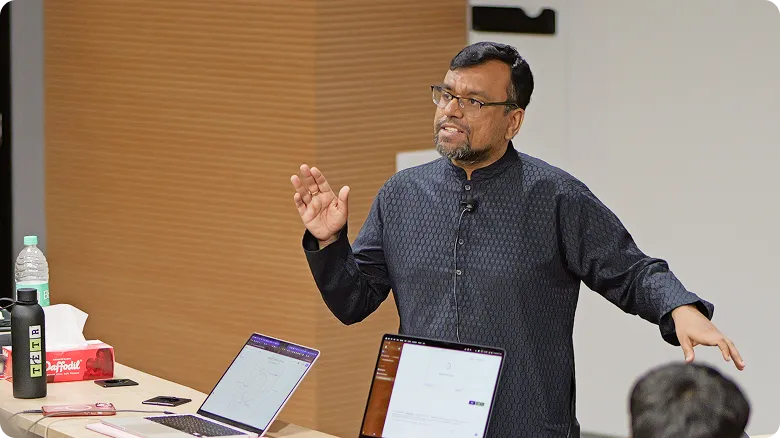
Our faculty take sustainability learning beyond Masters’ Union through pro bono teaching at public higher-education institutions. Across five engagements at four University of Delhi colleges, Masters’ Union faculty delivered 66 hours of pro bono sustainability teaching on circular economy, ESG, climate entrepreneurship and impact measurement. The programmes reached students at Miranda House, Hansraj College, Sri Guru Gobind Singh College of Commerce and Shaheed Bhagat Singh College.

Circular economy at Miranda House

At Miranda House, faculty delivered a 12-hour programme covering circular economy, waste management, responsible consumption, sustainable supply chains, climate communication and sustainability careers. Students examined how businesses can reduce waste and rethink the way resources move through products and supply chains.

Responsible business at SGGSCC

Students at Sri Guru Gobind Singh College of Commerce worked with ESG, responsible business, sustainability strategy and ethical decision-making. A second programme focused on climate innovation, circular business models and sustainable entrepreneurship.

Sustainability and impact at Shaheed Bhagat Singh College

Faculty worked with students at Shaheed Bhagat Singh College across programmes on climate entrepreneurship, sustainable business, ESG reporting, environmental impact and sustainability case analysis. Students used real business questions to explore how environmental performance can be measured and how more sustainable business models can be built.

Sustainability challenges with other universities

Masters’ Union also develops sustainability problem statements for students outside the institution. Students at Shaheed Bhagat Singh College, Hansraj College, Ashoka University and Miranda House have worked on challenges involving waste management, circular economy, responsible consumption, climate adaptation and sustainable business innovation. The challenges ask students to move from identifying an environmental problem to developing a practical response that can work in a real organisational or market setting.

Giving useful resources a longer life

Responsible consumption also means recognising when something still has value. Through a student-led donation initiative with the Robin Hood Army, SEWA Club volunteers collected food, clothing and funds for distribution to more than 250 residents of Ghata Village near Banjara Market. Twelve volunteers contributed to the initiative, which formed part of the Club's wider community-service activity. The programme gives students a practical example of redistribution, where useful resources can continue serving people rather than being unnecessarily discarded. SEWA Club volunteers following the 24-Hour Food Donation Drive with the Robin Hood Army, Ghata Village.

04 Teaching and learning

The PG Programme in Sustainability and Business Management maps each of its 40 courses to the goals it serves. 35 courses are mapped to this goal, including Introduction to Sustainability (Term 1), Introduction to Business Sustainability & Global Best Practices (Term 1), Financial Accounting (Term 1), Marketing Strategies (Term 1), Communication & Storytelling (Term 1), AI in Business (Term 1). Circular Economy covers linear versus circular systems and resource productivity, circular principles: reduce, reuse, repair, refurbish, remanufacture and recycle and life-cycle assessment and material-flow analysis. Waste Management covers types, sources and characteristics of municipal, industrial and hazardous waste, waste hierarchy, segregation, collection and treatment systems and recycling, composting, anaerobic digestion and waste-to-energy.

Sustainability and Business Management

The PG Programme in Sustainability and Business Management brings responsible consumption into business education through circular economy, sustainable supply chains, responsible sourcing, ESG and environmental strategy. Students work on practical sustainability challenges rather than studying these ideas only through theory. Projects include waste-to-value business models, supply-chain redesign, carbon and impact measurement, sustainable sourcing and environmental problem-solving.

Turning waste into value

The Waste-to-Wealth Innovation Lab asks students to start with materials that would normally be discarded. Students examine waste streams from areas such as fashion, food and beverage and e-commerce. They map where waste is generated and look for opportunities to reuse, recycle or upcycle those materials.

They then develop circular business models around the opportunities they identify. The work includes both environmental and commercial questions. Students consider how much waste could be avoided, what a new product or service could cost, whether customers would pay for it, and whether the idea could become a viable business.

Rethinking the supply chain

The Green Supply Chain Rearchitecture Challenge takes students further upstream. Teams examine where environmental impacts occur across a supply chain and look at ways to redesign packaging, logistics, procurement and supplier relationships. Students develop sustainability measures for suppliers and compare different transport and sourcing options. The challenge also asks them to work towards a 30% supply-chain emissions-reduction target as part of the exercise. The target is part of the learning challenge, giving students a measurable problem around which to test different operational decisions.

Building a responsible e-commerce business

Through the Sustainable Dropshipping Challenge, students build and operate sustainability-focused online businesses. Over six weeks, they move from identifying a product and assessing suppliers to creating an online store, acquiring customers and managing fulfilment. Students consider product sustainability and supplier credibility alongside the commercial questions of pricing, marketing and customer demand.

Food ventures apply the same discipline. Students work directly with farmers, food producers and manufacturers to source products and ensure quality, which keeps sourcing decisions visible and gives farmers a direct market for their produce. The challenge makes responsible consumption part of a live business decision. Students have to think about what they sell, where it comes from and how they communicate its value to customers.

Building alternatives to conventional materials

Student entrepreneurship provides another route into responsible production. Mellovia, part of the Masters’ Union venture ecosystem, develops biodegradable rice-husk kitchenware as an alternative to conventional plastic products. It connects the use of an agricultural by-product with product design and circular business models. Students have also explored business ideas around plastic-waste segregation and consumer awareness, using entrepreneurship to look at the practical barriers that prevent materials from being recycled effectively.

What comes next: future priorities

Across research, campus life, public education and teaching, our work on Sustainability Goal 12 focuses on helping people make better decisions about what we use, how we produce it and what happens when we are finished with it.

Explore Now