Governance across ventures and institutions
Faculty research connects governance with responsible innovation, new-venture governance and institutional design. Recent work also examines board governance and sustainability disclosure in regional climate initiatives, while research on identity and discrimination explores participation and social cohesion.
Dr Tathagata Bhowmik’s 2026 chapter in the Springer Nature volume Technology, Management, and Design for Social Justice, Marginalization and Disinformation: The Perilous Use of Tech by Political Consultancies in India, examines how political consultancies in India use technology and what that means for disinformation.
Dr Shikhar Bharadwaj’s paper on board interlocks and knowledge transfer in high-tech firms was featured at the India Strategy Conference in 2024 and at the Academy of Management in 2025. Dr Vipin Sreekumar’s paper on the governance role of transparency in R&D investment appeared in the 2024 Academy of Management Proceedings, and his 2025 Macromarketing paper in Rio de Janeiro examines advertising through the case of the Casteless Collective in India.
02 Campus and stewardship
Ethics oversight and accountable decision-making
Masters’ Union’s Ethics Committee meets monthly and publishes an annual account of claims and complaints. It provides a formal route for organisational and governance concerns involving fair process, conflicts of interest, confidentiality, workplace conduct, institutional authority, data use and stakeholder treatment; specialist matters are directed to the appropriate process. Ethics review has led to a common consent approach for surveys, recordings, testimonials and images; clearer requirements for requests involving student or employee data; and improved routing across ethics, student conduct, POSH, HR, data and privacy processes. Regular Cabinet meetings support decisions on academic delivery, programme development, accreditation, infrastructure and people systems. Agendas, attendees, decisions and action points are recorded and circulated within the Senior Management Group, creating a traceable rhythm of responsibility and follow-up.
Student representation and participation
Students participate through an elected Student Council, cohort representatives, clubs, Learning Experience roundtables and town halls. Feedback has informed programme delivery, including closer alignment between Product Marketing learning and the OutClass Dropshipping Challenge and the introduction of no-code masterclasses for student projects. Term-wise Net Promoter Score (NPS) surveys give the institution a regular check on how students rate their experience. A student-facing academic forum supporting participation and feedback.
Integrity, safety and grievance redressal
Institutional codes and procedures cover academic integrity, anti-plagiarism, conflicts of interest, prevention of sexual harassment, anti-ragging, discrimination, grievance redressal and professional conduct. Students facing academic-integrity proceedings are given an opportunity to respond before sanctions are applied, while concerns can be directed to the relevant academic, conduct, HR, POSH, ethics or data-privacy process.
Transparency, representation and access
The 2026 Gender Pay Gap Report records 206 women among 459 employees, or 44.9% of the workforce. Women hold 56.44% of senior-level roles and 26.67% of leadership roles. These measures support monitoring of representation, progression and compensation. Access is supported through alternative admissions pathways that recognise entrepreneurial and exceptional achievement, alongside 14 scholarship schemes or categories covering financial need, diversity, women’s education and innovation.
Multi-stakeholder participation and institutional learning
Students, faculty, staff, industry practitioners, alumni and external experts contribute to institutional life through committees, feedback forums, practitioner-led teaching and advisory engagement. More than 30 corporate partners contribute to curriculum content or live assignments, broadening the perspectives that inform programme delivery while formal governance authority remains with Masters’ Union’s designated bodies. External quality and institutional-development frameworks, including an overall five-star QS Stars rating, EFMD Global, AACSB and BGA membership, the EFMD Business School Impact System label and engagement with NSDC, support benchmarking, continuous improvement and alignment with recognised academic and skills-development ecosystems.
Student representation in residential life
Undergraduate students elect a Hostel Council, and academic representatives and student council members bring student concerns on academics, student affairs, hostel facilities and career services to the institution. The Internal Complaints Committee includes external representation.
Policies and student bodies that are public
Masters’ Union publicly lists its Code of Ethical Business Conduct, Diversity and Inclusion Policy, Equal Employment Opportunity Policy, Modern Slavery and Human Trafficking Policy, POSH Policy, Procurement Policy, Research Policy, Student Research Policy, Student Welfare Policy, Gender Pay Gap Report, Diversity, Equity and Inclusion Strategy and Annual Ethics Committee Report. Its website also documents the SEWA Club, Belong Club, Academic Committee, PoSH Committee and Student Council. Cabinet minutes are confidential and are not published.
03 Beyond campus
Building capacity in public education
Through the Punjab Entrepreneurship Mindset Programme, which it built for the Government of Punjab from curriculum to app, Masters’ Union contributes entrepreneurship frameworks, programme design and mentoring approaches to the public education ecosystem. The initiative builds problem-solving, responsible decision-making and enterprise capability beyond a single campus. A public entrepreneurship platform connecting education, enterprise and institutional capacity building.
Public dialogue and institutional partnerships
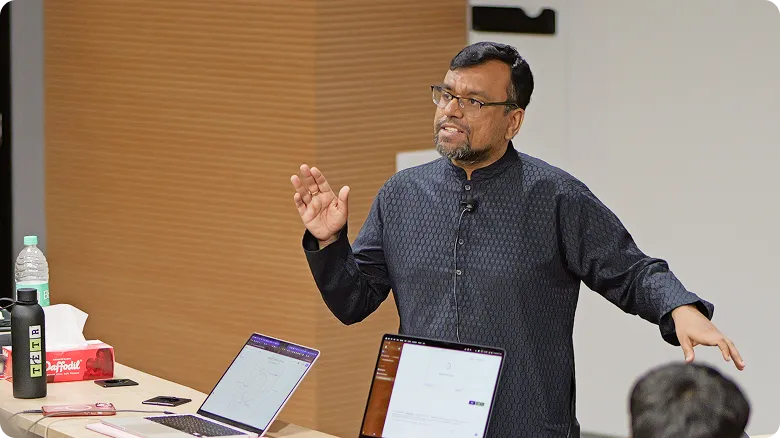
Masters’ Union convenes public officials, diplomats, industry leaders and students for non-partisan discussions on governance, infrastructure, democratic institutions, technology and public policy. These dialogues connect management learning with the responsibilities and trade-offs of public leadership. A moderated campus dialogue connecting students with public and institutional leadership. Academic and institutional partnerships with Griffith University, Illinois Institute of Technology, the University of Delhi, NSDC, SDA Bocconi, IÉSEG School of Management, H-FARM, Tetr College of Business, Babson College and Singapore Management University support exchange, capacity building and institutional learning. Through these relationships, Masters’ Union connects students and faculty with different academic, professional and public-institutional perspectives.
Student-led platforms and social cohesion
Sixteen student-led clubs and committees create opportunities for leadership, scrutiny and participation. Public-facing platforms such as the Fintech Mafia Challenge and Demo Day require participants to present ideas, disclose assumptions and respond to evaluation. Cultural, religious and civic activities, including Onam, Ganesh Chaturthi, Iftar, Diwali, Holi, Christmas and national-day observances, bring students together across regional, linguistic and religious identities and support an inclusive campus community. Student-led cultural participation across the campus community.
04 Teaching and learning
The PG Programme in Sustainability and Business Management maps each of its 40 courses to the goals it serves. 6 courses are mapped to this goal: Social Impact (Term 1), Corporate Governance (Term 1), Leadership and Negotiation (Term 2), Talent & People Decisions (Term 3), Cross-Cultural Management (Term 4), Managerial Decision-Making (Term 4). Corporate Governance covers board structures, fiduciary duties and governance mechanisms, shareholder rights, stakeholder interests and agency conflicts and risk oversight, internal controls and ethical decision-making. Social Impact covers social impact theory, inclusive growth and development challenges, theory of change, logic models and impact pathways and stakeholder and beneficiary analysis.
Governance as a management capability
Students encounter governance through corporate boards, organisational design, people systems, venture formation, compliance and responsible decision-making. Public-policy learning examines how regulation shapes markets and how organisations respond to public priorities.
Ethics and responsible leadership
Codes of conduct, academic-integrity standards, venture projects and live industry assignments place students in situations where disclosure, evidence, conflicts of interest and accountability have practical consequences. Responsible AI learning adds questions of fairness, bias, privacy and verification to this framework.
Learning through participation
Student elections, club leadership, student funds and town halls allow learners to practise representation and accountability. Students campaign, manage teams and budgets, evaluate ventures, engage partners and bring feedback into institutional discussions.


















 Back to Sustainability
