


We value your privacy

We use cookies to improve your browsing experience, personalise content, and understand how our website is used. By clicking “Accept all cookies”, you agree to our use of cookies. Learn more in our Privacy Policy.

Careers

Faculty

MU Ventures

Jobs

Become a Master

Merch Store

events

For Companies

Blog

Coach LMS

Back to Sustainability

Sustainable Development Goal 9

Industry, Innovation and Infrastructure

Build resilient infrastructure, promote inclusive and sustainable industrialisation and foster innovation

UN Sustainable Development Goal 9: Industry, Innovation and Infrastructure

Goal 9: Industry, Innovation and Infrastructure

Overview

Building the infrastructure for ideas to become real

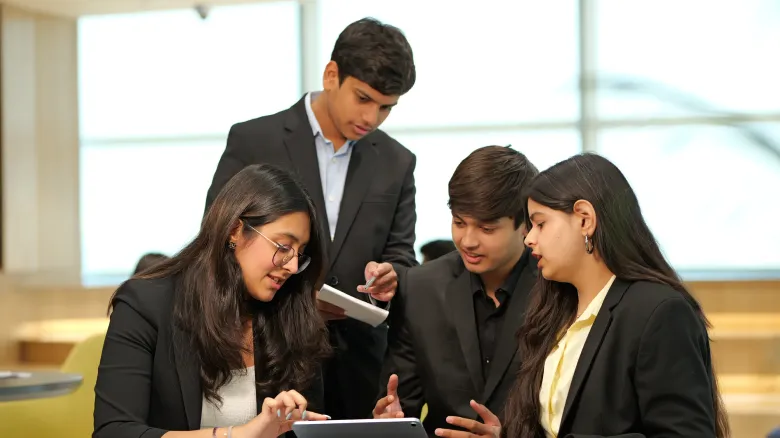
Innovation needs more than a good idea. It needs places to experiment, access to technology, industry expertise, mentorship, capital and opportunities to test whether something works in the real world. At Masters’ Union, students build alongside the technologies, businesses and people shaping industry today. AI and prototyping labs support experimentation, industry partnerships bring practitioners into the learning environment, and the entrepreneurship ecosystem helps students take ideas from an early problem through to customers and investors. Research adds another dimension by examining how knowledge moves between universities, businesses and markets, and what helps innovation create useful outcomes.

Highlights

30+

Ventures built and launched

₹1.36 Cr

Venture grants, Cohort 2025

50+

Factory visits in the curriculum

01 Research

Our faculty research looks at how businesses contribute to knowledge creation and how organisations turn new ideas into useful products, services and systems.

Product innovation and institutional conditions

Faculty research published in The Journal of Law and Economics in 2025 examines how debt-contract enforcement following legal reform in India affects product innovation. The work connects the legal and financing environment with firms’ capacity to develop new products, showing how institutions influence industrial innovation.

Building responsible innovation

Operations research examines how responsive pricing and product variety help firms manage demand during supply-chain disruption. Related work explores hybrid organisations and responsible innovation where supporting institutions are incomplete. This work considers how businesses respond when established systems, standards or institutional support are incomplete, and how new products and business models can be developed while accounting for their wider consequences. The faculty portfolio also includes research on industry’s contribution to scientific publishing and knowledge novelty, and on experiential learning and portfolio diversification in venture-capital firms. Together, these studies connect innovation with the institutions and organisations that bring knowledge into practice.

Dr Shikhar Bharadwaj’s research on how knowledge moves between firms has reached several leading strategy conferences. His paper on board interlocks, technology and knowledge transfer in high-tech firms was a spotlight paper at the 2024 India Strategy Conference at IIM Ahmedabad, featured at the Academy of Management in Copenhagen in 2025, and was a finalist for the Best PhD Paper Prize at the Strategic Management Society conference in San Francisco the same year. His work on cross-border and domestic R&D teams in multinationals was also a 2024 spotlight paper at IIM Ahmedabad, and his papers on CEO-inventor coinvention and on post-acquisition knowledge leverage were featured at the India Strategy Conference at ISB in December 2025. Dr Vipin Sreekumar’s paper on the governance role of transparency in R&D investment appeared in the 2024 Academy of Management Proceedings.

02 Campus and stewardship

Spaces to build, test and experiment

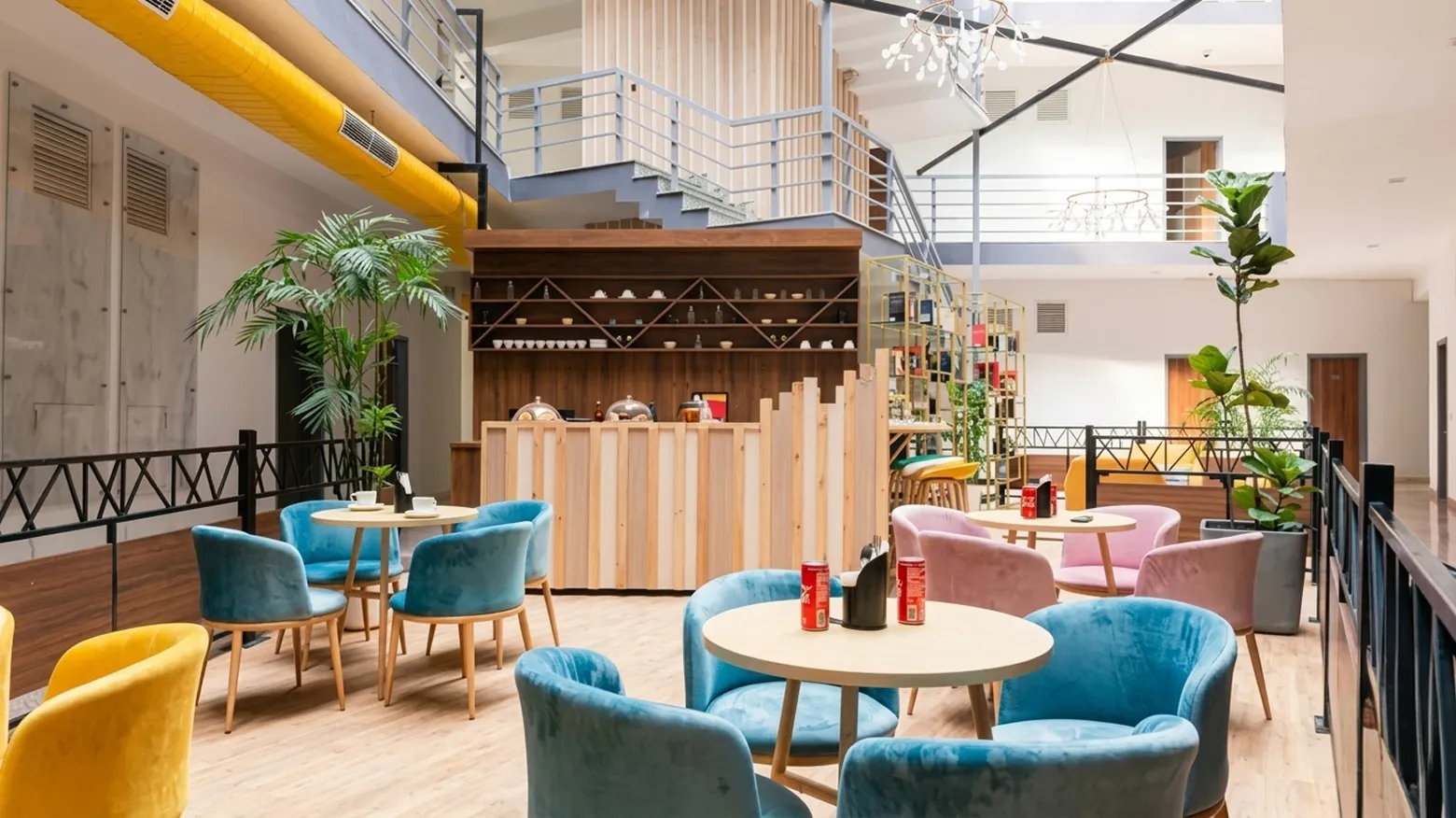
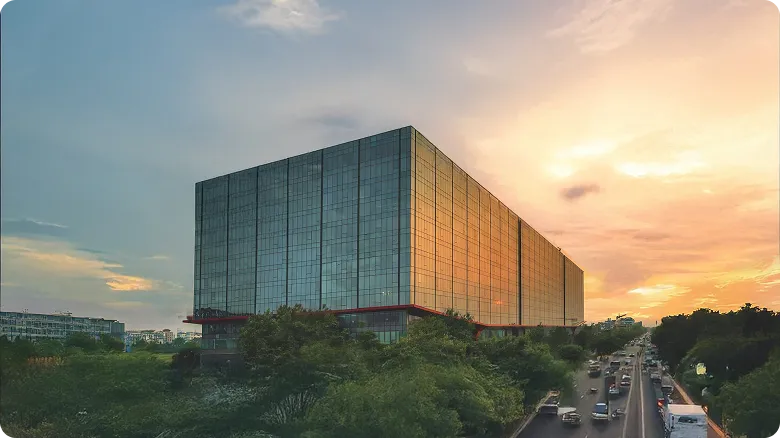
Masters’ Union has expanded its academic infrastructure to give students more places to work with technology and turn ideas into working experiments. Across FY 2023-24 and 2024-25, the campus footprint expanded from approximately 42,000 square feet to more than 100,000 square feet. The expansion included specialised spaces for artificial intelligence, prototyping, financial markets, entrepreneurship and collaborative work.

GenAI Experience Lab with PwC India

The GenAI Experience Lab, developed in partnership with PwC India, gives students direct exposure to generative artificial intelligence and its applications in business. The lab supports demonstrations, workshops, guest sessions and experimentation with emerging AI tools. Students use the space to explore how generative AI can change workflows, customer experiences, decision-making and business processes while learning from practitioners working with these technologies in industry.

Makers and Creators Lab

The Makers and Creators Lab gives students a place to move from digital ideas to physical prototypes. Workshops have included projects involving pocket cameras, AI companions, spider robots and drones, giving students experience with hardware, electronics and physical computing. Building something that works introduces a different kind of learning. Students have to make decisions around materials, functionality, users and technical constraints, then test and improve what they have made.

Technology across the learning environment

Innovation infrastructure extends beyond individual labs. Students have access to the Bloomberg Lab for financial-market data and analytics, the Food Lab for testing food ventures, the Gene Lab, technology-enabled classrooms, collaborative workspaces and entrepreneurship facilities that support research, customer discovery, venture development and investor interaction. Together, these spaces allow students to work across software, artificial intelligence, hardware, finance and new business models.

03 Beyond campus

Industry practitioners are closely involved in how students learn and experiment at Masters’ Union. Corporate partnerships, workshops, hackathons and live business challenges bring students into contact with current technologies and real organisational problems. The PwC collaboration is one example. Alongside student learning, the GenAI Experience Lab creates space for demonstrations, workshops, guest lectures and wider engagement around emerging AI applications. Other programmes such as the GenAI CXO Hackathon, Consulting Garage and FinOv8 bring students and practitioners together around business, technology and financial problems. These engagements give students experience of working with questions that companies are dealing with now, while giving industry partners a way to engage with new ideas and emerging talent.

Helping founders move beyond the first idea

Masters’ Union's entrepreneurship ecosystem supports students as they move from early ideas towards working businesses. For PGP-TBM Cohort 2025, Masters’ Union provided ₹1.36 crore in venture grants and approximately 4,500 hours of one-to-one mentoring. The wider entrepreneurship report profiles more than 30 ventures that have collectively created over 500 jobs.

Founders receive support with customer research, business models, product development, go-to-market strategy and fundraising. At Demo Day, student founders present their ventures to more than 150 venture capitalists and angel investors. This gives students an opportunity to test their businesses with people who evaluate new ventures professionally and can help promising companies move to their next stage.

Student ventures reaching wider markets

Student entrepreneurship has grown across technology, healthcare, education, consumer products and other sectors. The venture portfolio spans healthcare, education, finance and artificial intelligence, including MemoTag, Bullspree, Hive School, Astrazen, Context Layer and Fulcrum Labs AI. Their journeys show how student ventures can move beyond classroom projects and enter wider markets where customers, investors and industry participants determine whether an idea has potential.

Undergraduate ventures

Thirty-three undergraduate ventures are profiled in the undergraduate startup list. Meta Fashion creates digital wearables and has reached ₹2.5 crore in revenue and $400K in funds raised, with a ₹5 lakh Masters’ Union grant. Zenmo has reached ₹5.5 crore in gross revenue, MemoTag has completed 50 pilots and trials of its AI companion for clinical conversations, and Context Layer has helped AI startups cut token costs by 45 to 50%. Meta Fashion and MemoTag have also been featured on Shark Tank India, taking their products to a national audience.

The venture portfolio at a glance

The entrepreneurship report profiles more than 30 ventures. It records ₹11.2 crore in grants given by Masters’ Union, more than 10,000 hours of one-to-one mentoring, a combined valuation of ₹593.10 crore and annualised revenue of ₹319.8 crore, calculated as the latest month’s revenue multiplied by twelve. By sector, 38.7% are technology and SaaS, 35.4% direct-to-consumer, 16.1% food and beverage and 6.4% services. Eight, an audio and microdrama platform founded by Mohit Paliwal, Mohit Goswami and Yugal Tamang (PGP-TBM 2021), reports ₹13 crore in annual recurring revenue, more than 5 million downloads, ₹27 crore raised and ₹17.5 lakh in Masters’ Union grants.

04 Teaching and learning

The PG Programme in Sustainability and Business Management maps each of its 40 courses to the goals it serves. 35 courses are mapped to this goal, including Introduction to Sustainability (Term 1), Introduction to Business Sustainability & Global Best Practices (Term 1), Financial Accounting (Term 1), Marketing Strategies (Term 1), Communication & Storytelling (Term 1), AI in Business (Term 1). Digital Transformation covers digital strategy and business-model transformation, cloud, data, automation, platforms and enterprise architecture and customer and operating-model redesign. Innovation & New Market Entry covers opportunity identification and market attractiveness, customer discovery and problem-solution fit and entry modes, partnerships and ecosystem strategy.

Building ventures from problem to market

Entrepreneurship at Masters’ Union is taught through the process of building. The Venture Initiation Programme takes students through approximately nine to ten months of venture development. Students begin by identifying a real problem and speaking with potential users. They then develop a minimum viable product, test it in the market, acquire early customers and continue improving the business based on what they learn. Selected early-stage teams can receive non-dilutive institutional support to continue testing products, acquiring customers and developing their businesses. The experience teaches students that an idea becomes more useful when it can be built, tested and improved in response to real users.

Experimenting with emerging technologies

Students also encounter innovation through shorter technology-led projects, labs and hackathons. The GenAI Experience Lab introduces applications of artificial intelligence. Makers Lab activities allow students to work with hardware and physical prototypes. Design-thinking projects begin with users and problems before moving towards solutions.

Hackathons compress the same process into shorter periods of research, building, testing and iteration. The focus is not on learning one technology in isolation. Students learn how to understand what a new technology can do, identify where it may be useful and turn that capability into a practical application.

Learning from innovation in industry

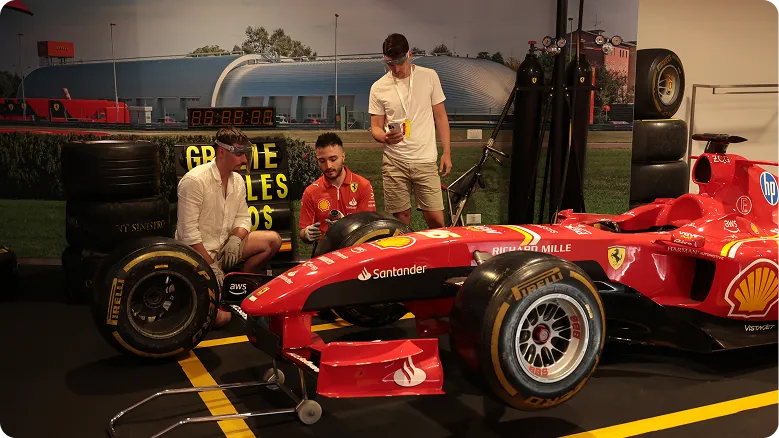
Company immersions show students what innovation looks like once it operates at scale. At Addverb, students encounter robotics, warehouse automation and AI-enabled logistics. Other industry visits expose them to advanced manufacturing, digital commerce, supply chains, technology platforms and large-scale infrastructure. These experiences show that innovation does not end with a prototype. Products and technologies eventually have to work with manufacturing, finance, infrastructure, people, regulation and supply chains.

Research as part of building

Student research also supports the process of creating and testing new ideas. Projects can include market studies, customer discovery, startup validation, product experimentation, user research, financial modelling, field studies and AI-assisted business intelligence. Students use research to understand what is already known, test assumptions and identify what evidence they need before making a decision.

Academic and Industry Partnerships

Sr. No Name of Organisation Nature of Collaboration National / International
1 Griffith University, Australia MoU (announced September 2025) for faculty and student exchange, dual-degree pathways, and a joint UG in Technology & Business Management International
2 Illinois Institute of Technology, USA Dual-degree undergraduate collaboration across Technology & Business Management, Psychology & Marketing, and Data Science & AI International
3 University of Delhi Dual-degree academic collaboration National
4 National Skill Development Corporation (NSDC) Registered Training Partner, linking Masters’ Union's programmes to a Government of India skilling framework National / Government
5 SDA Bocconi Academic Collaboration & Immersion International
6 IESEG School of Management Faculty Exchange & Immersion International
7 H-Farm Innovation Partner International
8 Tetr College of Business Cross-Faculty Deployment International
9 Babson College Academic Collaboration & Immersion International
10 Singapore Management University Academic Collaboration & Immersion International
11 EFMD Global Institutional membership; Masters’ Union carries the EFMD BSIS (Business School Impact System) label International
12 AACSB (Association to Advance Collegiate Schools of Business) Institutional membership International
13 Business Graduates Association (BGA) Institutional membership International
14 ASSOCHAM Institutional membership National
15 30+ corporate partners (incl. Google, Microsoft, McKinsey & Company, PwC, Bain, BCG, Cars24) Curriculum co-creation and live consulting engagements National / International

What comes next: future priorities

Across research, infrastructure, industry engagement and teaching, our work on Sustainability Goal 9 focuses on giving students the technology, spaces, relationships and support they need to turn ideas into products, ventures and solutions that can work in the real world.

Explore Now