01 Research
Faculty research examines the structures that influence whether women move from participation into positions of leadership, ownership and decision-making. One strand studies gender diversity and inclusion on Indian corporate boards following regulatory changes intended to increase women’s representation, looking at what happens once representation is formally required and how organisations respond as board diversity becomes part of corporate governance. Related research on board diversity and corporate governance places women’s representation within the development of leadership structures, organisational decision-making and accountability. Another strand looks at women as entrepreneurs, examining how technology adoption enables or differentiates Indian women entrepreneurs by linking digital capability with market access, business development and economic participation. Together, this work looks beyond participation alone to the systems that influence who gains access to technology, finance, governance and leadership.
Dr Kashika Sud and Neharika Vohra wrote The Case of Missing Women: Dynamics of Funding Women Entrepreneurs, a 2025 chapter in the Springer Nature volume Building Resilience, Responsibility and Well-being: Psychological Perspectives from India. It sits alongside Dr Sud’s wider work on how investors make funding decisions about women-led ventures.
Dr Kashika Sud has taken this research to international conferences. Her study of investor bias in the funding of women ventures, a qualitative narrative enquiry using LIWC text analysis, was shown as a poster at the American Psychological Association meeting in Seattle in 2024 and presented at the European Academy of Management in Florence in 2025. At the 2024 EGOS Colloquium in Milan she presented three cases of women entrepreneurs to examine how founders build legitimacy through the stories they tell.
02 Campus and stewardship
Opening access to education
The Rajni Thethi Scholarship for Women supports women with strong academic or professional records and the potential to grow as industry leaders. Women made up 72 of 233 students (30.9%) in PGP-TBM Cohort 5, and 11 of them (15.3%) were supported through the Rajni Thethi Scholarship. A further 20 women were supported in PGP-TBM Cohort 6 and 17 in UG-TBM Cohort 2, bringing the total to 48 across the three cohorts.
Measuring progression at work
Masters’ Union tracks gender representation and compensation alongside its equal employment opportunity policies, and publishes the results. The 2026 Gender Pay Gap Report recorded a median gender pay gap of 3.40% and a median bonus gap of 0.00%. In practice, this means the typical bonus is the same for women and men.
Women account for 49.82% of mid-level roles, 56.44% of senior-level roles and 26.67% of leadership roles. The figures show a workforce in which women are strongly represented at mid and senior levels, with leadership representation an area the institution continues to build on. Publishing these figures makes it possible to see where progression is strong and where it needs attention. Employment decisions across recruitment, compensation, appraisal, promotion and training are governed by equal-opportunity principles, with discrimination prohibited across gender and other protected characteristics. These commitments sit within an Equality, Diversity and Inclusion Strategy with pre-defined, time-bound targets, and student spaces such as the Belong Club keep conversations about inclusion, dignity and bias part of campus life.
Supporting women through parenthood and caregiving
Eligible women employees can access up to 26 weeks of paid maternity leave, along with provisions relating to miscarriage or medical termination of pregnancy, adoption and commissioning motherhood. Paid paternity leave is also available to eligible employees, recognising caregiving as a responsibility that should not sit with women alone. For parents with young children, KLAY Day Care operates within DLF Cyber Park, providing access to professional childcare within the wider campus environment. These provisions are intended to make it easier for people to remain connected with work during periods when family responsibilities change significantly.
Women's health and wellbeing
Health support forms another part of women's participation at Masters’ Union. Women employees have access to medical insurance, preventive-health benefits and confidential mental-health support. Women may also avail one menstrual leave day per month as a work-from-home day. Students have access to professional mental-health support through Amaha, while menstrual-hygiene facilities, including sanitary-pad dispensers, are available across relevant campus washrooms.
Maintaining a safe learning and working environment
Masters’ Union's Prevention of Sexual Harassment framework covers students and employees and is supported by an Internal Committee, reporting procedures and confidentiality requirements. Awareness sessions help members of the community understand what constitutes sexual harassment, how concerns can be reported and what institutional processes are available. Regular awareness sessions are delivered across postgraduate, undergraduate, executive-education and central-function groups, supporting prevention, reporting and understanding of the institution’s sexual-harassment procedures. These systems sit alongside campus security, visitor management and student-support mechanisms to support a learning and working environment in which women can participate safely.
Internal Complaints Committee and campus security
The Internal Complaints Committee includes external representation and works under the PoSH Act 2013 to handle complaints in a fair, confidential and time-bound way. The PoSH policy covers students, faculty, staff, interns, consultants, visitors and contractual personnel, and it is publicly available. Campus security includes 24×7 security personnel, CCTV surveillance, controlled access, emergency protocols and visitor management.
03 Beyond campus
For Masters’ Union, gender equality extends beyond its own campus in two ways: students hear directly from women leaders, and school-age entrepreneurs meet women founders and investors. Visible role models show students and younger founders what leadership, ownership and investment look like in practice. Together, these connections treat gender equality as something shaped by public platforms as well as by what happens inside the university.
Women leaders in conversation with students
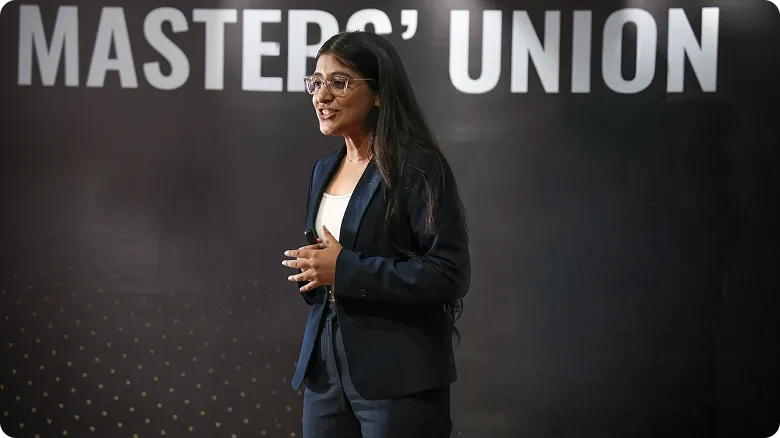
Students regularly hear from women building companies, managing teams, investing capital and leading organisations. Masters’ Union programmes have featured women leaders across entrepreneurship, human resources, education, investment and institutional leadership. The CHRO Exchange brings women people-leaders and industry professionals into discussions on workplace culture, leadership and the startup ecosystem. Masters’ Union was associated with the CII Women Leadership Summit held on 1 May 2025, contributing an institutional platform for discussion of inclusion, participation and women’s leadership. These interactions give students opportunities to hear directly from women making decisions across different parts of business.
Introducing younger founders to women entrepreneurs and investors
Women leaders also participate in programmes for school-age entrepreneurs. Season 3 of the High School Startup League brought women entrepreneurs and investors into judging and mentoring roles, including representation from Kalaari Capital. Young founders present ideas to experienced entrepreneurs and investors, connecting venture-building with professional feedback and mentorship. For girls considering entrepreneurship, these interactions make company-building, investment and business leadership more visible as possible career paths.
04 Teaching and learning
The PG Programme in Sustainability and Business Management maps each of its 40 courses to the goals it serves. 5 courses are mapped to this goal: Social Impact (Term 1), Leadership and Negotiation (Term 2), Talent & People Decisions (Term 3), Cross-Cultural Management (Term 4), Managerial Decision-Making (Term 4). Social Impact covers social impact theory, inclusive growth and development challenges, theory of change, logic models and impact pathways and stakeholder and beneficiary analysis. Talent & People Decisions covers workforce planning, role design and competency frameworks, recruitment, selection and evidence-based hiring and performance management, rewards and development.
Building leadership through experience
Women students take leadership roles across student government, clubs, careers, culture, wellbeing, fintech, hostel life, safety and student media. These roles require students to represent peers, organise communities, manage teams and take responsibility for decisions and outcomes. Classroom and practitioner-led learning adds another dimension. The Women in Management session used discussion and role-play to examine confidence, leadership presence and barriers to professional progression. Gender and inclusion also appear within wider organisational and leadership learning, giving students opportunities to examine how workplace structures and management decisions can affect participation and progression.
Women building companies
Entrepreneurship gives women another route into leadership. Through OutClass and the Venture Initiation Programme, women founders work through the same process of identifying problems, building products, acquiring customers and developing companies. They have access to mentors, institutional grants, business infrastructure and investor networks, with Demo Day connecting student founders to more than 150 venture capitalists and angel investors.
Women-founded and co-founded ventures in PGP-TBM Cohort 5 received ₹40.5 lakh in institutional grants across food, nutrition, artisan enterprise and consumer products. The five ventures were Mom’s Mixes, Yango, Saaha India, Flourish Foods and Spawn Right. Venture support combines grants with mentoring, business infrastructure and opportunities to present to investors, helping founders move from early concepts to operating businesses. The opportunity goes beyond learning how entrepreneurship works. Women founders make decisions about products, customers, teams, finance and growth, gaining direct experience of building and leading organisations.













 Back to Sustainability
