


We value your privacy

We use cookies to improve your browsing experience, personalise content, and understand how our website is used. By clicking “Accept all cookies”, you agree to our use of cookies. Learn more in our Privacy Policy.

Careers

Faculty

MU Ventures

Jobs

Become a Master

Merch Store

events

For Companies

Blog

Coach LMS

Back to Sustainability

Sustainable Development Goal 7

Affordable and Clean Energy

Ensure access to affordable, reliable, sustainable and modern energy for all

UN Sustainable Development Goal 7: Affordable and Clean Energy

Goal 7: Affordable and Clean Energy

Overview

Preparing for a cleaner energy future

The shift to clean energy is changing how businesses invest, operate and grow. It is also creating new questions around storage, infrastructure, finance, technology and the skills needed to manage the transition. At Masters’ Union, students engage with these questions through sustainability education, faculty research, field learning and conversations with people working across renewable energy, climate technology and green finance. Our campus also operates within commercial developments designed around energy efficiency and renewable power, giving students daily exposure to the way cleaner energy systems can be integrated into large urban infrastructure.

Highlights

40.40%

Lower energy performance index

57%

Space meeting daylight standard

32/35

LEED energy score

01 Research

Our faculty research looks at one of the central challenges of renewable power: matching the electricity generated from sources such as solar and wind with the times when people and businesses actually need it.

Matching renewable power with demand

Faculty operations research examines how battery storage can help renewable-energy generators balance variable supply with electricity demand. The work studies storage decisions when renewable generation and consumption occur at different times, bringing together battery capacity, costs and operational choices. The research brings together renewable generation, battery capacity, system costs and operational decision-making.

Related work has also examined the effect of renewable-energy storage on conventional generation, contributing to a wider understanding of how storage can change the way electricity systems operate as renewable capacity grows.

02 Campus and stewardship

Working from energy-efficient buildings

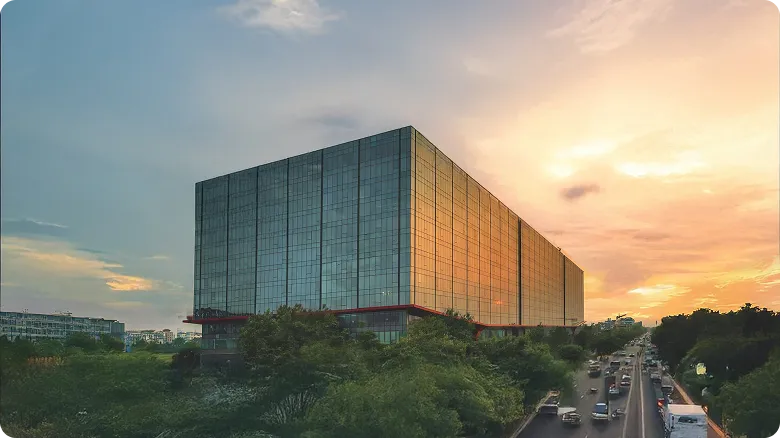
Masters’ Union operates from leased academic spaces within DLF Cyber Park and CDS Corporate Tower in Gurugram. It has also signed a lease for a new 10-acre campus at Cyberwalk, extending its approach to selecting green-certified premises. The energy systems of these developments form part of the infrastructure used by students and employees every day.

DLF Cyber Park

DLF Cyber Park holds LEED O+M Platinum certification and a GRIHA 4-Star provisional rating. Its GRIHA assessment records a 40.40% reduction in Energy Performance Index against the base case through energy-efficient building systems. The GRIHA assessment records that 57% of regularly occupied spaces meet the prescribed daylight factor. Its LEED O+M assessment awarded 32 out of 35 points under Energy and Atmosphere. These are building-level outcomes delivered by DLF, but they directly shape the physical environment in which part of the Masters’ Union community studies and works.

Renewable energy at DLF Cyber Park

A 550 kWp solar photovoltaic system forms part of DLF Cyber Park's energy infrastructure. The solar installation belongs to the base development rather than Masters’ Union independently, but it provides a practical example of renewable generation operating alongside energy-efficiency measures within a large commercial complex. The development also uses energy monitoring, efficient building services and other systems intended to reduce the amount of energy required in day-to-day operations.

Using less energy in everyday operations

Within Masters’ Union spaces, energy conservation also comes down to smaller operational choices. Efficient lighting, energy-conscious use of air-conditioning, star-rated equipment and reminders to switch off unused systems help reduce unnecessary consumption. Electric-vehicle charging infrastructure and access to public and shared transport within the surrounding business district also support lower-emission ways of travelling to and from the campus.

Energy performance at CDS Corporate Tower

CDS Corporate Tower earned 18 of 33 points under Energy and Atmosphere in its LEED v4.1 Core and Shell assessment, including 10 of 18 for optimised energy performance and full marks for enhanced commissioning (6 of 6) and advanced energy metering (1 of 1). Commissioning checks that building systems perform as designed, and metering lets the building track its energy use over time.

03 Beyond campus

Students regularly meet founders, investors and sustainability professionals working on the energy transition. Practitioner engagement with Green Marble VC connects climate technology and the energy transition with the investment decisions needed to bring new solutions to market. Sessions with Mynzo Carbon connect renewable energy with carbon-footprint measurement and the commercial and policy challenges of reducing emissions. Engagement with Onlygood introduces Scope 3 emissions and the use of AI and IoT in sustainability measurement. Together, these conversations expose students to different sides of the same transition: developing technology, financing it and helping organisations use it effectively.

Joining wider conversations on the energy transition

Masters’ Union also participates in external forums where businesses, investors and sustainability practitioners discuss the move towards a lower-carbon economy. Engagement with ASSOCHAM brings faculty and institutional representatives into conversations around sustainability, resource efficiency and industry transformation. Masters’ Union has also participated in the Net Zero Hour Summit on India's net-zero pathway, and sponsored the fifth Mint Sustainability Impact Summit in Mumbai, which covered climate finance and green investment. Through SusMafia, the institution has hosted three sessions covering low-carbon business transformation, climate technology, green entrepreneurship and sustainability careers. These engagements connect students with the people working on the financial, commercial and organisational side of the energy transition.

Building businesses around cleaner energy

Entrepreneurship provides another way for students and alumni to participate in the transition. The Masters’ Union venture ecosystem includes Smarto Cabs, an electric-vehicle mobility business focused on cleaner urban transport. Masters’ Union alumni are also working across organisations involved in renewable power, energy storage, electric mobility and solar infrastructure, including Param Renewable Energy, Livguard Energy Storage Solutions, Hitachi Energy, Artha Energy Projects, Amara Raja Energy & Mobility, Ola Electric and Infinia Solar. Their work places graduates inside the industries building and operating India's changing energy system.

04 Teaching and learning

The PG Programme in Sustainability and Business Management maps each of its 40 courses to the goals it serves. 8 courses are mapped to this goal, including Introduction to Sustainability (Term 1), Introduction to Business Sustainability & Global Best Practices (Term 1), Environmental Systems (Term 1), Decoding Sustainable Business Models (Term 1), Carbon Markets & Trading (Term 2), Introduction to Climate Finance (Term 2). Introduction to Climate Finance covers climate mitigation and adaptation investment needs, green bonds, sustainability-linked loans and transition finance and climate funds, blended finance and public-private capital mobilisation. Carbon Markets & Trading covers greenhouse-gas accounting and carbon-market fundamentals, compliance and voluntary carbon markets and allowance allocation, offsets, credits and verification.

Studying clean energy as a business challenge

The PG Programme in Sustainability and Business Management gives students a dedicated pathway into climate and energy-related work. Students study renewable-energy business models, carbon accounting, climate finance, net-zero strategy, climate risk, ESG reporting, sustainable supply chains and environmental policy. The programme treats clean energy as part of a wider business transition involving investment, regulation, technology and operations. Students apply this learning through sustainability consulting projects, carbon-accounting exercises, climate-risk analysis and industry challenges.

Seeing renewable energy at Khavda

Through PGP immersions, students visit the Khavda Renewable Energy Park in Kutch, Gujarat. The immersion gives them direct exposure to utility-scale renewable-energy infrastructure and the decisions required to develop projects of this size. Students examine project economics, grid integration, land requirements, supply chains, investment and the policy environment surrounding large renewable-energy developments. Seeing the infrastructure in person makes the scale of the transition much more tangible. Renewable energy becomes a physical system involving land, equipment, capital, people and networks.

Learning how the transition is financed

Clean-energy projects require large amounts of capital, often over long investment periods. Climate-finance learning helps students understand how investors assess renewable energy, climate technology and transition-related opportunities. Sessions with investors and founders show how capital moves from financial markets into technologies, companies and infrastructure. Students also examine how policy, commercial viability and risk influence whether new energy solutions can grow.

Connecting energy with data and technology

Energy management increasingly depends on data. Students examine how carbon accounting, digital monitoring, AI and IoT can help organisations understand where energy is being used and where emissions are being generated. This allows them to connect physical infrastructure with the information systems businesses use to measure performance and make operating decisions.

What comes next: future priorities

Across research, campus infrastructure, industry engagement and teaching, our work on Sustainability Goal 7 focuses on preparing students to understand and contribute to the shift towards cleaner, more efficient and more accessible energy systems.

Explore Now